|
They Landed by Moonlight by Robert Taylor.
To fly a small aircraft at the dead of night, without radio communication or navigational assistance, deep into enemy-occupied territory, was an extremely perilous task. To then land on an unlit remote field, deliver secret agents, collect Resistance leaders, or downed airmen and fly them home without attracting the attentions of enemy night fighters, was appallingly risky work. Yet throughout World War II the prime function of the pilots of the RAFs Special Duties Squadrons was to fly time and again into occupied France, in utmost secrecy, under the cover of darkness. It was acutely dangerous work requiring inordinate flying and navigational skills, and supreme courage. Most suited to these clandestine operations was the rugged Westland Lysander, operations being conducted, weather permitting, during the moons fullest phase. Guided only by torch light, the pilot made a hazardous night landing into an isolated field at a pre-arranged time, trusting that agents on the ground had che.........
More Text... |
| | Item Code : RT0310 | They Landed by Moonlight by Robert Taylor. - Editions Available | |
| | DESCRIPTION | SIZE | SIGNATURES | OFFERS | PRICE | PURCHASING | PACKS | | Signed limited edition of 750 prints. | Paper size 31 inches x 24 inches (79cm x 61cm) |
Anderson, MurrayNO
PHOTO
AVAILABLE
 |
| | Captain Murray Anderson DFC* (deceased) |
| Commissioned in the Royal Tank Regiment from RMA Woolwich in 1939, Murray Anderson was seconded to the Royal Air Force in 1940. He flew Spitfires with No.1 Photo Reconnaissance Unit at RAF Benson until 1943. He then joined 161 (Special Duties) Squadron flying Lysanders, and was the most successful pick up pilot for the whole of that year even though in May 1944 he was posted to 65 Squadron 2nd Tactical Air Force, flying Mustangs. After a rest period he was posted to 52 Sqn at Dum Dum in May 1 |
|

Cammaerts, FrancisNO
PHOTO
AVAILABLE
 |
| | Lieutenant Colonel Francis Cammaerts DSO (deceased) |
| Born in 1916 the son of a Belgian poet Emile Cammaerts, he was a pacifist at the beginning of the war but his views changed when his brother was killed in the RAF, and in 1942 joined the Special Operations Executive (SEO). Flown to France (by Hugh Verity), he was to join a circuit which he soon found to be insecure. Over 15 months in the field he hardly ever stayed in the same house for more than a night or two. By 1944 he was the inspired leader of thousands of well trained and armed resista |
|
Hodges, Lewis | | Air Chief Marshal Sir Lewis Hodges KCB CBE DSO DFC* (deceased) |
| Lewis Hodges flew with 49 Sqn from June 1940 until he was shot down over occupied France in Sept 1940 and taken prisoner by the Vichy French. He managed to escape and made his way back to England, rejoining 49 Sqn. He took part in the attacks against the German Channel dash operation in Feb 1942. In Nov of that year he joined 161 (Special Duties) Sqn, flying Halifaxes, Lysanders and Hudsons landing and parachuting agents into German occupied territory. Among the people he brought out of Fran |
|
Ratcliff, LenNO
PHOTO
AVAILABLE
 |
| | Wing Commander Len Ratcliff DSO DFC (deceased) |
| Len Ratcliff joined the RAFVR in early 1939 to train as a pilot. In 1941 he completed a full tour of 30 operations in Bomber Command with 49 Squadron. After a rest period he was posted to 161 (Special Duties ) Sqn as Flight Commander flying agents and supplies in and out of France, Belgium, Holland, Norway and Denmark. He then spent a period in charge of A.I.2.C at the very centre of clandestine activities in the whole of occupied Europe. He returned to 161 Squadron in 1943 as Flight Command |
|
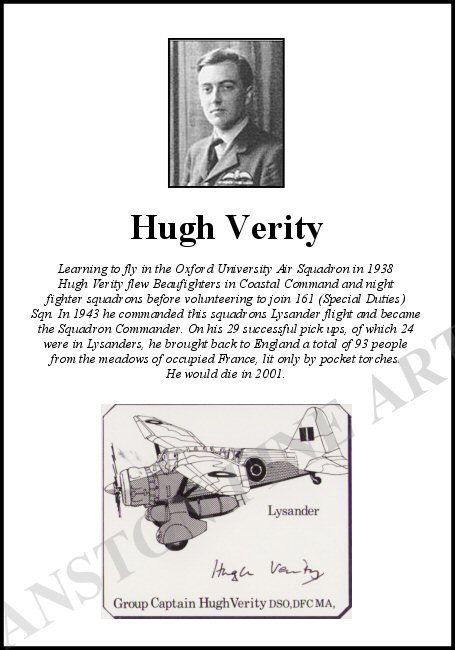
Verity, Hugh | | Group Captain Hugh Verity DSO* DFC (deceased) |
| Learning to fly in the Oxford University Air Squadron in 1938, Hugh Verity flew Beaufighters in Coastal Command and night fighter squadrons before volunteering to join 161 (Special Duties) Sqn. In 1943 he commanded this squadrons Lysander flight and became the Squadron Commander. On his 29 successful pick ups, of which 24 were in Lysanders, he brought back to England a total of 93 people from the meadows of occupied France, lit only by pocket torches. He died in 2001. |
|
+ Artist : Robert Taylor | £50 Off! | Now : £210.00 | | In 2 Pairs
View | | Limited edition of artist proofs. | Paper size 31 inches x 24 inches (79cm x 61cm) |
Anderson, MurrayNO
PHOTO
AVAILABLE
|
| | Captain Murray Anderson DFC* (deceased) |
| Commissioned in the Royal Tank Regiment from RMA Woolwich in 1939, Murray Anderson was seconded to the Royal Air Force in 1940. He flew Spitfires with No.1 Photo Reconnaissance Unit at RAF Benson until 1943. He then joined 161 (Special Duties) Squadron flying Lysanders, and was the most successful pick up pilot for the whole of that year even though in May 1944 he was posted to 65 Squadron 2nd Tactical Air Force, flying Mustangs. After a rest period he was posted to 52 Sqn at Dum Dum in May 1 |
|

Cammaerts, FrancisNO
PHOTO
AVAILABLE
|
| | Lieutenant Colonel Francis Cammaerts DSO (deceased) |
| Born in 1916 the son of a Belgian poet Emile Cammaerts, he was a pacifist at the beginning of the war but his views changed when his brother was killed in the RAF, and in 1942 joined the Special Operations Executive (SEO). Flown to France (by Hugh Verity), he was to join a circuit which he soon found to be insecure. Over 15 months in the field he hardly ever stayed in the same house for more than a night or two. By 1944 he was the inspired leader of thousands of well trained and armed resista |
|
Hodges, Lewis | | Air Chief Marshal Sir Lewis Hodges KCB CBE DSO DFC* (deceased) |
| Lewis Hodges flew with 49 Sqn from June 1940 until he was shot down over occupied France in Sept 1940 and taken prisoner by the Vichy French. He managed to escape and made his way back to England, rejoining 49 Sqn. He took part in the attacks against the German Channel dash operation in Feb 1942. In Nov of that year he joined 161 (Special Duties) Sqn, flying Halifaxes, Lysanders and Hudsons landing and parachuting agents into German occupied territory. Among the people he brought out of Fran |
|
Ratcliff, LenNO
PHOTO
AVAILABLE
|
| | Wing Commander Len Ratcliff DSO DFC (deceased) |
| Len Ratcliff joined the RAFVR in early 1939 to train as a pilot. In 1941 he completed a full tour of 30 operations in Bomber Command with 49 Squadron. After a rest period he was posted to 161 (Special Duties ) Sqn as Flight Commander flying agents and supplies in and out of France, Belgium, Holland, Norway and Denmark. He then spent a period in charge of A.I.2.C at the very centre of clandestine activities in the whole of occupied Europe. He returned to 161 Squadron in 1943 as Flight Command |
|
Verity, Hugh | | Group Captain Hugh Verity DSO* DFC (deceased) |
| Learning to fly in the Oxford University Air Squadron in 1938, Hugh Verity flew Beaufighters in Coastal Command and night fighter squadrons before volunteering to join 161 (Special Duties) Sqn. In 1943 he commanded this squadrons Lysander flight and became the Squadron Commander. On his 29 successful pick ups, of which 24 were in Lysanders, he brought back to England a total of 93 people from the meadows of occupied France, lit only by pocket torches. He died in 2001. |
|
+ Artist : Robert Taylor | | £325.00 | | | | Limited edition of 25 remarques. | Paper size 31 inches x 24 inches (79cm x 61cm) |
Anderson, MurrayNO
PHOTO
AVAILABLE
|
| | Captain Murray Anderson DFC* (deceased) |
| Commissioned in the Royal Tank Regiment from RMA Woolwich in 1939, Murray Anderson was seconded to the Royal Air Force in 1940. He flew Spitfires with No.1 Photo Reconnaissance Unit at RAF Benson until 1943. He then joined 161 (Special Duties) Squadron flying Lysanders, and was the most successful pick up pilot for the whole of that year even though in May 1944 he was posted to 65 Squadron 2nd Tactical Air Force, flying Mustangs. After a rest period he was posted to 52 Sqn at Dum Dum in May 1 |
|
Cammaerts, FrancisNO
PHOTO
AVAILABLE
|
| | Lieutenant Colonel Francis Cammaerts DSO (deceased) |
| Born in 1916 the son of a Belgian poet Emile Cammaerts, he was a pacifist at the beginning of the war but his views changed when his brother was killed in the RAF, and in 1942 joined the Special Operations Executive (SEO). Flown to France (by Hugh Verity), he was to join a circuit which he soon found to be insecure. Over 15 months in the field he hardly ever stayed in the same house for more than a night or two. By 1944 he was the inspired leader of thousands of well trained and armed resista |
|
Hodges, Lewis | | Air Chief Marshal Sir Lewis Hodges KCB CBE DSO DFC* (deceased) |
| Lewis Hodges flew with 49 Sqn from June 1940 until he was shot down over occupied France in Sept 1940 and taken prisoner by the Vichy French. He managed to escape and made his way back to England, rejoining 49 Sqn. He took part in the attacks against the German Channel dash operation in Feb 1942. In Nov of that year he joined 161 (Special Duties) Sqn, flying Halifaxes, Lysanders and Hudsons landing and parachuting agents into German occupied territory. Among the people he brought out of Fran |
|
Ratcliff, LenNO
PHOTO
AVAILABLE
|
| | Wing Commander Len Ratcliff DSO DFC (deceased) |
| Len Ratcliff joined the RAFVR in early 1939 to train as a pilot. In 1941 he completed a full tour of 30 operations in Bomber Command with 49 Squadron. After a rest period he was posted to 161 (Special Duties ) Sqn as Flight Commander flying agents and supplies in and out of France, Belgium, Holland, Norway and Denmark. He then spent a period in charge of A.I.2.C at the very centre of clandestine activities in the whole of occupied Europe. He returned to 161 Squadron in 1943 as Flight Command |
|
Verity, Hugh | | Group Captain Hugh Verity DSO* DFC (deceased) |
| Learning to fly in the Oxford University Air Squadron in 1938, Hugh Verity flew Beaufighters in Coastal Command and night fighter squadrons before volunteering to join 161 (Special Duties) Sqn. In 1943 he commanded this squadrons Lysander flight and became the Squadron Commander. On his 29 successful pick ups, of which 24 were in Lysanders, he brought back to England a total of 93 people from the meadows of occupied France, lit only by pocket torches. He died in 2001. |
|
+ Artist : Robert Taylor | | SOLD
OUT | NOT
AVAILABLE | |
|
|