|
|
|
|
||
|
|
|
|
||
| Navigation Menus |
|
Military Art Index |
Aviation Art Index |
Naval Art Index |
Artists Index |
Aviation History Archive |
Naval History Archive |
|
| HALF PRICE AND FREE PRINT SPECIAL OFFERS | ||||||
|
| ||||||||||||||||||||||||||||||||||||||||||||||||||||||||||||||||||||||||||||||||||||||||||||||||||||||||||||||||||||||||||||||||||||||||||||||||||||||||||||||||||||||||||||||||||||||||||||||||
Some other related items available from this site. | ||||
  Over the Beaches by Philip West. |   Victory Above Dover by Ivan Berryman. |   Spitfire Mk.IXE by Ivan Berryman. |   Back from Normandy by Nicolas Trudgian. | |
| Signatures on these products | |
| *The value given for each signature has been calculated by us based on the historical significance and rarity of the signature and is for the unmatted version where available. Values of many pilot signatures have risen in recent years and will likely continue to rise as they become more and more rare. | |
| Name | Info |
  Squadron Leader Neville Duke, DSO, OBE, DFC*, AFC, CzMC (deceased) Died : 2007 *Signature Value : £75 Editions signed : Duke / Tuck Presentation Edition of Artist Proofs Nos. 1 - 5. | Duke, Neville (Squadron Leader Neville Duke, DSO, OBE, DFC*, AFC, CzMC (deceased)) Neville Duke flew Spitfires as wingman to Sailor Malan in 92 Squadron. In November 1941 he was posted to 112 Squadron in the Middle East. After a second tour in the Desert, he flew a third tour, with 145 Squadron in Italy. He was the top scoring Allied Ace in the Mediterranean with 28 victories. After the war, in 1953, he captured the World Air Speed record. He died 7th April 2007. |
 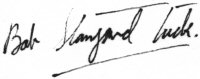 Wing Commander Bob Stanford Tuck DSO DFC** (deceased) Died : 1987 *Signature Value : £85 Editions signed : Duke / Tuck Presentation Edition of Artist Proofs Nos. 1 - 5. | Stanford-Tuck, Bob (Wing Commander Bob Stanford Tuck DSO DFC** (deceased)) Bob Stanford Tuck was a flamboyant fighter pilot, his dashing good looks, courage, and success in the air coming to epitomise the young flyers who fought and won the Battle of Britain. To the British public he was a hero in the mould of the knights of old, and today his name is legend. In the early stages of the Battle of Britain Bob fought with 92 Squadron flying Spitfires, quickly becoming one of the leading aces. Promoted to command 257 Squadron, now flying Hurricanes, Bobs dashing style of leadership inspired his pilots to great success. He went on to command the Duxford and Biggin Hill Wings, taking his personal score to 29 air victories before being shot down by ground fire over Northern France in 1942. He died on 5th May 1987. |
  Walter Wolfrum (deceased) Died : 2010 *Signature Value : £60 Editions signed : Walter Wolfum Knights Cross signature edition of 25 signed limited edition prints from the edition of 1150. | Wolfrum, Walter (Walter Wolfrum (deceased)) Walter Wolfrum first saw combat in the Crimea with 5/JG52. He was shot down three times, and wounded twice before scoring his first victory. With his score at 70 he was again wounded, but returned to take command of 1/JG52 in May 1944, taking part in the fiercely fought defence of the Ploesti oilfields. he was again wounded, but returned to command 1/JG52 until the end of the war. he had flown 423 missions, achieved 137 victories, and was awarded the Knights Cross. Sadly, Walter Wolfrum passed away on 26th August 2010. |
  Leutnant Hugo Broch *Signature Value : £60 Editions signed : Hugo Broch Knights Cross signature edition of 25 signed limited edition prints from the edition of 1150. | Broch, Hugo (Leutnant Hugo Broch) Vital to all fighter units are the pilots who make such superb wingmen that their leaders are loath to part with them. Hugo Broch was one such wingman. Having joined VI./JG54 in January he flew first with Horst Adameit (166 victories), and later with Bazi Sterr (130 victories), but soon demonstrated his own skill in combat. By the end of 1944 he had lifted his personal score to 71 victories. One of JG54s great Fw190 Aces, Hugo Broch saw combat on the Eastern and Baltic Fronts, and completed the war having flown 324 combat missions, and claiming 81 victories. He was awarded the Knights Cross. |
 Wing Commander Roger Morewood (deceased) Died : 2014 *Signature Value : £55 Editions signed : Morewood Signature edition of 100 prints (Nos 351 - 450) from the signed limited edition of 1150 prints. | Morewood, Roger (Wing Commander Roger Morewood (deceased)) An uncle suggested to Roger Morewood that he should join the RAF so Roger did at the age of 17. Roger said : I was going be a pilot, that was the only reason to join. Roger trained to fly in a Tiger Moth biplane before joining 56 Squadron - regarded within the RAF as an elite unit - flying open cockpit Gauntlet fighters. The squadron were then re-equipped with Gloster Gladiators - the last RAF biplane - then the Hawker Hurricanes that would join Spitfires in fighting off Hitlers Luftwaffe in the Battle of Britain. While serving with 56 Squadron Roger Morewood was assigned the dangerous role of long-range fighter sweeps over the coast of occupied France and Holland but left to help form 248 Sqn at Hendon with whom he served throughout the Battle of Britain flying Blenheims. Roger said: We had a few panic station alerts when we were scrambled. We wouldd be leaping into our aircraft with flying suits over our pyjamas as we tried to get into the air in a minute and a half. In July 1942 Morewood went to 9 OTU and later HQ Transport Command. After a long post-war career in the RAF he retired in 1957. Roger Morewood once said of his squadron: It was damned dodgy. We had a high loss rate on operations. And on one sortie - then aged 21 - he nearly met his maker : I flew across to Den Helder (Northern Holland) in a long-nosed Blenheim to look after this battleship at the entrance to the Zuiderzee. We flew round this thing and sure enough I saw some aircraft coming up. They were twin-engine bombers naturally - Messerschmitt 110s. That was a bit hairy. My two blokes (other pilots) shoved off in a hurry into a cloud, and there was me popping away until I ran out of ammunition. There was just me left. I realised there was no point chasing - I was not going to knock his wings off. So I started flying home. After making hardly any noise all flight the chap (navigator) in the back said you haveve got somebody on your tail now - you had better move swiftly. So I moved to left and right. We got a pretty hefty clobbering. His turret disappeared at the back. My poor navigator wore a tin hat and I dont blame him. He got a bullet half way through his armour. He was alright. I had a dreadful wound. If I shook my hand really hard I could get blood out of one finger. I was hit all over the place. We took dozens of bullets. The aircraft was ruined. That is all there was to it. We were still going home - even with the North Sea to go across. So I trundled off back and ditched the damn thing. Thank God it didnt blow up. We literally got away with it. It was the hairiest trip I ever did. On another occasion, Roger intercepted a German weather forecasting flying boat called Weary Willy : I was in a Beaufighter at this time. I flew upwind and had a shot at him downwind. Then all the guns jammed. So I pulled alongside him - not too close - and waved him good luck lad. Anyway he sank when he got back to Norway. That was that one finished. Flying from Shetland, his squadron attacked German shipping off Norway. Roger was rested and spent two years training new Beaufighter pilots but still managed to go on some operations, mainly attacking convoys off the coast of Holland. Roger Morewood said: job was to attack the flak ships, floating anti-aircraft batteries, so other Beaufighters could attack the cargo ships. It could be pretty hairy as 12 Beaufighters lined up to have a crack at the target. You wouldd see tracer shells from your mates plane whizzing over your head or underneath you. They were a bigger danger than the Germans Wing Commander Roger Morwood was posted to the Mediterranean where he contracted TB. He recalled: "In hospital, they treated you with whisky in milk and a pint of Guinness for breakfast, very primitive stuff." When the war ended and the RAF were scaled down, Roger continued to serve in various postings around the UK until 1947. after leaving the RAF Roger was recalled again as an instructor at the Central Flying School, but with the rank of flight lieutenant. He was posted to Edinburgh and then Glasgow University squadrons. finnaly leaving service in 1957. Wing Commander Roger Morewood notched up more than 5000 flying hours in 32 different types of aircraft. Roger Morewood died in early December 2014. |
  Wing Commander John Freeborn DFC* (deceased) Died : 2010 *Signature Value : £70 Editions signed : Battle of Britain Signature edition of 300 prints from the edition of 1150 prints. Dahlmann Knights Cross / Freeborn DFC signature edition of 100 prints from the signed limited edition of 1150 prints. | Freeborn, John (Wing Commander John Freeborn DFC* (deceased)) Wing Commnader John. C. Freeborn was born on the 1st of December 1919 in Middleton, Yorkshire. John left grammar school at 16 and joined the RAF in 1938, where he made 14 shillings a week and shot pheasant in his spare time. He later visited his classmates after flight school by landing his plane on a nearby cricket pitch. In March 1938 John Freeborn was commissioned in the RAFO, and on the 9th of April 1938 went to Montrose and joined 8 FTS, where he completed his training before going to 74 'Tiger' Squadron at Hornchurch on 29th October. He relinquished his RAFO commission on being granted a short service one in the RAF in January 1939. Johnie Freeborn flew Spitfires with 74 Squadron over Dunkirk, and claimed a probable Ju 88 on May 21st 1940. On the 22nd of May 1940 he destroyed a Junkers 88, and a probable Bf 109 on the 24th of May followed soon after on the 27th by a Bf 109 destroyed and another probably destroyed. On one occasion his Spitfire was badly damaged over Dunkirk and he crash-landed on the beach near Calais but managed to get a lift home in a returning aircraft. His squadron flew relentlessly during the Battle of Britain. In one eight-hour period, its pilots flew into combat four times, destroying 23 enemy aircraft (three by John Freeborn) and damaging 14 more. Five kills denoted an Ace and by the end of the Battle of Britain, John had seven to his credit and won the DFC. John claimed a Bf 109 destroyed on 10th July, shared a probable Dornier 17 on the 24th, shot down a Bf 109 on the 28th, destroyed two Bf 110s, a Bf 109 and probably another on 11th August, destroyed a Do 17 on the 13th, destroyed another on 11th September and damaged an He 111 on the 14th. Freeborn was made a Flight Commander on 28th August. He shared a Bf 109 on 17th November, shot down two Bf 109s, shared another and damaged a fourth on 5th December, and damaged a Dornier 17 on 5th February and 4th March 1941. John Freeborn had been with his squadron longer, and flown more hours, than any other Battle of Britain pilot and on the 25th of February 1941 John freeborn was awarded a Bar to the DFC. In January, 1942 John Freeborn was posted to Army Air Force Base in Selma, Alababma which was home to the South East Training Command in America. After two months as RAF liaison officer he went to Eglin Field, Florida where he helped in testing various aircraft, including the new fighters the Thunderbolt and P-51 Mustang. He returned to the UK in December 1942 and went to Harrowbear, Exeter, and then to Bolt Head as Station Commander. John Freeborn joined 602 Squadron in 1942, and commanded 118 Squadron in June 1943 at Coltishall, leading it until January 1944. In June 1944 he was promoted Wing Commander (the youngest Wing Commander in the RAF) of 286 Wing in Italy. John Freeborn scored 17 victories and left the Royal Air Force in 1946. Sadly, we have learned that John Freeborn passed away on 28th August 2010. John Freeborn was truly one of the great Fighter Pilots of world war two and his autograph is certainly a major additon to any signature collection, as he did not sign a great deal of art pieces. |
  Group Captain Byron Duckenfield AFC (deceased) Died : 2010 *Signature Value : £50 Editions signed : Battle of Britain Signature edition of 300 prints from the edition of 1150 prints. Duckenfield signature edition of 100 prints from the limited edition of 1150 prints. | Duckenfield, Byron (Group Captain Byron Duckenfield AFC (deceased)) Byron Duckenfield started at Flying Training School on 25th November 1935 in a Blackburn B2 at Brough. As a Sergeant, he joined No.32 Sqn at Biggin Hill on 8th August 1936 and flew Gauntlets and Hurricanes. He joined 74 Squadron at Hornchurch on 11th April 1940, flying Spitfires, and on 5th May was posted to 501 Squadron flying Hurricanes at Tangmere. On the 11th of May at Betheniville, he survived a crash in a passenger transport Bombay aircraft in an aircraft in which he was a passenger, While comin ginto land the aircraft at 200 feet the aircraft stalled and the aircrfat fell backwards just levelly out as it histhe ground. 5 of th epassengers were killed when the centre section collapsed and crushed them. Duckenfield was fortunate as he had moved position during the flight. as the two passengers sitting each side of where he was sitting had died in the crash. (it was found later that the Bombay had beeb loaded with to much weight in the aft sectiion. ) recovering in hospital in Roehampton. On 23rd July 1940, he rejoined No.501 Sqn at Middle Wallop, then moved to to Gravesend two days later, scoring his first victory, a Ju87, on the 29th of July 1940. During August and September he scored three more victories. After a spell as a test pilot from 14th September 1940, he was posted to command 66 Squadron on 20th December 1941, flying Spitfires. On 26th February 1942 he took command of 615 Squadron flying Hurricanes from Fairwood Common, taking the squadron to the Far East. In late December 1942 he was shot down in Burma and captured by the Japanese. He remained a POW until release in May 1945. After a refresher course at the Flying Training School in November 1949, he took command of No.19 Squadron flying Hornets and Meteors from Chruch Fenton. After a series of staff positions, he retired from the RAF as a Group Captain on 28th May 1969. Duckenfield would write later his details : Burma At first light, 12 Hurricanes IIC aircraft of 615 Squadron, myself in the lead, took off from Chittagong for central Burma to attack the Japanese air base at Magwe, 300 miles away on the banks of the River Irrawaddy. Arriving at Yenangyaung, we turned downstream at minimum height for Magwe, 30 miles to the South and jettisoned drop tanks. Just before sighting the enemy base, the squadron climbed to 1200 feet and positioned to attack from up sun. On the ramp at the base, in front of the hangers, were 10 or 12 Nakajima KI - 43 Oscars in a rough line up (not dispersed) perhaps readying for take. These aircraft and the hangars behind them were attacked in a single pass, before withdrawing westward at low level and maximum speed. A few minutes later perhaps 20 miles away form Magwe, I was following the line of a cheung (small creek), height about 250 feet, speed aboput 280 mph, when the aircraft gave a violent shudder, accompanied by a very lound, unusual noise. The cause was instantly apparent: the airscrew has disappeared completely, leaving only the spinning hub. My immediate reaction was to throttle back fully and switch off to stop the violently overspeeding engine. Further action was obvious: I was committed to staying with the aircraft because, with a high initial speed, not enough height to eject could be gained without the help of an airscrew. So I jettisoned the canopy and acknowledged gratefully the fact that I was following a creek; the banks of either side were hillocky ground, hostile to a forced landing aircraft. Flying the course of the creek, I soon found the aircraft to be near the stall (luckily, a lower than normal figure without an airscrew) extended the flaps and touched down wheels-up with minimum impact ( I have done worse landings on a smooth runway!) My luck was holding, if one can talk of luck in such a situation. December is the height of the dry season in that area and the creek had little water, it was shallow and narrow at the point where I came down: shallow enough to support the fusalage and narrow enough to support wing tips. So I released the harness, pushed the IFF Destruct switch, climed out and walked the wing ashore, dryshod. The question may occur -Why did not others in the squadron see their leader go down? - the answer is simple, the usual tatctic of withdrawal from an enemy target was to fly single at high speed and low level on parallel courses until a safe distance from target was attained. Then, the formation would climb to re-assemble. Having left the aircraft, I now faced a formidable escape problem? I was 300 miles from friendly territory: my desired route would be westward but 80% of that 300 miles was covered by steep north-south ridges impenetrably clothed in virgin jungle; these were natural impediments, there was also the enemy to consider. Having thought over my predicament, I decided the best I could do - having heard reports of mean herted plainspeope - was to get as far into the hills as possible and then find a (hopefully sympathetic) village. I suppose I may have covered about 15 miles by nightfall when I came upon this small hill village and walked into the village square. Nobody seemed surprised to see me (I suspect I had been followed for some time) I wa given a quiet welcome, seated at a table in the open and given food. Then exhaustion took over, I fell asleep in the chair and woke later to find myself tied up in it. Next day I was handed over to a Japanese sergeant and escort who took me back to Magwe and, soon after that, 2.5 years captivity in Rangoon jail. Sadly we have learned that Byron Duckenfield passed away on 19th November 2010. |
  Kurt Dahlmann *Signature Value : £65 Editions signed : Dahlmann Knights Cross / Freeborn DFC signature edition of 100 prints from the signed limited edition of 1150 prints. | Dahlmann, Kurt (Kurt Dahlmann) Kurt Dahlmann was born on the 4th of March 1918 in Konigsberg, moving to Danzig in 1925 where Dahlmann went to school. Dahlman took up flight training in 1936 at the Fliegerübungsstelle (flight training center) at Marienburg in Elbing. Following obligatory service in the Reichsarbeitsdienst Dahlamnn was inducted into the Luftwaffe in November 1937 and furthered his flight training at Luftkriegsschule Wildpark-Werder, in 1939 shortly before the start of the war. Dahlmann received his commission as a Lieutenant. Dahlmann became bomber and ground attack pilot flying both Junkers Ju88 and Fw190 aircraft in that role. He participated in the Polish Campaign, the Battle of Britain, the campaign against France as well as the North African Campaign under Rommel flying Ju88s. Dahlmann later specialized in solo night bombing attacks against specific high value targets. Some of these missions included weapons factories in Britain, British airfields, and later in the war attacking the Remagen bridge. Dahlmann was also personally assigned a specially stripped down, high speed, Fw190 for target marking, pathfinding, missions. He flew over 350 combat missions between September 1940 and 5 May 1945 and was awarded the Knights Cross (No. 711) for flying 200 missions and subsequently the Oak leaves for having successfully completed 300 combat missions becoming the highest decorated German Jabo pilot of the war. Dahlmann finished the war as a Major commanding I./SKG 10, III./KG 51 and NSG 20. 1940 pilot in III./KG 30. 19.01.42 awarded the Ehrenpokal. 1942 appt Staka 9./KG 30 (to 6.43). 15.02.43 Oblt., awarded DKG for prior service in III./KG 30. 11.05.43 Oblt. in III./KG 30, ordered to RLM (Gen.d.Kampfflieger – L.In.2) for temporary duty (to 11.06.43). 11.06.43 appt. Staka 1./SKG 10 (or 2./SKG 10?). 01.10.43 Oblt., appt Kdr. I./SKG 10 (to 20.10.44). 01.04.44 promo to Hptm. 01.06.44 promo to Maj. 11.06.44 Hptm., awarded Ritterkreuz, Kdr. I./SKG 10. 20.10.44 appt Kdr. III./KG 51. 31.10.44 appt Kdr. NSGr. 20 (to 08.05.45). 24.01.45 Maj., awarded the Eichenlaub (No. 711), NSGr. 20. Settled in South Africa after the war. |
| Squadrons Related to This Print |
| KG53 |
| No.610 Sqn |
| Aircraft Related to This Print |
| He111 |
| Spitfire |
|
Contact Details |
Sign Up To Our Newsletter!
This website is owned by Cranston Fine Arts. Torwood House, Torwoodhill Road, Rhu, Helensburgh, Scotland, G848LE Contact: Tel: (+44) (0) 1436 820269. Email: cranstonorders -at- outlook.com |


 Signature(s) value alone : £160
 Signature(s) value alone : £60


