Cranston Military Prints .com Home Page
Customer Helpline (UK) : 01436 820269
Subscribe to our Newsletter!

You currently have no items in your basket

Payment Options Display
Buy with confidence and security!
Publishing historical art since 1985


Navigation Menus
Military
Art Index
Aviation
Art Index
Naval
Art Index
Artists
Index
Product Search         
Aviation
History Archive
Naval
History Archive
HALF PRICE AND FREE PRINT SPECIAL OFFERS
ALWAYS GREAT OFFERS :
20% FURTHER PRICE REDUCTIONS ON HUNDREDS OF LIMITED EDITION ART PRINTS
BUY ONE GET ONE HALF PRICE ON THOUSANDS OF PAINTINGS AND PRINTS
FOR MORE OFFERS SIGN UP TO OUR FREE NEWSLETTER
Erich Rudorffer - Eastern Front Ace by Brian Bateman. (P) - Cranston Military Prints

Erich Rudorffer - Eastern Front Ace by Brian Bateman. (P)


Erich Rudorffer - Eastern Front Ace by Brian Bateman. (P)

Major Erich Rudorffer claims one of three Airacobra's shot down on 10th October 1944 as he claims seven victories in a single day in his Fw190 of JG54. One of the greatest Aces of World War Two, Rudorffer scored a total of 222 victories including over 75 on the western front, making him the 7th highest scoring Ace of all time.
Item Code : B0410PErich Rudorffer - Eastern Front Ace by Brian Bateman. (P) - Editions Available
DESCRIPTIONSIZESIGNATURESOFFERSPRICEPURCHASINGPACKS
Original pencil drawing by Brian Bateman. Paper size 16 inches x 12 inches (41cm x 31cm)
Rudorffer, Erich

Died : 2016
Major Erich Rudorffer (deceased)
Erich Rudorffer was born on November 1st 1917 in the town of Zwickau in Saxony. Erich Rudorffer joined the Luftwaffes I./JG2 Richthofen in November 1939, and was soon flying combat patrols in January 1940 and was assigned to I/JG 2 Richthofen with the rank of Oberfeldwebel. He took part in the Battle of France, scoring the first of his many victories over a French Hawk 75 on May 14th, 1940. He went on to score eight additional victories during the Battle of France and the Battle of Britain.
Signature Value : £70
CLICK HERE FOR FULL PROFILE
 
+ Artist : Brian Bateman


Signature(s) value alone : £70
£100 Off!Now : £300.00

Quantity:


Some other related items available from this site.

 St Nazaire, France, 3rd January 1943.  The Fw190A4 of Georg-Peter <i>Schorsch</i> Eder, 7/JG2, streaks past <i>Meat Hound</i>, a B17F of th 423rd Bomb Squadron, 306th Bomb Group en route to attack the U-boat pens at St Nazaire.  Along with his Gruppenkommandeur Egon Mayer, it was Eder who pioneered the head on pass tactic against the Flying Fortresses.  On this day he to achieve his thirteenth victory, and second B17.  By the end of the war he had accounted for some 36 heavy bombers.

Lucky 13 by David Pentland.
A large umbrella of Spitfire Wings covered most of the sky over Dieppe during the Allied attack Operation Jubilee on 19th August 1942. Squadron leader Johnnie Johnson leads 610 (County of Chester) Squadron down from top cover support to lend a hand to Spitfires of 485 Squadron (New Zealand) and 411 Squadron (Canadian) which made up the 12 Group Wing, led by W/C Pat Jameson. The enemy being made up of a huge mixed force of Fw190 and Me109 fighters from JG2 and JG26. 12 Group Wing flew four times that disastrous day and in the end the Royal Air Force lost 106 aircraft compared to the Luftwaffe losses of 48.

The Battle for the Skies Over Dieppe, 19th August 1942 by Graeme Lothian
 An Me109 pilot, Dieter Hrabak scored a victory during the Battle of France, 15 more during the Battle of Britain, commanded JG54 and JG52 and survived the war scoring a total of 125 victories.  He is shown here flying Bf109 G-6 of JG52, Krakow, Poland in 1944.  After the war he was instrumental in rebuilding the German Air Force, retiring in 1970.  He died in 1995.

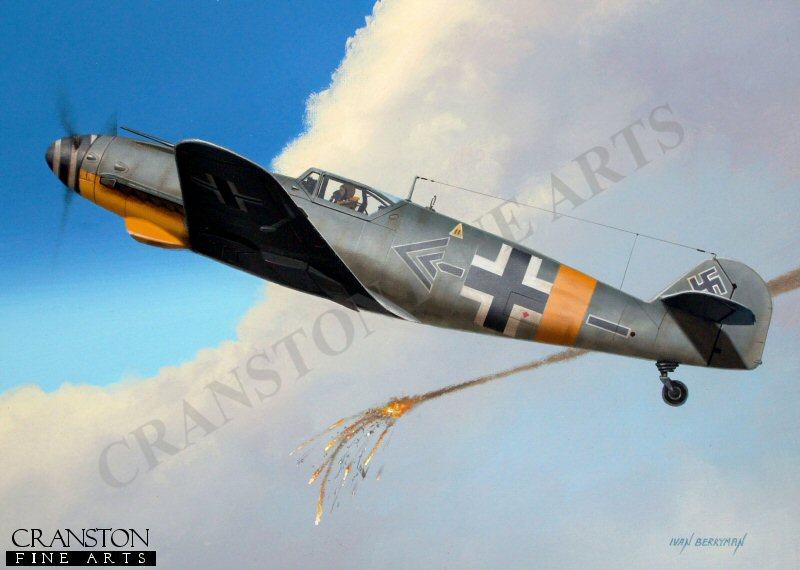
Tribute to Dieter Hrabak by Ivan Berryman.
 Even the most faithful of Messerschmitt Me 109 pilots that also flew the Focke-Wulf Fw190 grudgingly admitted the well-proportioned and aesthetically pleasing Fw190 was the finest single-seat fighter in the Luftwaffes armoury during World War II. Soon after its arrival on the Channel Front in 1941, when initial bugs were ironed out, this superb fighter came close to fighter design perfection by the standards of the day. Just as the Mk IX Spitfire held the mantle as Britains most outstanding combat fighter of the war, so was the Fw190 regarded by experienced Luftwaffe pilots. Within months of its operational debut the Fw190 was causing widespread consternation among RAF pilots, the new fighter equal to the Mk IX Spitfire in all but its ability in the tightest of turning circles.  By 1944 the technically superb Fw190 came into its own in the great air battles against the USAAFs massed daylight raids. The defence of the Reichs western airspace rested on the shoulders of a few Jagdgschwarden who, against steadily increasing odds, were tasked with interception and destruction of the attacking American heavy bombers. Flying alongside the two established Channel fighter wings JG2 Richthofen and JG26 Schlageter, equipped with Fw190s and led by the great fighter ace Oberst Walter Oesau, JG1 joined the battle in defence of northern Germany. Nicolas Trudgians painting Storm Chasers depicts the Fw190As of I./JG1, distinguished by their distinctive black and white striped cowls, scrambling from the snow-covered Dortmund airfield on 10 February 1944 to intercept another inbound American daylight raid. Nicks dramatic view of this technically supreme fighter conveys its true class as it hurtles over the airfield, its undercarriage retracting as the Fw190 accelerates into the climb. Below, sharing the airfield with I./JGI, are the Fw190s of the newly formed Sturmstaffel 1, identified by their black-white-black tail bands, seen taxiing out to join in the interception. Despite bad weather conditions the Luftwaffes defending fighters scored heavily that day, inflicting severe losses on the Americans, claiming 29 bombers and 8 fighters shot down in the action.

Storm Chasers by Nicolas Trudgian.
Signatures on these products
*The value given for each signature has been calculated by us based on the historical significance and rarity of the signature and is for the unmatted version where available. Values of many pilot signatures have risen in recent years and will likely continue to rise as they become more and more rare.
NameInfo


Major Erich Rudorffer (deceased)
Died : 2016
*Signature Value : £70

Editions signed :

Original pencil drawing by Brian Bateman.


Rudorffer, Erich
(Major Erich Rudorffer (deceased))

Erich Rudorffer was born on November 1st 1917 in the town of Zwickau in Saxony. Erich Rudorffer joined the Luftwaffes I./JG2 Richthofen in November 1939, and was soon flying combat patrols in January 1940 and was assigned to I/JG 2 Richthofen with the rank of Oberfeldwebel. He took part in the Battle of France, scoring the first of his many victories over a French Hawk 75 on May 14th, 1940. He went on to score eight additional victories during the Battle of France and the Battle of Britain. Rudorffer recalled an incident in August 1940 when he escorted a badly damaged Hurricane across the Channel - ditching in the English Channel was greatly feared by pilots on both sides. As fate often does, Rudorffer found the roles reversed two weeks later, when he was escorted by an RAF fighter after receiving battle damage. By May 1st 1941 Rudorffer had achieved 19 victories, which led to the award of the Knights Cross. In June 1941 Rodorffer became an Adjutant of II./JG2. In 1942 Rudorffer participated in Operation Cerberus (known as the Channel Dash) and flew over the Allied landings at Dieppe. Erich Rudorffer along with JG2 was transferred to North Africa in December 1942. It was in North Africa that Rudorffer showed his propensity for multiple-victory sorties. He shot down eight British aircraft in 32 minutes on February 9th 1943 and seven more in 20 minutes six days later. After scoring a total of 26 victories in Tunisia, Rudorffer returned to France in April 1943 and was posted to command II./JG54 in Russia, after Hauptmann Heinrich Jung, its Kommodore, failed to return from a mission on July 30th 1943. On August 24th 1943 he shot down 5 Russian aircraft on the first mission of the day and followed that up with three more victories on the second mission. He scored seven victories in seven minutes on October 11th but his finest achievement occurred on November 6th when in the course of 17 minutes, he shot down thirteen Russian aircraft. Rudorffer became known to Russian pilots as the fighter of Libau. On October 28th 1944 while about to land, Rudorffer spotted a large formation of Il-2 Sturmoviks. He quickly aborted the landing and moved to engage the Russian aircraft. In under ten minutes, nine of the of the II-2 Sturmoviks were shot down causing the rest to disperse. Rudorffer would later that day go on and shoot down a further two Russian aircraft. These victories took his total to 113 and he was awarded the Oak Leaves on April 11th 1944. Rudorffer would on the 26th January 1945 on his 210th victory receive the addition of the Swords. In February 1945 Rudorffer took command of I./JG7 flying the Me262. He was one of the first jet fighter aces of the war, scoring 12 victories in the Me262. He shot down ten 4-engine bombers during the 'Defense of the Reich missions'. He was the master of multiple scoring - achieving more multiple victories than any other pilot. Erich Rudorffer never took leave, was shot down 16 times having to bail out 9 times, and ended the war with 222 victories from over 1000 missions. He was awarded the Knights Cross, with Oak Leaves and Swords. Erich Rudorffer died on 8th April 2016.
Squadrons Related to This Print
JG54
Aircraft Related to This Print
Fw190

Contact Details
Shipping Info
Terms and Conditions
Cookie Policy
Privacy Policy

Sign Up To Our Newsletter!

Stay up to date with all our latest offers, deals and events as well as new releases and exclusive subscriber content!

This website is owned by Cranston Fine Arts.  Torwood House, Torwoodhill Road, Rhu, Helensburgh, Scotland, G848LE

Contact: Tel: (+44) (0) 1436 820269.  Email: cranstonorders -at- outlook.com

Return to Home Page