Cranston Military Prints .com Home Page
Customer Helpline (UK) : 01436 820269
Subscribe to our Newsletter!

You currently have no items in your basket

Payment Options Display
Buy with confidence and security!
Publishing historical art since 1985


Navigation Menus
Military
Art Index
Aviation
Art Index
Naval
Art Index
Artists
Index
Product Search         
Aviation
History Archive
Naval
History Archive
HALF PRICE AND FREE PRINT SPECIAL OFFERS
ALWAYS GREAT OFFERS :
20% FURTHER PRICE REDUCTIONS ON HUNDREDS OF LIMITED EDITION ART PRINTS
BUY ONE GET ONE HALF PRICE ON THOUSANDS OF PAINTINGS AND PRINTS
FOR MORE OFFERS SIGN UP TO OUR FREE NEWSLETTER
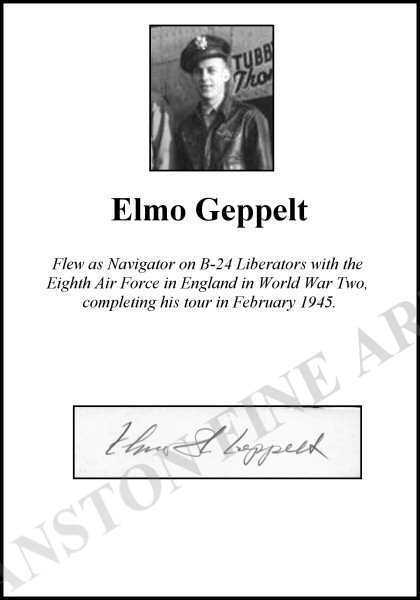
Clipped Signature - Elmo Geppelt. - Cranston Military Prints

Clipped Signature - Elmo Geppelt.


Clipped Signature - Elmo Geppelt.

Flew as Navigator on B-24 Liberators with the Eighth Air Force in England in World War Two, completing his tour in February 1945.
Item Code : CLP0916Clipped Signature - Elmo Geppelt. - Editions Available
DESCRIPTIONSIZESIGNATURESOFFERSPRICEPURCHASINGPACKS
Clipped Signature.
Great value : Value of signatures exceeds price of item!

Geppelt, Elmo W

Lt Col Elmo W Geppelt
Lt Elmo W. Geppelt was the DR Navigator. He had trained with the crew in the States and had flown to England with them. Geppelt was elevated to Assistant Squadron Navigator for the 755th in December 1944, completing his tour in February 1945.
Signature Value : £40
CLICK HERE FOR FULL PROFILE


Signature(s) value alone : £40
£10 Off!
Add any two items on this offer to your basket, and the lower priced item will be half price in the checkout!
Now : £30.00

Quantity:


Some other related items available from this site.

Depicting two B17s from 92nd bomb group having joined a lone B24 from 93rd. In the background, the distinctive triangles on the tails of the two aircraft denote membership to the 303rd BG.

Motley Crew by Tim Fisher
 E.W. Bruce was a B-24 Liberator commander with the 704th Bomb Squadron, of the 446th Bomb Group of the Eighth Air Force. His squadron was based at Bungay in East Anglia. On the morning of January 29, 1944 a hush falls over the bomb crews in Bruces squadron as the intelligence officer unveils the mission map for the days activities. An all out maximum force raid on Frankfurt. When formation positions are assigned the tail-end-charlie spot goes to Bruce piloting the Hula Wahine. Low clouds are expected at 5000 feet, and the bombing run will most likely be made with radar. Hopefully the weather will keep the Lufwaffes fighters on the ground. Bruces group is at the end of the formation, so he is the last plane of several hundred on the bomb run. The group increases air speed and altitude as it approaches Frankfurt. Within minutes of the target Bruces B-24 loses the supercharger on its No.2 engine. They begin to trail the formation and lose altitude. Suddenly the supercharger fails on the B-24s No 3 engine. Shifting to full power on the No 1 and No 4 engines, a condition they can maintain for only a few precious minutes, Bruces crew delivers its payload over the target. Seconds later the turbos give out on the two remaining engines, and Bruce puts his B24 into a fast power dive. He needs to get down to low altitude feet so his engines will function. As the B-24 hurtles towards the earth at 300MPH two Me-210 fighters close in fast. The Liberators right waist gunner, Sgt. McLaughlin opens fire and sets one of the 210s afire, while the other leaves the scene with a P-38 on his tail. The B-24 makes it safely to the relative comfort of cloud cover and a course is set back to England. After several minutes the Liberator leaves the protective cloud cover, and Bruce elects to fly at tree-top level to avoid detection. Sgt. Jones, the left waist gunner yells bandits at 8 oclock! All hell breaks loose for a few moments. Sgt. McGuire, the engineer and top gunner, is injured as well as both waist gunners during the attack. Bruce unsuccessfully attempts to radio for potential friendly fighter support. The B-24 flies on around the outskirts of Liege, and closer to home. Minutes later they have a bandit at 6 oclock. The tail gunners guns are not firing properly, and an Fw-190 opens up with everything its got. The Liberator flies on in a virtual sea of tracers. Time seems to slowdown, as Bruce sees a thatched roof, half-timber farmhouse dead ahead. The B-24 is dead center with the upstairs bedroom window, as the 190s tracers tear across the farmhouse roof. Bruce puts the B-24 into a steep bank, and misses the farmhouse by a few feet. The prop wash blows chickens and chicken feathers everywhere. For a moment it feels more like a pillow fight than a life and death struggle. The 190 breaks off to make another run. Bruce turns directly into him, and the surprised 190 pilot wings over and flies parallel again. On his next pass, Bruce banks steeply and rolls out fast. Its now a free for all - somebodys going to die. The 190 approaches again without firing. Possibly out of ammunition, the 190 appears to be attempting to ram the B-24. Bruces bombardier/nose gunner, Lt. Pretty, opens up on the Jerry. The B-24s bullets tear into the 190s engine, across the fuselage and into the cockpit. The 190 spins out of control and goes down. Bruce manages to get his bird back to England, and puts her down in a belly landing at Depling. The crew is awarded a Silver Star, a DFC, two Air Medals, and four Purple Hearts for the mission; a routine day for a Tail-End Charlie.

Tail End Charlie by Stan Stokes.
  For bomber crews, any daylight-bombing mission almost certainly meant combat. If it werent the attentions of determined Luftwaffe fighter pilots, it would be an aerial carpet of flak that welcomed the bombers en route to the target - and again on the journey home. On most missions the Eighth Air Force aircrews had to contend with both. Enduring up to ten hours of concentrated flying under cramped conditions, extreme cold, with the constant noise and vibration produced by four powerful engines, made every mission uncomfortable enough without being shot at. But the USAAF aircrews confronted the odds - a one in three chance of completing a 25-mission tour of operations - cheerfully and with gallant resolve. Playing a major role in the great raids on Germany and other targets in occupied Europe from early in 1944, equipped with the Consolidated B-24 Liberator, the USAAF Second Air Division flew no fewer than 95,048 sorties. Based in Norfolk, England, the crews also attacked targets far distant in Norway, Poland and Rumania, unloading almost 100,000 tons of bombs and claiming over 1000 enemy fighters shot down.

End Game by Nicolas Trudgian.
B-24 Liberators with escorting P-51D Mustangs of the US 8th Air Force hit a communication centre.  Due to the overwhelming air attacks by both Strategic and Tactical Air Forces, German gunners had run out of ammunition by noon in many strongpoints.
Mustangs and Liberators by Richard Ward
Signatures on these products
*The value given for each signature has been calculated by us based on the historical significance and rarity of the signature and is for the unmatted version where available. Values of many pilot signatures have risen in recent years and will likely continue to rise as they become more and more rare.
NameInfo


Lt Col Elmo W Geppelt
*Signature Value : £40

Editions signed :

Clipped Signature.


Geppelt, Elmo W
(Lt Col Elmo W Geppelt)

Lt Elmo W. Geppelt was the DR Navigator. He had trained with the crew in the States and had flown to England with them. Geppelt was elevated to Assistant Squadron Navigator for the 755th in December 1944, completing his tour in February 1945.
Aircraft Related to This Print
Liberator

Contact Details
Shipping Info
Terms and Conditions
Cookie Policy
Privacy Policy

Sign Up To Our Newsletter!

Stay up to date with all our latest offers, deals and events as well as new releases and exclusive subscriber content!

This website is owned by Cranston Fine Arts.  Torwood House, Torwoodhill Road, Rhu, Helensburgh, Scotland, G848LE

Contact: Tel: (+44) (0) 1436 820269.  Email: cranstonorders -at- outlook.com

Return to Home Page