Cranston Military Prints .com Home Page
Customer Helpline (UK) : 01436 820269
Subscribe to our Newsletter!

You currently have no items in your basket

Payment Options Display
Buy with confidence and security!
Publishing historical art since 1985


Navigation Menus
Military
Art Index
Aviation
Art Index
Naval
Art Index
Artists
Index
Product Search         
Aviation
History Archive
Naval
History Archive
HALF PRICE AND FREE PRINT SPECIAL OFFERS
ALWAYS GREAT OFFERS :
20% FURTHER PRICE REDUCTIONS ON HUNDREDS OF LIMITED EDITION ART PRINTS
BUY ONE GET ONE HALF PRICE ON THOUSANDS OF PAINTINGS AND PRINTS
FOR MORE OFFERS SIGN UP TO OUR FREE NEWSLETTER
Clipped Signature - Peter Boggis. - Cranston Military Prints

Clipped Signature - Peter Boggis.


Clipped Signature - Peter Boggis.

A bomber pilot, he was the first to fly the aircraft MacRobert's Reply in 1941. He flew many sorties with No.15 Sqn in the Stirling and was awarded the Distinguished Flying Cross for his final mission. The original aircraft crashed, and its replacement also shot down, with the name not re-used until 1982, this time on a Buccaneer. The tradition continued until No.15 Sqn was disbanded and the last Tornado scrapped in 2018. Peter Boggis retired as Squadron Leader in 1967. He died in 2010.
Item Code : CLP2758Clipped Signature - Peter Boggis. - Editions Available
DESCRIPTIONSIZESIGNATURESOFFERSPRICEPURCHASINGPACKS
Clipped Signature.
Great value : Value of signatures exceeds price of item!

Boggis, Peter

Died : 2010
Squadron Leader Peter Boggis DFC (deceased)
Flying Officer Peter Boggis, at the remarkably early age of 22, was the first pilot to fly MacRobert's Reply and did so with much distinction, courage and skill. He had proved himself an exemplary pilot, having flown 15 operational sorties. He took control of the bomber and joined Squadron XV in September 1941. Boggis flew many bombing raids over Europe in MacRobert's Reply, attacking Pilsen, Nuremberg, Cologne and, in a daylight raid on the port of Brest, destroying many German battles
Signature Value : £60
CLICK HERE FOR FULL PROFILE
 

Signature(s) value alone : £60
£10 Off!
Add any two items on this offer to your basket, and the lower priced item will be half price in the checkout!
Now : £50.00

Quantity:


Some other related items available from this site.

 During the years of the German occupation of Holland in World War II, more than 20,000 Dutch civilians perished through starvation and lack of basic provisions. Operation Manna was set in motion on Sunday, 29th April 1945 when Lancasters of the Royal Air Force began the first of 2,835 sorties, dropping 6,672 tons of food, to relieve the crisis in the Netherlands.  These humanitarian missions continued until 8th May, saving many thousands of civilians from certain death by starvation and malnutrition.  Here, Lancaster 4K765, LS-Z of 15 Sqn piloted by Flying Officer Jack Darlow, releases its precious cargo over a sports field north of The Hague.  Also in the crew was Alistair Lamb the Rear Gunner.

Operation Manna by Ivan Berryman.
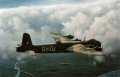
Stirling Q-OJ of No.149 Sqn is shown minelaying in the Batlic.  It was on precisely this type of mission - minelaying in the Baltic that aircraft W7639 (shown) was lost on 8th December 1942.  Developing technical problems, the aircraft turned for home, but crashed in Suffolk, killing all seven crew on board.  The crew were : <br>P/O J Philp BEM,<br>Sgt W S Hughes,<br>Sgt G E Hills,<br>Sgt C W Higgins,<br>Sgt F Craven,<br>Sgt T H Harris, and<br>Sgt T G Williams.

Stirling Mine Laying by Keith Aspinall.
 Lancasters of No.15 Squadron are shown releasing their bombs during the attack against German armour that had amassed in and near the French village of Villers Bocage on 30th June 1944. ED395 (LS-M), piloted by Fl Off W Hall, is in the background with LM473 (LS-P) in the foreground, flown by Fl Sgt N Overend. The village was almost completely obliterated during the bombing raid and the operation was deemed a tactical success.

The Attack on Villers Bocage by Ivan Berryman.
 Stirling Q-OJ of No.149 Sqn is shown minelaying in the Batlic.  It was on precisely this type of mission - minelaying in the Baltic that aircraft W7639 (shown) was lost on 8th December 1942.  Developing technical problems, the aircraft turned for home, but crashed in Suffolk, killing all seven crew on board.  The crew were : <br>P/O J Philp BEM,<br>Sgt W S Hughes,<br>Sgt G E Hills,<br>Sgt C W Higgins,<br>Sgt F Craven,<br>Sgt T H Harris, and<br>Sgt T G Williams.

Stirling Mine Laying by Keith Aspinall.
Signatures on these products
*The value given for each signature has been calculated by us based on the historical significance and rarity of the signature and is for the unmatted version where available. Values of many pilot signatures have risen in recent years and will likely continue to rise as they become more and more rare.
NameInfo


Squadron Leader Peter Boggis DFC (deceased)
Died : 2010
*Signature Value : £60

Editions signed :

Clipped Signature.


Boggis, Peter
(Squadron Leader Peter Boggis DFC (deceased))

Flying Officer Peter Boggis, at the remarkably early age of 22, was the first pilot to fly MacRobert's Reply and did so with much distinction, courage and skill. He had proved himself an exemplary pilot, having flown 15 operational sorties. He took control of the bomber and joined Squadron XV in September 1941. Boggis flew many bombing raids over Europe in MacRobert's Reply, attacking Pilsen, Nuremberg, Cologne and, in a daylight raid on the port of Brest, destroying many German battleships. That sortie was particularly hazardous: casualties were high and the trip home was interrupted by much enemy gunfire. While flying over the Channel at almost sea level, Boggis heard his rear gunner shout that there were six aircraft on their tail. 'They were Halifaxes' Boggis later recalled with relief. 'They were a welcome sight. They opened up their formation in invitation and gratefully we climbed and were enfolded in their midst. We returned in grand style.' The manipulation of the Stirling bomber required much care. Their maximum bomb payload was 8,000lb so movement at take off and landing was, at best, cumbersome. They usually flew at 15,000ft which made them easy prey for enemy fire. For the Brest mission, his last with the squadron, Boggis was awarded the DFC for his bravery and skill: his flying under extremely dangerous conditions was highly commended. Boggis was transferred to a training squadron for the remainder of the war. A few months later, the original MacRobert's Reply had an accident with a Spitfire on take-off at Peterhead. The badge on the nose was preserved and transferred to another Stirling. That, in turn, was shot down over Denmark in May, 1942. But the tradition of naming a plane in the RAF MacRobert's Reply has lasted to the present day, with Bucaneers and Tornado aircraft carrying the name. After the war, Boggis took command of the squadron at Stradishall in 1947 and he retired from the RAF with the rank of squadron leader in 1967. Peter Boggis died on 2nd June 2010.
Squadrons Related to This Print
No.15 Sqn
Aircraft Related to This Print
Stirling

Contact Details
Shipping Info
Terms and Conditions
Cookie Policy
Privacy Policy

Sign Up To Our Newsletter!

Stay up to date with all our latest offers, deals and events as well as new releases and exclusive subscriber content!

This website is owned by Cranston Fine Arts.  Torwood House, Torwoodhill Road, Rhu, Helensburgh, Scotland, G848LE

Contact: Tel: (+44) (0) 1436 820269.  Email: cranstonorders -at- outlook.com

Return to Home Page