Cranston Military Prints .com Home Page
Customer Helpline (UK) : 01436 820269
Subscribe to our Newsletter!

You currently have no items in your basket

Payment Options Display
Buy with confidence and security!
Publishing historical art since 1985


Navigation Menus
Military
Art Index
Aviation
Art Index
Naval
Art Index
Artists
Index
Product Search         
Aviation
History Archive
Naval
History Archive
HALF PRICE AND FREE PRINT SPECIAL OFFERS
ALWAYS GREAT OFFERS :
20% FURTHER PRICE REDUCTIONS ON HUNDREDS OF LIMITED EDITION ART PRINTS
BUY ONE GET ONE HALF PRICE ON THOUSANDS OF PAINTINGS AND PRINTS
FOR MORE OFFERS SIGN UP TO OUR FREE NEWSLETTER
Clipped Signature - Sir Hughie Edwards VC. - Cranston Military Prints

Clipped Signature - Sir Hughie Edwards VC.


Clipped Signature - Sir Hughie Edwards VC.

Commissioned in the RAF in 1936 flying Hind bombers with No.15 Sqn, he transferred to No.60 Sqn flying Blenheims - a crash hospitalised him for nine months. Commanding No.105 Sqn, he was awarded the Victoria Cross for a low-level attack on the dock area of Bremen in July 1941, where few aircraft returned unscathed. He remained in the RAF, retiring in 1963. He died in 1982.

Please note that this particular signature has been written in pen - not in pencil like most of our signatures.
Item Code : CLP2936Clipped Signature - Sir Hughie Edwards VC. - Editions Available
DESCRIPTIONSIZESIGNATURESOFFERSPRICEPURCHASINGPACKS
Clipped Signature.
Great value : Value of signatures exceeds price of item!

Edwards, Hughie
NO
PHOTO
AVAILABLE

Died : 1982
Air Commodore Sir Hughie Edwards VC KCMG CB DSO OBE DFC (deceased)
Hughie Idwal Edwards was the son of a Welsh emigrant couple who settled in Freemantle, Western Australia in 1910.

Born on 1st August 1914 at Freemantle and educated at White Gum Valley School and Freemantle High.

In 1934 he enlisted in the local garrison artillery and in July 1935 transferred to the RAAF receiving his wings in June 1936. On 21st August 1936 he was commisioned in the RAF and posted to No.15 Sqn at Abingdon to fly Hawker Hind bombers. The following March he was pos
Signature Value : £80
CLICK HERE FOR FULL PROFILE
 

Signature(s) value alone : £80
£10 Off!
Add any two items on this offer to your basket, and the lower priced item will be half price in the checkout!
Now : £70.00

Quantity:


Some other related items available from this site.

 Although fifty years has passed since the end of WW II, the de Havilland Mosquito, or Mossie, is still held in high admiration by the crews which flew this wonderful aircraft. Built in a number of variants, the Mosquito served in a number of roles including fighter, bomber, trainer, transport, night fighter, and reconnaissance aircraft. Prior to WW II the de Havilland Company had built a good reputation for building highly streamlined, very fast aircraft, utilized for racing. The Company submitted a design proposal in 1939 for an all new twin-engined aircraft, primarily built of wood, which would be capable of 400 MPH with its twin Merlin engines. Late in 1939 the Air Ministry ordered a prototype, and in March of 1940 an initial fifty production aircraft were ordered. The Mosquito was built utilizing a one-piece, two-spar wing. Spruce and plywood were utilized extensively. The aircraft performed admirably in its initial tests and the first combat mission took place in September, 1941. Some of the early Mosquitoes were produced in a bomber variant. Early Mosquitoes were painted in a unique blue-gray camouflage. One of the first squadrons equipped with the Mosquito was number 105. In September of 1942, 105 squadron sent four of its aircraft on a daring daylight low level raid to bomb the Gestapo Headquarters in Oslo, Norway. This successful mission was lead by RAF Squadron Leader George Parry. The mission was important because the Gestapo Headquarters housed vital dossiers on Norwegian resistance personnel, and the resistance had requested the mission to boost morale. The Mosquitoes were unexpectedly attacked by two Fw-190s as they approached the target. One of the aircraft (piloted by F/Sgt. Carter) was hit and crashed while attempting a forced landing on a lake. One of the Fw-190s struck a tree during the chase, and crash landed in a mountainous area. Stan Stokes, in his striking painting, appropriately titled Those Nagging Mosquitoes, depicts the three returning aircraft of 105 Squadron flying fast and low over a fjord in Norway. Because the Mossie utilized speed as a way to avoid enemy fighters, several minor modifications were made to coax every additional MPH possible out of the aircraft. Other modification were made to some aircraft which allowed them to carry a 4,000 pound bomb. The Mosquito was also produced under license in Canada utilizing Packard-manufactured Merlin engines. The Mosquito B Mk IX utilized a pair of 1,680 HP Merlin 72s and the prototype attained a speed of 437 MPH. Other Mossies were modified to utilize a bulbous ventral radar dome. The Mosquito was produced until 1950. More than 7,700 aircraft were built. The aircraft remained in service with the RAF until 1963. Only a few restored examples of this versatile aircraft remain in existence.

Those Nagging Mosquitoes by Stan Stokes.
 A pair of No.105 Sqn Mosquitos return over the English Channel in the early dawn light.

Home Again by Ivan Berryman.
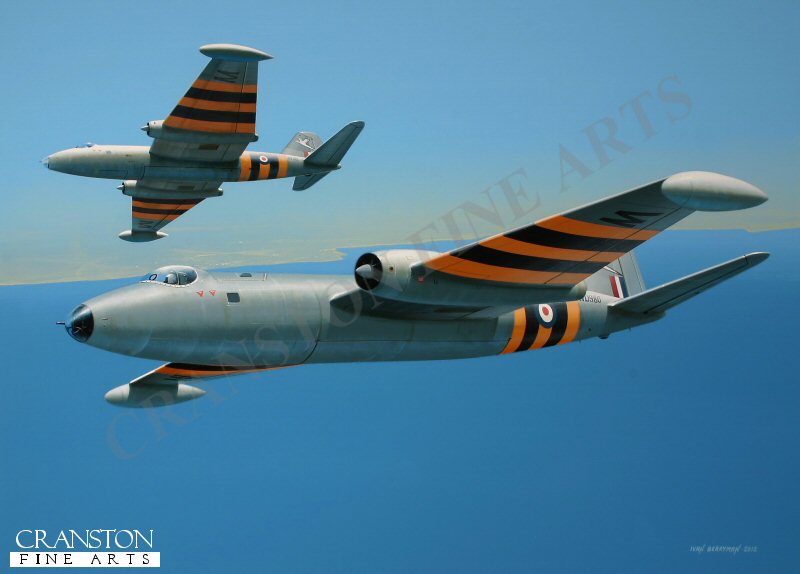
 The Suez conflict of 1956 necessitated a large deployment of bombers from the RAF's new fleet of jets.  24 Vickers Valiants and 29 English Electric Canberras operated out of Luqa, together with a further 59 of the type flying from bases in Nicosia and Cyprus under the codename <i>Operation Musketeer</i>.  Adorned in the theatre's black and yellow identification stripes, two XV Sqn Canberras are depicted here on a bombing mission to attack Egyptian airfields in October 1956.  The squadron flew a total of 37 missions during the Suez crisis, its aircraft dropping more bombs than any other Canberra squadron.

Musketeer Canberras by Ivan Berryman.
Mosquitos of 105 Squadron, Marham.  No. 105 Squadron, stationed at Marham, Norfolk, became the first Royal Air Force unit to become operational flying the Mosquito B. Mk. IV bomber on 11th April 1942.  The painting shows 105 Squadron on the raid of 10th April 1945, to the Wahren railway marshalling yards at Leipzig, Germany.

Return From Leipzig by Anthony Saunders
Signatures on these products
*The value given for each signature has been calculated by us based on the historical significance and rarity of the signature and is for the unmatted version where available. Values of many pilot signatures have risen in recent years and will likely continue to rise as they become more and more rare.
NameInfo


Air Commodore Sir Hughie Edwards VC KCMG CB DSO OBE DFC (deceased)
Died : 1982
*Signature Value : £80

Editions signed :

Clipped Signature.


Edwards, Hughie
(Air Commodore Sir Hughie Edwards VC KCMG CB DSO OBE DFC (deceased))

Hughie Idwal Edwards was the son of a Welsh emigrant couple who settled in Freemantle, Western Australia in 1910.

Born on 1st August 1914 at Freemantle and educated at White Gum Valley School and Freemantle High.

In 1934 he enlisted in the local garrison artillery and in July 1935 transferred to the RAAF receiving his wings in June 1936. On 21st August 1936 he was commisioned in the RAF and posted to No.15 Sqn at Abingdon to fly Hawker Hind bombers. The following March he was posted to Bicester (No.60 Sqn) to fly Bristol Blenheim Mk.Is. In August 1938 Edwwards received extensive injuries through a crash in the Blenheim, which left him in hospital for nine months and leaving him paralysed below the knee in his right leg. He returned to flying duties in February 1941 at Horsham St Faith, flying Blenheim Mk.IVs. In May he was apppointed CO of No.105 Sqn at Swanton Morley. On June 15th he led six Blenheim on a low level attack of enemy shipping, going in at 50ft, severely damaged a 4,000 ton ship for which he was subsequently awarded the DFC.

On 4th July 1941, flying a Blenheim Mk.IV, V6028 GB-D, with his crew Pilot Officer Ramsay (navigator) and Sgt G Quinn DFM (air gunner), he led fifteen Blenheims flying at 50-100ft across the North Sea, twelve aircraft eventually crossed the German border and headed towards Bremen, flying in excellent visibility, a mixed blessing for the bomber crews. They ran into a wall of tracer and shellfire on their approach to their target. Flying at between 50-100ft, they flew through flak, balloon cable and telephone wires before releasing their bombs over the centre of the dock area. Several aircraft were lost and the remainder suffered various degrees of damage, and many of the survivors returned home trailing telegraph wires around wings and tailplanes.

On 22nd July, Edwards was awarded a Victoria Cross for : displaying the highest possible standard of gallantry and determination. whilst of his crew, Ramsay received the DFC and Quinn a bar to the DFM.

There followed a short detachment to Malta, where he led attacks on Axis shipping in the Mediterranean before participating in a lecture tour of the USA.

In 1942 on his return to the UK he married, before joining No.105 Sqn to fly the Mosquito, leading them on numerous ddaylight raids against the enemy. On 5th January 1943 he was awarded the DSO and in February was promoted to Group Captain. In December 1944 he was posted to the Far East, becoming Group Captain, Bombing Operations at Ceylon HQ, Kandy, and was then appointed to SEAC as SASO and then followed various senior staff posts in Malaya and Batavia, resulting in the OBE in February 1947.

Remaining in the RAF, he returned to Bracknell Staff College and became SPSO at 21 Group HQ in 1946-49.

Group Captain Edwards was Station Commander at Wattisham 1953-56 before moving to Habbaniya as Commanding Officer until 1958.

Promoted to Air Commodore in January 1958, he was appointed Commandant of the Central Fighter Establishment at West Raynham and received a CB in the 1959 New Years Honours. In March 1960 he was made and ADC to HM Queen Elizabeth, and in 1962 became Director of Establishments at the Air Ministry.

He retired on 30th September 1963. Returning to Australia, he was knighted as a KCMG in 1974 and became Governor of West Australia until ill health forced him to resign on 2nd April 1975. He died on 5th August 1982.
Squadrons Related to This Print
No.105 Sqn
No.15 Sqn
No.60 Sqn
Aircraft Related to This Print
Blenheim
Hind

Contact Details
Shipping Info
Terms and Conditions
Cookie Policy
Privacy Policy

Sign Up To Our Newsletter!

Stay up to date with all our latest offers, deals and events as well as new releases and exclusive subscriber content!

This website is owned by Cranston Fine Arts.  Torwood House, Torwoodhill Road, Rhu, Helensburgh, Scotland, G848LE

Contact: Tel: (+44) (0) 1436 820269.  Email: cranstonorders -at- outlook.com

Return to Home Page