Cranston Military Prints .com Home Page
Customer Helpline (UK) : 01436 820269
Subscribe to our Newsletter!

You currently have no items in your basket

Payment Options Display
Buy with confidence and security!
Publishing historical art since 1985


Navigation Menus
Military
Art Index
Aviation
Art Index
Naval
Art Index
Artists
Index
Product Search         
Aviation
History Archive
Naval
History Archive
HALF PRICE AND FREE PRINT SPECIAL OFFERS
ALWAYS GREAT OFFERS :
20% FURTHER PRICE REDUCTIONS ON HUNDREDS OF LIMITED EDITION ART PRINTS
BUY ONE GET ONE HALF PRICE ON THOUSANDS OF PAINTINGS AND PRINTS
FOR MORE OFFERS SIGN UP TO OUR FREE NEWSLETTER
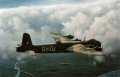
The Night Shift by Philip West. (AP) - Cranston Military Prints

The Night Shift by Philip West. (AP)


The Night Shift by Philip West. (AP)

The Short Stirling was the RAFs first four-engined bomber to enter service and it served throughout WWII in many roles including bomber, minelayer, troop carrier and glider-tug. The lack of power produced by its engines severely limited the loads carried by Stirlings. On long-range trips such as Italy, even with a greatly reduced bomb load the aircraft could barely clear the Alps. Despite very large losses due to its operational limitations, those that flew this big, agile aircraft, came to respect and look upon it with it with affection.
Item Code : DHM1670APThe Night Shift by Philip West. (AP) - Editions AvailableExtra....

A photograph of an edition of the print :

DESCRIPTIONSIZESIGNATURESOFFERSPRICEPURCHASINGPACKS
Limited edition of 50 artist proofs. Paper size 27 inches x 18 inches (69cm x 46cm)
Goodman, L S Benny

Died : 2021
Squadron Leader L S Benny Goodman (deceased)
Benny Goodman (Pilot) volunteered for aircrew at 18 years of age and was called up in 1940. After basic training he went to RAF Abingdon - a Whitley OTU - for what he was told would be straight through training. This did not materialise and he found himself in the role of a Ground Gunner. In 1941, a posting eventually came through to the Initial Training Wing followed by Elementary Fyling School at Peterborough and an instructors course at Woodley, Reading; then to Clyffe Pyparde, a holding u
Signature Value : £40
CLICK HERE FOR FULL PROFILE
 
Lucas, W E Bill
NO
PHOTO
AVAILABLE

Sqn Ldr W E Bill Lucas DFC
Born in 1917, Bill Lucas volunteered for aircrew early in 1940 and after training as a fighter pilot he became, due to the high demand, a bomber pilot and joined 9 Squadron (Wellingtons) in August 1941. After 14 missions over Germany Bill converted to Stirlings and completed a further 26 operations, this time with 15 Squadron at Wyton. After two years instructing at 19 OTU Kinloss he was selected to join Pathfinder Force in October 1944 to fly Mosquitoes with 162 Squadron at Bourn, Cambridgeshi
Signature Value : £15
CLICK HERE FOR FULL PROFILE

Livermore, R
NO
PHOTO
AVAILABLE

Flt Lt R Livermore
Was part of 299 Air Support Squadron in Norfolk. He flew six ops. on Stirlings, taking supplies to the French resistance - dropping 24 containers at a time by parachute at night, each one full of supplies, including guns and ammunition. They had to arrive at the target area within a five minute period, or else the resistance would leave for fear of a trap being set by the Germans. When the resistance were satisfied they were watching the correct aircraft they would flash they torches on and off
Signature Value : £20
CLICK HERE FOR FULL PROFILE

+ Artist : Philip West


Signature(s) value alone : £75
£35 Off!
Add any two items on this offer to your basket, and the lower priced item will be half price in the checkout!
Now : £125.00

Quantity:


Some other related items available from this site.

 Stirling Q-OJ of No.149 Sqn is shown minelaying in the Batlic.  It was on precisely this type of mission - minelaying in the Baltic that aircraft W7639 (shown) was lost on 8th December 1942.  Developing technical problems, the aircraft turned for home, but crashed in Suffolk, killing all seven crew on board.  The crew were : <br>P/O J Philp BEM,<br>Sgt W S Hughes,<br>Sgt G E Hills,<br>Sgt C W Higgins,<br>Sgt F Craven,<br>Sgt T H Harris, and<br>Sgt T G Williams.

Stirling Mine Laying by Keith Aspinall.
 A flak-damaged Lancaster of 617 Squadron struggles across the airfield perimeter as it returns to base after a precision raid over enemy territory.  After writing a new chapter in aviation history with the famous Dams Raid of May 1943, 617 Squadron went on to execute many more daring operations including the sinking of the Tirpitz.  Often flying specially modified Lancasters with enlarged bomb bay doors to accommodate the huge 12,000lb Tallboy, they specialised in high value precision targets such as canals, tunnels and U-Boat pens.
Welcome Home by Stephen Brown.
 Short Stirling N6086 <i>MacRobert's Reply</i> of 15 Sqn is shown during the bombing raid on the French Harbour of Brest on 18th December 1941.  British bombers had been dispatched to bomb the German battleships <i>Gneisenau</i> and <i>Scharnhorst</i> that were docked there, an action that earned N6086's skipper Fl Off Peter Boggis a DFC.  Stirling W7428 is also shown with her port wing ablaze, one of two Stirlings lost on this operation.  The subject of the RAF's attention can be seen amid the smoke - <i>Gneisenau</i> in drydock and <i>Sharnhorst</i> alongside.

MacRobert's Reply by Ivan Berryman.
 12th Janaury 1945 and the Lancatsers of 9 and 617 squadrons are once again taking their deadly cargo of Tallboy bombs over enemy territory. This time it is the turn of the U boat pens at Bergen in Norway. En route home the bombers are bounced by FW 190s of JG5. One of the Luftwaffe Pilots in White1, Heinze Owlowski, believes he has made a fatal attack on Lancaster KC-M piloted by Squadron Leader Tony Iveson. He salutes the crew before doing a victory roll in front of the badly damaged bomber. However, thanks to the bravery and skill of its young pilot the Lancaster would actually make it home to a force land on 3 engines at Dumburgh in the Shetland Isles. A feat for which the Squadorn Leader Iveson recieved his D.F.C. This Print was split into dfferent editions signed by different groups of crew, this edition is not signed by the artist.

Lancaster Attack by David Pritchard.
Signatures on these products
*The value given for each signature has been calculated by us based on the historical significance and rarity of the signature and is for the unmatted version where available. Values of many pilot signatures have risen in recent years and will likely continue to rise as they become more and more rare.
NameInfo


Squadron Leader L S Benny Goodman (deceased)
Died : 2021
*Signature Value : £40

Editions signed :

Limited edition of 50 artist proofs.


Goodman, L S Benny
(Squadron Leader L S Benny Goodman (deceased))

Benny Goodman (Pilot) volunteered for aircrew at 18 years of age and was called up in 1940. After basic training he went to RAF Abingdon - a Whitley OTU - for what he was told would be straight through training. This did not materialise and he found himself in the role of a Ground Gunner. In 1941, a posting eventually came through to the Initial Training Wing followed by Elementary Fyling School at Peterborough and an instructors course at Woodley, Reading; then to Clyffe Pyparde, a holding unit. A sea journey to Canada followed and Service Flying Training School on Ansons. On completion he was posted to Kingston, Ontario, to instruct Acting Leading Naval Airmen on the Royal Navy tactics of the time, e.g. jinking after take off, dive bombing, etc. Eventually he returned to the UK and OTU on Wellingtons at Silverstone and Heavy Conversion Bomber Unit at Swinderby on Stirlings, followed by a short course at the Lancaster Conversion Unit. After an interview Benny and his crew were surprised and delighted to find they had been selected for 617 squadron - this was in 1944 and they had stayed together as a crew on 617 squadron until the war in Europe ended. He completed 30 missions - all with Jock Burnett as his flight engineer. Notable raids Jock took part in were on the Tirpitz, 29th October 1944, dropping the Grand Slam 22,000 bomb on the Arnsberg Viaduct, 19th March 1945, and the attack on Berchtesgarten Eagles Nest, 25th May 1945. Benny Goodman died in July 2021.


Sqn Ldr W E Bill Lucas DFC
*Signature Value : £15

Editions signed :

Limited edition of 50 artist proofs.


Lucas, W E Bill
(Sqn Ldr W E Bill Lucas DFC)

Born in 1917, Bill Lucas volunteered for aircrew early in 1940 and after training as a fighter pilot he became, due to the high demand, a bomber pilot and joined 9 Squadron (Wellingtons) in August 1941. After 14 missions over Germany Bill converted to Stirlings and completed a further 26 operations, this time with 15 Squadron at Wyton. After two years instructing at 19 OTU Kinloss he was selected to join Pathfinder Force in October 1944 to fly Mosquitoes with 162 Squadron at Bourn, Cambridgeshire, where he remained until war end to complete 41 more missions making 81 in total. Bill attained the rank of Squadron Leader and was awarded the DFC and a Mention in Despatches. The most memorable of his missions must be the first 1000 bomber raid on Cologne on May 30 1942, as this seems to have struck a lasting memory in the minds of the general public. After the war Bill pursued a career in the insurance industry and also began to pick up the pieces of a serious athletic activity with the Belgrave Harriers which resulted in selection for the 5000 metres at the Olympic Games at Wembley in 1948, but at the age of 32 he was not in his own words 'very successful'. Bill says his greatest regret was missing the games in Helsinki in 1940 and the cancelled games in 1944. 'These should have been the best athletic years of my life.'


Flt Lt R Livermore
*Signature Value : £20

Editions signed :

Limited edition of 50 artist proofs.


Livermore, R
(Flt Lt R Livermore)

Was part of 299 Air Support Squadron in Norfolk. He flew six ops. on Stirlings, taking supplies to the French resistance - dropping 24 containers at a time by parachute at night, each one full of supplies, including guns and ammunition. They had to arrive at the target area within a five minute period, or else the resistance would leave for fear of a trap being set by the Germans. When the resistance were satisfied they were watching the correct aircraft they would flash they torches on and off as both a signal and also to pinpoint the drop zone. Flt. Lt. Livermore also towed gliders behind his Stirling aircraft during the Rhine crossing.
Aircraft Related to This Print
Stirling

Contact Details
Shipping Info
Terms and Conditions
Cookie Policy
Privacy Policy

Sign Up To Our Newsletter!

Stay up to date with all our latest offers, deals and events as well as new releases and exclusive subscriber content!

This website is owned by Cranston Fine Arts.  Torwood House, Torwoodhill Road, Rhu, Helensburgh, Scotland, G848LE

Contact: Tel: (+44) (0) 1436 820269.  Email: cranstonorders -at- outlook.com

Return to Home Page