|
|
|
|
||
|
|
|
|
||
| Navigation Menus |
|
Military Art Index |
Aviation Art Index |
Naval Art Index |
Artists Index |
Aviation History Archive |
Naval History Archive |
|
| HALF PRICE AND FREE PRINT SPECIAL OFFERS | ||||||
|
| ||||||||||||||||||||||||||||||||||||||||||||
Some other related items available from this site. | ||||
  Invasion Force by Nicolas Trudgian | Invasion Force by Nicolas Trudgian. |   Lancaster VC by Graeme Lothian. |   Market Garden. Arnhem by Graeme Lothian. | |
| Signatures on these products | |
| *The value given for each signature has been calculated by us based on the historical significance and rarity of the signature and is for the unmatted version where available. Values of many pilot signatures have risen in recent years and will likely continue to rise as they become more and more rare. | |
| Name | Info |
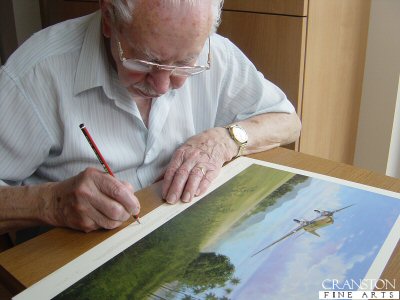
  Sqd Ldr Larry Lewis DFC DFM (deceased) Died : 2015 *Signature Value : £45 Editions signed : Limited edition of 50 artist proofs. | Lewis, Larry (Sqd Ldr Larry Lewis DFC DFM (deceased)) Squadron Leader Larry Lewis (born October 25th 1918 in Bristol, died May 12th 2014) earned the DFM as an air gunner before training as a pilot. After picking up air crash survivors from behind Japanese-held lines in Siam, he was awarded the DFC. On May 29th 1945 Japanese fighters shot down a Liberator bomber of 358 Squadron over Siam (Thailand) during a flight to drop supplies and US Special Forces to the 'Seri Thai' (Free Thailand) Resistance movement. Some of the crew and passengers survived the crash landing and were sheltered by natives and police. Once SOE in India had been alerted to the plight of the survivors, a rescue mission was mounted. On June 14th Lewis took off in his Dakota and flew at very low level to a remote airstrip at Pukio in Siam. He found the short runway adequate but the aircraft became bogged down at the end of the landing run. Within an hour, however, it had been recovered with the aid of Siamese workers and Lewis took off with seven passengers, including some of the crew of the crashed Liberator. The citation to his DFC concluded, he successfully completed a mission well into enemy territory, in daylight. The results obtained are an excellent tribute to his outstanding ability. One of seven children, Laurence 'Larry' Godfrey Lewis was born in Bristol on October 25 1918 and educated at Bristol Grammar School. He won a Pelaquin Scholarship but had to leave school at 15 to help support his family. He joined the Auxiliary Air Force as a metal rigger in May 1939 and served with No 501 (County of Gloucester) Squadron. Equipped with Hurricane fighters, and based in the south of England, the squadron was heavily involved during the Battle of Britain. Lewis volunteered for pilot training but was selected to be an air gunner, commencing his training in late 1940. At the end of the year he was posted to No.12 Squadron equipped with the Wellington bomber. During a daylight attack on Brest, his aircraft was attacked by a German fighter, which he engaged and probably shot down. He completed 33 operations over enemy territory as a rear gunner including the three 'Thousand Bomber Raids' in the spring of 1942. He was awarded the DFM for his outstanding keenness, reliability and devotion to duty. Lewis was finally selected for pilot training, which he completed in Canada where he converted to the Dakota. He arrived in the Far East in January 1945 and joined No 357 (Special Duties) Squadron at Jessore near Calcutta. Over the next six months he completed 42 operations dropping supplies and agents over Burma and Siam. Some of these long-range missions involved flying over enemy territory for many hours and in extreme weather conditions to find small clearings marked by flares and cloth panels. Some areas were so small that as many as eight or nine runs were necessary before all the loads could be dropped, sometimes from heights of 100 feet. After the capture of Rangoon, flights were mounted from advanced airfields when sorties could be mounted deep into Siam, Indo-China and Malaya in support of clandestine forces. Lewis flew his final sortie on August 3rd 1945 when he made eleven runs to drop his 'packages' over a clearing in southern Burma. After serving at Air HQ Burma in a plans appointment, Lewis was released form the RAF in March 1946. He received the Air Efficiency Award. |
  Pilot Officer Bill Leckie, AEM, KW (deceased) Died : 2021 *Signature Value : £50 Editions signed : Limited edition of 50 artist proofs. | Leckie, Bill (Pilot Officer Bill Leckie, AEM, KW (deceased)) Bill Leckie was born in Glasgow, Scotland on 23rd June 1921, joined the Royal Air Force in June 1941 and went to St Johns Wood on the 15th of September 1941. Bill Leckie started his flying training on the 4th of April 1942 at Stoke Orchard near Cheltenham in Tiger Moths. He went to Canada on the 26th of May 1942 at Monkton for further training until June before going on to Detroit and on to Pensacola, Florida on the 1st October 1942, flying Stearman and Catalina Flying boats until 31st March 1943 when Bill went to Prince Edward Island for further training. Back in the UK, Bill was expecting to join a Coastal Command squadron flying Catalinas but was transferred to Bomber Command and a conversion course on to Whitleys at Kinloss Scotland on the 22nd of February 1944, and joined 77 Squadron at Full Sutton on the 19th July 1944 on Halifaxes, flying 6 bombing missions, one being the bombing of the Flying Bomb Factory at Russesheim, before transferring to 148 Special Duties squadron on the 19th of August 1944 and going to Brindisi. Pilot Officer Bill Leckie was involved in the dropping of supplies (guns, ammunition and food) to the Polish during the Warsaw uprising. This was a costly mission and many aircraft were lost. (Bill was flying Halifax JD319 (FS - G). For his efforts in air-dropping supplies during this period, Bill Leckie was awarded the Polish Cross of Valour (KW). Pilot Officer Bill Leckie was also the Pilot for Operation Ebensburg on Sunday 8th April 1945. Halifax B.II Series 1 (Special) JP254 of 148 Special Duties Squadron carried out the misison to drop four SOE agents and their equipment near Alt Aussee salt mine in the Austrian Alps. Thier mission was to secure and protect 6,755 items of the worlds greatest works of art that had been looted and stored by the Germans as they swept across Europe. With the allied forces closing in, the Germans had planned to blow up the entire store to prevent the artworks from falling into the hands of the liberators. Once on the ground, the four agents linked up with local resistance fighters and the mine and its valuable contents were eventually secured, the explosives made safe and the entire cache taken into the safe keeping of the 80th US Infantry Division as the German occupation of Europe crumbled. Bill Leckie stayed with 148 Squadron until 18th May 1945 when he was posted to Cairo with 216 Squadron (Dakotas) of Transport Command and on 1st January 1946 to 78 Squadron flying Dakotas again until 1st June 1946 , finally leaving the RAF on the 18th September 1946. He died in October 2021. |
| Squadrons Related to This Print |
| No.357 Sqn |
| Aircraft Related to This Print |
| Dakota |
|
Contact Details |
Sign Up To Our Newsletter!
This website is owned by Cranston Fine Arts. Torwood House, Torwoodhill Road, Rhu, Helensburgh, Scotland, G848LE Contact: Tel: (+44) (0) 1436 820269. Email: cranstonorders -at- outlook.com |



 Signature(s) value alone : £95