|
|
|
|
||
|
|
|
|
||
| Navigation Menus |
|
Military Art Index |
Aviation Art Index |
Naval Art Index |
Artists Index |
Aviation History Archive |
Naval History Archive |
|
| HALF PRICE AND FREE PRINT SPECIAL OFFERS | ||||||
|
| ||||||||||||||||||||||||||||||||||||||||||||||||||||||||||||||||||||||||||||||||||||||||||||||||||||||||||||||||||||||||||||||||||||||||||||||||||||||||||||||||||||||||||||||||||||||||||||||||||||||||||||||||||||||||||||||||||||||||
Some other related items available from this site. | ||||
  Mädchen für Alles by Ivan Berryman. |   One on the Run by Ivan Berryman. |   Hurricane Patrol by Graeme Lothian. |   Desperate Measures by Ivan Berryman. | |
| Signatures on these products | |
| *The value given for each signature has been calculated by us based on the historical significance and rarity of the signature and is for the unmatted version where available. Values of many pilot signatures have risen in recent years and will likely continue to rise as they become more and more rare. | |
| Name | Info |
  Group Captain Byron Duckenfield AFC (deceased) Died : 2010 *Signature Value : £50 Editions signed : Signed limited edition of 800 prints. Limited edition of 50 artist proofs. Presentation edition of 2 prints. Wilkinson / Duckenfield edition of 300 prints - part of the signed limited edition of 800 prints. Signed limited edition of 800 prints. | Duckenfield, Byron (Group Captain Byron Duckenfield AFC (deceased)) Byron Duckenfield started at Flying Training School on 25th November 1935 in a Blackburn B2 at Brough. As a Sergeant, he joined No.32 Sqn at Biggin Hill on 8th August 1936 and flew Gauntlets and Hurricanes. He joined 74 Squadron at Hornchurch on 11th April 1940, flying Spitfires, and on 5th May was posted to 501 Squadron flying Hurricanes at Tangmere. On the 11th of May at Betheniville, he survived a crash in a passenger transport Bombay aircraft in an aircraft in which he was a passenger, While comin ginto land the aircraft at 200 feet the aircraft stalled and the aircrfat fell backwards just levelly out as it histhe ground. 5 of th epassengers were killed when the centre section collapsed and crushed them. Duckenfield was fortunate as he had moved position during the flight. as the two passengers sitting each side of where he was sitting had died in the crash. (it was found later that the Bombay had beeb loaded with to much weight in the aft sectiion. ) recovering in hospital in Roehampton. On 23rd July 1940, he rejoined No.501 Sqn at Middle Wallop, then moved to to Gravesend two days later, scoring his first victory, a Ju87, on the 29th of July 1940. During August and September he scored three more victories. After a spell as a test pilot from 14th September 1940, he was posted to command 66 Squadron on 20th December 1941, flying Spitfires. On 26th February 1942 he took command of 615 Squadron flying Hurricanes from Fairwood Common, taking the squadron to the Far East. In late December 1942 he was shot down in Burma and captured by the Japanese. He remained a POW until release in May 1945. After a refresher course at the Flying Training School in November 1949, he took command of No.19 Squadron flying Hornets and Meteors from Chruch Fenton. After a series of staff positions, he retired from the RAF as a Group Captain on 28th May 1969. Duckenfield would write later his details : Burma At first light, 12 Hurricanes IIC aircraft of 615 Squadron, myself in the lead, took off from Chittagong for central Burma to attack the Japanese air base at Magwe, 300 miles away on the banks of the River Irrawaddy. Arriving at Yenangyaung, we turned downstream at minimum height for Magwe, 30 miles to the South and jettisoned drop tanks. Just before sighting the enemy base, the squadron climbed to 1200 feet and positioned to attack from up sun. On the ramp at the base, in front of the hangers, were 10 or 12 Nakajima KI - 43 Oscars in a rough line up (not dispersed) perhaps readying for take. These aircraft and the hangars behind them were attacked in a single pass, before withdrawing westward at low level and maximum speed. A few minutes later perhaps 20 miles away form Magwe, I was following the line of a cheung (small creek), height about 250 feet, speed aboput 280 mph, when the aircraft gave a violent shudder, accompanied by a very lound, unusual noise. The cause was instantly apparent: the airscrew has disappeared completely, leaving only the spinning hub. My immediate reaction was to throttle back fully and switch off to stop the violently overspeeding engine. Further action was obvious: I was committed to staying with the aircraft because, with a high initial speed, not enough height to eject could be gained without the help of an airscrew. So I jettisoned the canopy and acknowledged gratefully the fact that I was following a creek; the banks of either side were hillocky ground, hostile to a forced landing aircraft. Flying the course of the creek, I soon found the aircraft to be near the stall (luckily, a lower than normal figure without an airscrew) extended the flaps and touched down wheels-up with minimum impact ( I have done worse landings on a smooth runway!) My luck was holding, if one can talk of luck in such a situation. December is the height of the dry season in that area and the creek had little water, it was shallow and narrow at the point where I came down: shallow enough to support the fusalage and narrow enough to support wing tips. So I released the harness, pushed the IFF Destruct switch, climed out and walked the wing ashore, dryshod. The question may occur -Why did not others in the squadron see their leader go down? - the answer is simple, the usual tatctic of withdrawal from an enemy target was to fly single at high speed and low level on parallel courses until a safe distance from target was attained. Then, the formation would climb to re-assemble. Having left the aircraft, I now faced a formidable escape problem? I was 300 miles from friendly territory: my desired route would be westward but 80% of that 300 miles was covered by steep north-south ridges impenetrably clothed in virgin jungle; these were natural impediments, there was also the enemy to consider. Having thought over my predicament, I decided the best I could do - having heard reports of mean herted plainspeope - was to get as far into the hills as possible and then find a (hopefully sympathetic) village. I suppose I may have covered about 15 miles by nightfall when I came upon this small hill village and walked into the village square. Nobody seemed surprised to see me (I suspect I had been followed for some time) I wa given a quiet welcome, seated at a table in the open and given food. Then exhaustion took over, I fell asleep in the chair and woke later to find myself tied up in it. Next day I was handed over to a Japanese sergeant and escort who took me back to Magwe and, soon after that, 2.5 years captivity in Rangoon jail. Sadly we have learned that Byron Duckenfield passed away on 19th November 2010. |
  Flight Lieutenant Alexander Henry Thom DFC (deceased) Died : 2016 *Signature Value : £50 Editions signed : Signed limited edition of 800 prints. Limited edition of 50 artist proofs. Presentation edition of 2 prints. Signed limited edition of 800 prints. | Thom, Alex (Flight Lieutenant Alexander Henry Thom DFC (deceased)) Born in Perth, Scotland, Alex Thom joined the RAFVR on June 24th 1939 and flew at the weekends at 11 EARFTS Perth. At the outbreak of World War Two, Thom was called up for full time service with the Royal Air Force and was posted to 3 ITW at Hastings on October 2nd 1939, moving to 15 EFTS at Redhill on April 29th 1940 and on June 15th moved again to 15 FTS, initially at Brize Norton and later to Chipping Norton. Alex Thom went to 6 OTU on September 29th at Sutton Bridge where he converted to Hawker Hurricanes and joined 79 squadron stationed at Pembury only for a short period when he was transferred to 87 Squadron on October 6th 1940, moving with the squadron on the 31st of October to their new base at Exeter. He achieved the rank of Pilot Officer on the 3rd of December 1941. During his time at Exeter he was also based on the Scilly Isles and on one occasion after shooting down an enemy bomber the crew bailed out over the sea. Alex Thom circled the downed German crew who were in a life raft until a motor launch came and picked them up. Thom would later meet the crew and was given a flying helmet by the German pilot, an item he still has today. Alex Thom was appointed B Flight commander on 10th July 1942 and was awarded the DFC on the 14th August 1942. At this time he was credited with two enemy aircraft destroyed and a probable He111. On the 19th of August 1942 while supporting the ground forces at Dieppe, his Hurricane (LK - M) was hit by ground fire and lost oil pressure. He managed to limp back to England where he made a forced landing at East Den. Thom managed to get back to his airfield as a passenger in a Master flown by Flt Sgt Lowe and immediately took off again in Hurricane (LK - A) back to Dieppe where he proceeded to strafe enemy positions. On the 1st of October 1942 he became F/O. In November 1942, 87 Squadron was transferred to North Africa. They were transported by ship to Gibraltar where the squadron flew sorties, and then onto North Africa. Thom was posted away from the squadron to be a flying control officer at Bone. He returned to 87 Squadron which was then based at Tongley and took command on June 27th 1943. He was again posted away from the squadron on September 27th returning to the UK with the Rank of Flight Lt. Thom became an instructor with 55 OTU at Annan on November 17th moving to Kirton in Linsay on March 12th 1944 to join 53 OTU. He was appointed Flight Commander Fighter Affiliation Flight at 84 (Bomber) OTU at Husbands Bosworth on May 19th 1944 and remained there until October 10th when he went to RAF Peterhead as Adjutant. His final posting was to HQ13 Group, Inverness on May 8th 1945 as a Staff Officer and retired from the RAF on December 4th 1945 as a Flight Lt. He died on 10th January 2016. |
  Squadron Leader Maurice Peter Brown (deceased) Died : 2011 *Signature Value : £60 Editions signed : Limited edition of 50 artist proofs. | Brown, Maurice Peter (Squadron Leader Maurice Peter Brown (deceased)) Maurice Peter Brown (known as Peter) was born in London on 17th June 1919. On leaving school he qualified for entry in the civil service with an appointment in the Air Ministry. But in April 1938 he left to join the Royal Air Force with a short service commission. In September 1939 he was posted to 611 West Lancashire Squadron with Spitfires in 12 Group, initially at Duxford and then Digby. His initiation into battle was over Dunkirk. He was at readiness throughout the Battle of Britain, including with the controversial Ducford Big Wing on 15th September, when the Luftwaffe's morale was broken, and then in late September with 41 Squadron at Hornchurch where the fiercest fighting with highest casualties had taken place. It was a quantum leap. In June 1941, after serving as a flight commander in the squadron, Peter was posted as an instructor to 61 Operational Training Unit at Heston and other OTUs and then at AFUs as a Squadron Leader Flying. He left the RAF with the rank of Squadron Leader and was awarded the Air Force Cross. In his flying career, Maurice Peter Brown flew Spitfire Mk.I, Mk.II and Mk.V. We have learned the sad news that Maurice Peter Brown passed away on 20th January 2011. |
  Wing Commander George W Swanwick (deceased) Died : 2011 *Signature Value : £50 Editions signed : Battle of Britain Pilots edition of 200 prints. | Swanwick, George (Wing Commander George W Swanwick (deceased)) George Swanwick was born on 10th November 1915 and was an air-gunner on Wallaces and Hinds with 504 squadron at RAF Hucknall during the 1930s. In May 1936, 504 became part of the Auxiliary Air Force, and in October 1938 converted to a fighter unit, equipped with Gauntlets. In 1938 George re-trained as a pilot, and was promoted to Sergeant Pilot in August 1939. In May 1940 George Swanwick joined 7 BGS, and on 7th September was posted to 54 Squadron at Catterick flying Spitfires. He then went to 41 Squadron at Hornchurch. Commissioned in late 1941, he was posted to 222 Squadron at North Weald in April 1942 as a Flight Commander. In July George Swanwick joined 603 Squadron in Malta and in September 1942, George was posted to 7 OTU at Port Sudan as Flight Commander. In July 1943, he joined 81 Squadron in Malta as a supernumerary. George was invalided back to the UK and following his discharge from hospital in 1944, George held various staff appointments until the end of the war. George Swanwick was granted a Permament Commission in 1949 and retired on 30th April 1970, as a Wing Commander. Sadly, George Swanwick passed away on 4th January 2011. |
  Flight Lieutenant Richard L Jones (deceased) Died : 2012 *Signature Value : £45 Editions signed : Battle of Britain Pilots edition of 200 prints. | Jones, Richard L (Flight Lieutenant Richard L Jones (deceased)) Richard Jones was born in 1918 and in July 1940 Richard Jones was posted to 64 Squadron at Kenley, flying Spitfires. He was involved in heavy fighting over the Channel during the Battle of Britain, with the squadron suffering many losses during July and August. Towards the end of the Battle of Britain, in October, he moved to 19 Squadron flying Spitfires from Fowlmere, and was heavily involved in the fighter sweeps taking place at that time. Near the end of the Battle of Britain, Pilot Officer Richard Jones was shot down during a dogfight over Kent with Me 109s. Jones crash landed his Spitfire in a field, colliding with a flock of sheep - he would go on to write in his log book 'Crashed into a load of sheep. What a bloody mess!' After the Battle of Britain, Richard Jones became a test pilot for De Havilland at Witney in Oxfordshire, and test flew thousands of Hawker Hurricanes and other types, including civil types. After the war Richard Jones joined the RAFVR and started a long career in the motor industry. Sadly Richard Jones passed away on 7th March 2012. |
 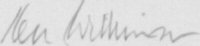 Flying Officer Ken Wilkinson (deceased) Died : 2017 *Signature Value : £45 Editions signed : Presentation edition of 2 prints. Wilkinson / Duckenfield edition of 300 prints - part of the signed limited edition of 800 prints. | Wilkinson, Ken (Flying Officer Ken Wilkinson (deceased)) Battle of Britain pilot flying Hurricanes, he flew Spitfires with 611 Sqn and then 616 Sqn at Kirton-in-Lindsey and 19 Sqn at Fowlmere during 1940 and after a spell instructing returned to operations on Spitfires, with 234 and 165 Squadrons. After spending time with 53, 24 and 10 Operational Training Units, he left the RAF in November 1945 and served in the RAFVR. Ken said : From 1st September 1939 I wrote myself off. I thought, 'you've got no chance' lasting through whatever is going to be. It was quite obvious, in the way the Germans were moving, they were going to make a hell of a war out of it, so I was ready for war. I can remember saying 'we've got to stop this fellow Hitler'. When you think of all the thousands of citizens that were being killed by this absurd bombing. They had to pay for it didn't they. Yes, we lost people. Friends that didn't come back. I don't think we were the sort of people to brood over it, ever. You have to get into an attitude to make sure that you're as cold as a fish. Once someone has failed to return, that's it. Fortune smiled on me and not on some of the others. I can only say that whoever it was who popped off at me, wasn't a very good marksman. It transpired that we were doing something far more important than we thought. As far as we were concerned, it was just that there were some untidy creatures from over the other side of the channel, trying to bomb England and the United Kingdom. And we didn't want them to bomb us. After all, we never asked the Germans to start this nonsense, did we? But they did, and we had to stop them, and we did. It's our country. You die for you country. |
  Group Captain Sir Douglas Bader CBE, DSO*, DFC* (deceased) Died : 1982 *Signature Value : £150 Editions signed : Presentation edition of 2 prints. | Bader, Douglas (Group Captain Sir Douglas Bader CBE, DSO*, DFC* (deceased)) One of the most famous fighter aces of World War Two, Douglas Bader joined the RAF in 1928. A fearless aerobatic flyer, his luck ran out when his aircraft crashed attempting a slow roll. He lost both legs, and his career in the RAF was, for the time being, over. At the outbreak of World War Two however, his persistence persuaded the RAF to let him fly again, this time with artificial legs. Joining 19 Squadron in February 1940, he soon scored his first victory. A brilliant fighter leader, he was given command of 242 Squadron - and led them throughout the Battle of Britain. Posted to Tangmere in 1941 Bader was one of the first Wing Leaders. Baders luck again ran out on August 9th 1941, when he was brought down over St Omer, France. Bader was taken prisoner, ending up in Colditz for the rest of the war. He scored 20 and shared 4 victories. |
| Squadrons Related to This Print |
| No.242 Sqn |
| Aircraft Related to This Print |
| Hurricane |
|
Contact Details |
Sign Up To Our Newsletter!
This website is owned by Cranston Fine Arts. Torwood House, Torwoodhill Road, Rhu, Helensburgh, Scotland, G848LE Contact: Tel: (+44) (0) 1436 820269. Email: cranstonorders -at- outlook.com |


 Signature(s) value alone : £100


 Signature(s) value alone : £160


