Cranston Military Prints .com Home Page
Customer Helpline (UK) : 01436 820269
Subscribe to our Newsletter!

You currently have no items in your basket

Payment Options Display
Buy with confidence and security!
Publishing historical art since 1985


Navigation Menus
Military
Art Index
Aviation
Art Index
Naval
Art Index
Artists
Index
Product Search         
Aviation
History Archive
Naval
History Archive
HALF PRICE AND FREE PRINT SPECIAL OFFERS
ALWAYS GREAT OFFERS :
20% FURTHER PRICE REDUCTIONS ON HUNDREDS OF LIMITED EDITION ART PRINTS
BUY ONE GET ONE HALF PRICE ON THOUSANDS OF PAINTINGS AND PRINTS
FOR MORE OFFERS SIGN UP TO OUR FREE NEWSLETTER
Roam at Will by Anthony Saunders. - Cranston Military Prints

Roam at Will by Anthony Saunders.


Roam at Will by Anthony Saunders.

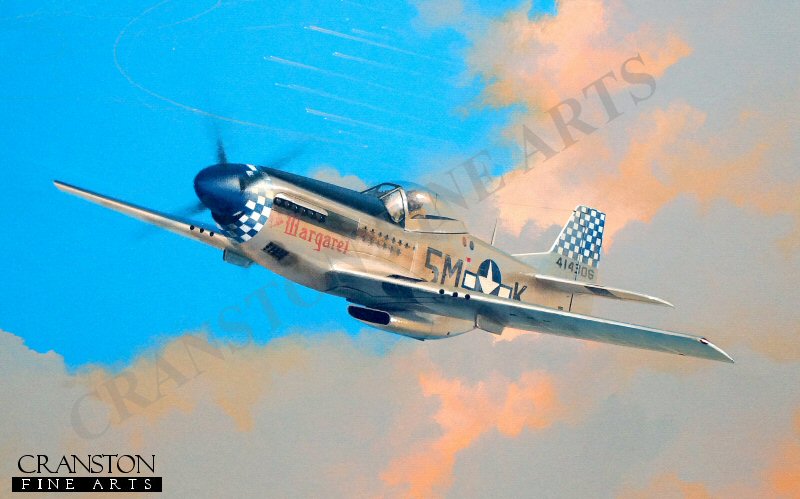
Returning to base after an arduous escort mission, Captain Art Fiedler leads a flight of P51 Mustangs from the 325th Fighter Group - the Checkertail Clan - through the Po Valley in northern Italy seeking out targets of opportunity amongst the retreating Axis forces, July 1944. When in December 1943 the 325th Fighter Group, the Checkertail Clan, had moved into south-eastern Italy they were soon escorting American bombers on long range missions deep into occupied Europe. In two years of air combat the Checkertails soon became one of the crack units in the Fifteenth Air Force, destroying a staggering 537 enemy aircraft in the air, and accounting for many more on the ground.
Item Code : DHM1964RMRoam at Will by Anthony Saunders. - Editions AvailableExtra....

Detail Images :


DESCRIPTIONSIZESIGNATURESOFFERSPRICEPURCHASINGPACKS
Signed limited edition of 425 prints. Image size 21.5 inches x 14 inches (54cm x 36cm)
Fiedler, Arthur C

Died : 2016
Colonel Arthur C Fiedler (deceased)
Arthur Charles Fiedler was born in Oak Park, Illinois on August 1, 1923. In April of 1942, five months after America entered WW 11, Fiedler enlisted in the Army Air Corps. He was sent to Avon Park, Florida for primary training, followed by basic training at Macon, Georgia, and advanced training at Marianna, Florida. He graduated with Class 43G in July of 1943, and was assigned as a flight instructor, flying Republic P-47 Thunderbolts at Dover, Delaware. In April of 1944 Second Lieutenant Feidler
Signature Value : £55
CLICK HERE FOR FULL PROFILE
 
+ Artist : Anthony Saunders


Signature(s) value alone : £55
£95.00

Quantity:
In 2 Pairs
and 1 Pack
View
Limited edition of 25 artist proofs. Image size 21.5 inches x 14 inches (54cm x 36cm)
Fiedler, Arthur C

Died : 2016
Colonel Arthur C Fiedler (deceased)
Arthur Charles Fiedler was born in Oak Park, Illinois on August 1, 1923. In April of 1942, five months after America entered WW 11, Fiedler enlisted in the Army Air Corps. He was sent to Avon Park, Florida for primary training, followed by basic training at Macon, Georgia, and advanced training at Marianna, Florida. He graduated with Class 43G in July of 1943, and was assigned as a flight instructor, flying Republic P-47 Thunderbolts at Dover, Delaware. In April of 1944 Second Lieutenant Feidler
Signature Value : £55
CLICK HERE FOR FULL PROFILE
 
+ Artist : Anthony Saunders


Signature(s) value alone : £55
£140.00

Quantity:
In 1 Pair
View
Limited edition of 10 double remarques. Image size 21.5 inches x 14 inches (54cm x 36cm)
Fiedler, Arthur C

Died : 2016
Colonel Arthur C Fiedler (deceased)
Arthur Charles Fiedler was born in Oak Park, Illinois on August 1, 1923. In April of 1942, five months after America entered WW 11, Fiedler enlisted in the Army Air Corps. He was sent to Avon Park, Florida for primary training, followed by basic training at Macon, Georgia, and advanced training at Marianna, Florida. He graduated with Class 43G in July of 1943, and was assigned as a flight instructor, flying Republic P-47 Thunderbolts at Dover, Delaware. In April of 1944 Second Lieutenant Feidler
Signature Value : £55
CLICK HERE FOR FULL PROFILE
 
+ Artist : Anthony Saunders


Signature(s) value alone : £55
£475.00

Quantity:
In 1 Pair
View
Limited edition of 25 remarques. Image size 21.5 inches x 14 inches (54cm x 36cm)
Fiedler, Arthur C

Died : 2016
Colonel Arthur C Fiedler (deceased)
Arthur Charles Fiedler was born in Oak Park, Illinois on August 1, 1923. In April of 1942, five months after America entered WW 11, Fiedler enlisted in the Army Air Corps. He was sent to Avon Park, Florida for primary training, followed by basic training at Macon, Georgia, and advanced training at Marianna, Florida. He graduated with Class 43G in July of 1943, and was assigned as a flight instructor, flying Republic P-47 Thunderbolts at Dover, Delaware. In April of 1944 Second Lieutenant Feidler
Signature Value : £55
CLICK HERE FOR FULL PROFILE
 
+ Artist : Anthony Saunders


Signature(s) value alone : £55
£300.00

Quantity:
In 1 Pair
View


Some other related items available from this site.

Chuck Older was born in California in 1914. He graduated from UCLA and entered the U.S. Marine Corps. in 1940. He earned his wings as an aviation cadet, and was assigned to VNIF-1. In mid-1941, anxious to see some action, Chuck resigned his USNIC commission and joined Claire Chennaults American Volunteer Group. He was assigned to the 3rd Pursuit Squadron Hells Angels and experienced his first combat in December of 1941. In the first two combat missions he flew on December 23 and December 25, 1941, Older would be credited with downing five Japanese aircraft becoming one of the first two AVG aces. He bagged four more enemy aircraft prior to mid-1942 when the AVG was disbanded. In mid-1942 Older returned to the States and accepted a commission with the USAAF. He commanded a P-38 squadron for a time, and in 1944, having been promoted to Major, he was sent back to China to serve once again with General Claire Chennault, this time with the 14th Air Force. Chuck served as Deputy Commander and Group Operations Officer for the 23rd Fighter Group. Flying P-5 Is for the first time, he downed as Oscar over Yochow on July 28, 1944. Promoted to Lt. Colonel, Older would down four more aircraft in December including three more Oscars and a Lilly. In January of 1945, Older bagged three different types of enemy aircraft on a single mission, including a Sonia, a Betty, and a Tess on the outskirts of Shanghai. His attack on the Sonia is depicted in Stan Stokes painting entitled Triple Dates With Destiny. Some artistic license has been utilized in the depiction. The artist has chosen to depict in the scene Olders regular aircraft, rather than the borrowed one he actually flew on the mission. Chucks regular mount had actually been destroyed the day before during a ground attack . Later, Older would lead the first attack on Shanghai with a flight of sixteen Mustangs. This successful mission caught the Japanese by surprise, and resulted in the destruction of more than seventy aircraft on the ground and five more in the air. Following the War, with a total of 18.25 aerial victories, Older left the Air Force. He earned a Law Degree from the University of Southern California, and entered the law profession. In 1952 he was recalled for the Korean War, and served with the 352nd Bomb Group based in Japan. He returned home and practiced law for fifteen years before Governor Ronald Reagan appointed him to the bench, as a Judge of the Superior Court in Los Angeles. Judge Older served the court for twenty years hearing both criminal and civil cases. He presided over the highly publicized Charles Manson murder case. Chuck retired from the bench in 1987 and continues to live in Los Angeles. His numerous decorations include the Distinguished Flying Cross with one oak leaf cluster, the Air Medal with two oak leaf clusters, the British Distinguished Flying Cross, the Chinese Air Force Medal and the Order of the Cloud Banner. In 1996, the USAF honored Older and other AVG members, and Chuck received the USAF Distinguished Flying Cross for his service with the AVG.

Triple Dates With Destiny by Stan Stokes.
On July 24, 1945, Air Group 87 on board the USS Ticonderoga was informed that the Hyuga, anchored off a small island near Kure, Japan, would be its target. The ship, a WW I vintage battleship which had been modernized in 1936, and later converted to part battleship and part sea plane tender, would be a formidable objective with its impressive firepower and the fact that its location would place the attackers in the line of fire of numerous shore batteries. The ship was 704 feet in length, displaced 39,000 tons, and carried a compliment of Aichi E16A1 Zuiun reconaissance aircraft which were code named Paul by the Allies. Lt Cdr. Kanaga would lead the squadrons Curtiss SB2C Helldivers on the attack. Each of the twelve Helldivers would carry a 1,000 pound bomb in the internal bomb bay, a 260 pound fragmentation bomb under one wing and a droppable wing tank under the other wing. The drop tank weighed substantially more than the 260 pounder so it was anticipated that the Helldivers might be a bit unstable on takeoff. The first aircraft launched, that of Lt. Al Matteson, went into a immediate hard right turn given the uneven wing loading, and hit the water hard. The other Helldivers managed to become airborne, and eventually joined up for the outbound leg of the mission. The plan was for the Helldivers to dive bomb the Hyuga while torpedo bombers made glide bombing attacks, as the water was too shallow for use of torpedoes. In Stan Stokes painting entitled Big Tailed Beast, an SB2C-4E piloted by Lt. H. Paul Brehm pulls out over its target. Anti-aircraft fire is fierce, and the Hyuga is partially obscured by the incredible amount of smoke being generated by its AA guns. Lt. Brehm has decided to make his dive without dive flaps, hoping to make himself a faster moving target for the Hyugas gunners. During Brehms dive, the SB2C of Lt. Vaughn, which was immediately in front of him, went straight down, crashing next to the Hyuga in a great splash of white foam. Brehm released his bomb and pulled out very low over the target. He momentarily blacked out, and his windscreen fogged over. Brehm and his gunner W. Tommy Thompson, could feel the jolt from their 1000 pounder as it scored a direct hit. Returning to their Task Force low on fuel and in bad weather, Brehm was forced to ditch his Helldiver, but he and Thompson were rescued within minutes by the USS Chauncey. The mission was successful, but was not without cost as more than half the attacking Helldivers failed to return safely. The Curtiss SB2C was the last combat aircraft produced by Curtiss-Wright for the US Navy. The aircraft entered service in late 1943 supplementing the Navys SBD Dauntless dive bomber force. More than 7,000 of these large single engine aircraft were produced, with the most widely produced variant being the SB2C-4. Helldivers were capable of carrying a 2,000 pound bomb load, and could also be modified to be used in the torpedo bombing role. Referred to as The Big Tailed Beast by many of its pilots, the Helldiver had a top speed approaching 280-MPH, but also had the reputation of being one of the most difficult carrier based aircraft to land. As a result, many of the Helldivers lost during the War were victims of landing accidents.

Big Tailed Beast by Stan Stokes.
 Clyde East joined the Royal Canadian Air Force and by 1942 was flying P-51 Mustangs with No.414 Sqn RCAF in England.  He then transferred to the US Air Force, joining the 15th Tactical Reconnaissance Squadron.  He is shown here in P.51D Mustang 44-14306 5M-K, 'Lil Margaret', April 1945.  In more than 200 missions he scored 13 victories, later serving in Korea flying RF-80 Shooting Stars and retiring in 1965.  He died in 2014.

Tribute to Clyde East by Ivan Berryman.
 At the time of World War II there was still a great deal of prejudice in America, and this extended to all the branches of the military. Although black soldiers and seaman fought with dignity and bravery during WW I, many thought that blacks were incapable of handling difficult assignments. It was therefore with great uncertainty and trepidation that the Army Air Corps authorized the training of black pilots in 1941. The Air Corps proposed that a segregated training program be established. Judge William Hastie, Dean of the Howard University Law School, who was serving as a Civilian Assistant for Negro Affairs to the Secretary of War, protested about the segregated training, but his complaints were ignored. Hastie also proposed that the Army consider affiliating with the Tuskegee Institute which had already established a pilot training program. The Army allocated $1 million for the construction of the Tuskegee Army Air Field. The men sent to Tuskegee had to pass rigorous physical tests and pass nine weeks of ground school. They then received their basic flight instruction from instructors with the Civilian Instructor Corps. Those who passed moved on to more sophisticated military training for another seventy hours of flight time. A third phase of advanced training followed after which pilot cadets received their wings and were appointed to an initial rank of either 2nd Lieutenant or Flight Officer. Only about 60% of the cadets made it through the program, and many were killed or injured in flying accidents during training. Captain Noel Parish who oversaw much of the training at Tuskegee was a vocal supporter of the men under his command. Despite their ability to successfully handle the Air Corps training program, considerable hostility was still evident and the Army was reluctant to assign Tuskegee graduates to combat units. This created a difficult morale problem for those who had earned their wings and were now anxious to see combat. Finally, in the spring of 1943, the 99th Fighter Squadron headed for North Africa. In June of 1943 the 99th finally saw combat flying P-40s. On July 2 Lt. Charles Hall became the first black aviator to record an aerial victory in WW II. The 99th played an important role in preparing for the invasion of Sicily. The 332nd Fighter Group (under the command of then Lt. Col. Benjamin O. Davis, Jr.) consisting of the 100th, 301st, and 302nd fighter squadrons entered combat in Italy flying P-39s in early 1944. By mid-1944 the Group was receiving P-47s, but in another about face the Air Corps quickly substituted P-51s. At this time the 99th FS was folded into the 332nd FG. From mid-1944 until the end of the War in Europe the Tuskegee Airmen of the 332nd FG flew an incredible number of missions. They generally escorted Fifteenth Air Force bombers on their attacks into Germany from bases in Italy. The red-tailed fighters of the 332nd FG had the distinction of having a perfect record - losing no escorted bombers to enemy fighter attack during the entire War. In Stan Stokes painting, the P-51 piloted by Charles E. McGee, who would also go on to fly combat missions in both Korea and Vietnam, is depicted over a Czech airfield on August 24, 1944. On this mission McGee would down an Fw-190.

A Perfect Record by Stan Stokes.
Signatures on these products
*The value given for each signature has been calculated by us based on the historical significance and rarity of the signature and is for the unmatted version where available. Values of many pilot signatures have risen in recent years and will likely continue to rise as they become more and more rare.
NameInfo


Colonel Arthur C Fiedler (deceased)
Died : 2016
*Signature Value : £55

Editions signed :

Signed limited edition of 425 prints.
Limited edition of 25 artist proofs.
Limited edition of 10 double remarques.
Limited edition of 25 remarques.


Fiedler, Arthur C
(Colonel Arthur C Fiedler (deceased))

Arthur Charles Fiedler was born in Oak Park, Illinois on August 1, 1923. In April of 1942, five months after America entered WW 11, Fiedler enlisted in the Army Air Corps. He was sent to Avon Park, Florida for primary training, followed by basic training at Macon, Georgia, and advanced training at Marianna, Florida. He graduated with Class 43G in July of 1943, and was assigned as a flight instructor, flying Republic P-47 Thunderbolts at Dover, Delaware. In April of 1944 Second Lieutenant Feidler was assigned to combat duty, and was assigned to the 317th Fighter Squadron of the 325th Fighter Group (the 'Checkertails'), based in Lesina, Italy. He transitioned to the North American P-51 Mustang, naming his assigned aircraft after his wife 'Helen' whom he had married in 1943. On June 24, Fiedler claimed a probable. On June 28 he attained his first two aerial victories. At that morning's briefing Fiedler was elated to learn that his squadron's mission would be a fighter sweep over Polesti, Rumania, in advance of a bombing mission targeting the massive oil refining operations in that area.. When flying fighter escort for bombers the fighters were prohibited from flying below 15,000-feet. This gave the Germans a dog fighting advantage, as the early Allison-powered Mustangs were good performers at low altitudes but relatively poor performers at higher altitudes. Forty P-5 Is from the 325th 17G took off at 0725 hours for the fighter sweep. Sweeping the target area at 25,000-29,000 feet for about 45 minutes a total of 47 enemy aircraft were encountered. During this mission Fiedler would earn his first two victories. Fiedler became an ace on July 26 when he downed his fourth and fifth aircraft, a Fw- 190, south of Vienna, and a 109 several minutes later. Promoted to Captain, Fiedler attained his eighth and final victory on January 20, 1945 while escorting B-17s to Regerisbuurg. His flight of four P-51s broke-up an attacking force of 40 German fighters. Following the War Fiedler left the military and attended the University of Illinois, earning a bachelor's degree in mechanical engineering. He was recalled for active duty during the Korean War, and decided to make a career in the Air Force. In addition to his 66 combat missions flown in WW 11, Fiedler would fly 247 combat missions in C-130s during the Vietnam War Col. Fiedler retired from the USAF in 1975, and currently resides in Southern California. His decorations include the Silver Star, the Legion of Merit, the Distinguished Flying Cross with one OLC, the Air Medal with 22 OLCs, and the Partisan Star. He died on 11th May 2016.
Squadrons Related to This Print
325th Fighter Group
Aircraft Related to This Print

Contact Details
Shipping Info
Terms and Conditions
Cookie Policy
Privacy Policy

Sign Up To Our Newsletter!

Stay up to date with all our latest offers, deals and events as well as new releases and exclusive subscriber content!

This website is owned by Cranston Fine Arts.  Torwood House, Torwoodhill Road, Rhu, Helensburgh, Scotland, G848LE

Contact: Tel: (+44) (0) 1436 820269.  Email: cranstonorders -at- outlook.com

Return to Home Page