Cranston Military Prints .com Home Page
Customer Helpline (UK) : 01436 820269
Subscribe to our Newsletter!

You currently have no items in your basket

Payment Options Display
Buy with confidence and security!
Publishing historical art since 1985


Navigation Menus
Military
Art Index
Aviation
Art Index
Naval
Art Index
Artists
Index
Product Search         
Aviation
History Archive
Naval
History Archive
HALF PRICE AND FREE PRINT SPECIAL OFFERS
ALWAYS GREAT OFFERS :
20% FURTHER PRICE REDUCTIONS ON HUNDREDS OF LIMITED EDITION ART PRINTS
BUY ONE GET ONE HALF PRICE ON THOUSANDS OF PAINTINGS AND PRINTS
FOR MORE OFFERS SIGN UP TO OUR FREE NEWSLETTER
Dawn of a Legend by Stephen Brown. - Cranston Military Prints

Dawn of a Legend by Stephen Brown.


Dawn of a Legend by Stephen Brown.

In what became a familiar sight over East Anglia during World War II, RAF de Havilland Mosquitoes head out at low level towards the North Sea. These aircraft are Mosquito B. Mk IVs of No 2 Group, 105 Squadron operating from Horsham St. Faith in the summer of 1942. Also known as The Wooden Wonder or Timber Terror, the Mosquito was a twin-engine aircraft with the pilot and navigator sitting side by side. Its plywood structure gave the Mosquito exceptional speed, ability and durability.
Item Code : DHM2623APDawn of a Legend by Stephen Brown. - Editions AvailableExtra....

A photograph of an edition of the print :

DESCRIPTIONSIZESIGNATURESOFFERSPRICEPURCHASINGPACKS
Signed limited edition of 100 prints. Paper size 28 inches x 13.5 inches (71cm x 34cm)

Extras....


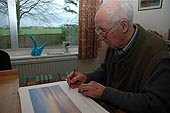
Geoff Perks signing this edition.


Perks, Geoffrey
NO
PHOTO
AVAILABLE

Flight Lieutenant Geoffrey Perks DFC
Joining the RAF in July 1941 he trained as a pilot in the USA and was posted to 420 Sqn as part of no 6 Group (RCAF) initially flying Wellingtons. The unit then converted to Halifaxes and he moved firstly to 427 Squadron and then 434 Sqn still flying this aircraft. In November 1944 he joined OTU as an instructor on Halifaxes, converting to Mosquitoes in January 1945. He then joined 571 Sqn as part of the Light Night Strike Force, flying the B Mk XVI and dropping 4000lb cookie bombs over Germa
Signature Value : £50
CLICK HERE FOR FULL PROFILE

+ Artist : Stephen Brown


Signature(s) value alone : £50
£40 Off!Now : £95.00

Quantity:
Limited edition of 25 artist proofs. Paper size 28 inches x 13.5 inches (71cm x 34cm)

Extras....


Branse Burbridge signing this edition.


Geoff Perks signing this edition.


Burbridge, Branse

Died : 2016
Wing Commander Branse Burbridge DSO* DFC* (deceased)
Posted to 85 Squadron on night-fighters in October 1941, Branse Burbridge flew Havocs on his first tour, scoring just a single claim, but when he returned to 85 Squadron for a second tour - this time on Mosquitos, he was far more successful. His first enemy kill was in Febraury 1944 when he shot down a Messerschmitt 410 fighter plane off the Sussex coast. On the night of March 24, 1944 he became embroiled in a life-or-death dogfight with a Dornier 217 bomber over the Channel. His Mosquito chas
Signature Value : £55
CLICK HERE FOR FULL PROFILE
 
Perks, Geoffrey
NO
PHOTO
AVAILABLE

Flight Lieutenant Geoffrey Perks DFC
Joining the RAF in July 1941 he trained as a pilot in the USA and was posted to 420 Sqn as part of no 6 Group (RCAF) initially flying Wellingtons. The unit then converted to Halifaxes and he moved firstly to 427 Squadron and then 434 Sqn still flying this aircraft. In November 1944 he joined OTU as an instructor on Halifaxes, converting to Mosquitoes in January 1945. He then joined 571 Sqn as part of the Light Night Strike Force, flying the B Mk XVI and dropping 4000lb cookie bombs over Germa
Signature Value : £50
CLICK HERE FOR FULL PROFILE

+ Artist : Stephen Brown


Signature(s) value alone : £105
Add any two items on this offer to your basket, and the lower priced item will be half price in the checkout!£120.00

Quantity:


Some other related items available from this site.

 The de Havilland Mosquito was one of the most outstanding British built aircraft of the Second World War. It was first proposed as a fast, unarmed bomber. However, once in service it proved to be extremely versatile and was produced in great numbers in various variants, fighter, bomber, photo reconnaissance and many more. The Wooden Wonder became a true thoroughbred.

Ready for Action by Philip West.
When De Havilland built the prototype DH.98 Mosquito (E-0234) they did so as an act of the purest faith in their design since the Air Ministry had already dismissed the companys proposal for their all-wood aircraft as impractical and unworkable.  However, when E-0234 first flew on 25th November 1940, it demonstrated remarkably smooth handling characteristics and its speed, as expected, was outstanding.  Here at last was a bomber which, in a straight line, could outfly even the Spitfire, giving rise to such nicknames as Wooden Wonder and, succicntly <i>The</i> Aeroplane.  With such an aircraft, it was soon realised, many new possibilities were laid open to the RAF, among them the chance to initiate precision raids whereupon carefully selected isolated targets could be attacked with pinpoint accuracy.  Just such a raid took place on 18th February 1944, involving 18 Mosquitoes of Nos 64 and 487 Squadrons in an operation on the jail at Amiens, France, where a large number of the French Resistance were being held for questioning by the Gestapo.  It was thought unlikely that any of them would survive their ordeal at the hands of their inquisitors and it was considered more sensible to try to aid their escape by breaching the prison walls, even if it meant that some of the prisoners might be killed in the process.  An accurate model of the jail and the nearby town was constructed and each pilot viewed the model from eye level to familiarise themselves with the view that they would get from a planned height of 50 feet.  With this knowledge and some carefully selected reference points such as church spires and chimneys, the Mosquitoes, led by Group Captain Charles Pickard, were able to brush over the rooftops of the town and deliver their bombs with incredible accuracy, breaching the prison walls in four places.  258 prisoners escaped in the ensuing chaos and were quickly spirited away by other Resistance groups who were waiting outside.  Sadly, a number of French prisoners were killed in the raid and added to the losses of that day was Group Captain Pickard himself who fell victim to marauding Focke Wulf 190s, but the raid had been a tremendous success and further precision attacks using the most superb Mosquito were carried out throughout 1944 and 1945, each one making its own significant contribution to the downward turn in the fortunes of Hitlers Reich.

Breakout. Amiens Raid by Mosquitos by Ivan Berryman.
 On 31st August 1944, 6 Mosquitoes of 305 Polish Squadron, Lasham, 2nd TAF were led by Wing Commander Orlinski to attack oil refineries at Nomexy, south of Nancy, France. Diving down and releasing their bombs before escaping at tree top height they destroyed 4 large containers and several smaller ones. All aircraft safely returned after their four and a half hour sortie. Fl Lt Eric Atkins DFC(bar) KW(bar) and his navigator Fl Lt Majer can be seen exiting the area to reform on the other 3 Mosquitoes who have already finished their bombing run. This was Atkins 61st operation, finishing the war with 78 ops over 3 tours.

Mosquito Attack by Graeme Lothian.
Mosquitos of 105 Squadron, Marham.  No. 105 Squadron, stationed at Marham, Norfolk, became the first Royal Air Force unit to become operational flying the Mosquito B. Mk. IV bomber on 11th April 1942.  The painting shows 105 Squadron on the raid of 10th April 1945, to the Wahren railway marshalling yards at Leipzig, Germany.

Return From Leipzig by Anthony Saunders.
Signatures on these products
*The value given for each signature has been calculated by us based on the historical significance and rarity of the signature and is for the unmatted version where available. Values of many pilot signatures have risen in recent years and will likely continue to rise as they become more and more rare.
NameInfo


Flight Lieutenant Geoffrey Perks DFC
*Signature Value : £50

Editions signed :

Signed limited edition of 100 prints.
Limited edition of 25 artist proofs.


Perks, Geoffrey
(Flight Lieutenant Geoffrey Perks DFC)

Joining the RAF in July 1941 he trained as a pilot in the USA and was posted to 420 Sqn as part of no 6 Group (RCAF) initially flying Wellingtons. The unit then converted to Halifaxes and he moved firstly to 427 Squadron and then 434 Sqn still flying this aircraft. In November 1944 he joined OTU as an instructor on Halifaxes, converting to Mosquitoes in January 1945. He then joined 571 Sqn as part of the Light Night Strike Force, flying the B Mk XVI and dropping 4000lb cookie bombs over Germany. He left the RAF in 1946 but rejoined, finally leaving in 1958


Wing Commander Branse Burbridge DSO* DFC* (deceased)
Died : 2016
*Signature Value : £55

Editions signed :

Limited edition of 25 artist proofs.


Burbridge, Branse
(Wing Commander Branse Burbridge DSO* DFC* (deceased))

Posted to 85 Squadron on night-fighters in October 1941, Branse Burbridge flew Havocs on his first tour, scoring just a single claim, but when he returned to 85 Squadron for a second tour - this time on Mosquitos, he was far more successful. His first enemy kill was in Febraury 1944 when he shot down a Messerschmitt 410 fighter plane off the Sussex coast. On the night of March 24, 1944 he became embroiled in a life-or-death dogfight with a Dornier 217 bomber over the Channel. His Mosquito chased the aircraft from 19,000ft to just 3,000ft before it crashed into the sea, with Wg Cmdr Burbridge pulling up with just 1,000ft to spare. During the period of the build up to the invasion of Normandy, and after, together with his radar navigator, Bill Skelton, They flew 30 sorties over Germany to provide escort cover to RAF bombers. His greatest achievement came on November 4, 1944 during a bombing raid over Bonn. He shot down three Junkers 88 bombers and a Me 110, firing just 200 rounds in the process. In total they claimed 21 victories in a ten month spell. In the days after D-Day, he shot down a Junkers 88 bomber on the France/Belgium border that was piloted by Major Herget, who was credited with 72 aerial victories. In June 1944 he also shot down three V-1s. With his final air victory, in January 1945, he passed the total set by John Cats Eyes Cunningham to become the highest scoring RAF night fighter Ace of the war. Following the war Wg Cmdr Burbridge studied theology at Oxford before becoming a lay preacher for the Scripture Union. He now lives in care in Chorleywood, Herts.
Squadrons Related to This Print
No.105 Sqn
Aircraft Related to This Print
Mosquito

Contact Details
Shipping Info
Terms and Conditions
Cookie Policy
Privacy Policy

Sign Up To Our Newsletter!

Stay up to date with all our latest offers, deals and events as well as new releases and exclusive subscriber content!

This website is owned by Cranston Fine Arts.  Torwood House, Torwoodhill Road, Rhu, Helensburgh, Scotland, G848LE

Contact: Tel: (+44) (0) 1436 820269.  Email: cranstonorders -at- outlook.com

Return to Home Page