Cranston Military Prints .com Home Page
Customer Helpline (UK) : 01436 820269
Subscribe to our Newsletter!

You currently have no items in your basket

Payment Options Display
Buy with confidence and security!
Publishing historical art since 1985


Navigation Menus
Military
Art Index
Aviation
Art Index
Naval
Art Index
Artists
Index
Product Search         
Aviation
History Archive
Naval
History Archive
HALF PRICE AND FREE PRINT SPECIAL OFFERS
ALWAYS GREAT OFFERS :
20% FURTHER PRICE REDUCTIONS ON HUNDREDS OF LIMITED EDITION ART PRINTS
BUY ONE GET ONE HALF PRICE ON THOUSANDS OF PAINTINGS AND PRINTS
FOR MORE OFFERS SIGN UP TO OUR FREE NEWSLETTER
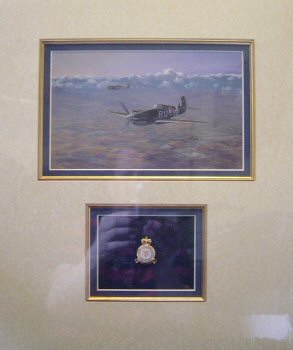
Curtiss Tomahawks by Roy Cross. - Cranston Military Prints

Curtiss Tomahawks by Roy Cross.


Curtiss Tomahawks by Roy Cross.

Curtiss Tomahawks of No.414 Sqn RAF supplied from the United States under the lend-lease program.
Item Code : DHM5021Curtiss Tomahawks by Roy Cross. - Editions AvailableExtra....

The print as supplied in the mount

DESCRIPTIONSIZESIGNATURESOFFERSPRICEPURCHASINGPACKS
Signed limited edition of 95 prints, supplied mounted. Image size 8.5 inches x 5.5 inches (22cm x 14cm) Mount size 13.5 inches x 16 inches (34cm x 41cm)Artist : Roy Cross£50 Off!Now : £120.00

Quantity:


Some other related items available from this site.

 Curtiss had been the primary supplier of fighter aircraft to the U.S. Army Air Corps. since its inception, and the company was dismayed when the Army procured the Boeing P-26 Peashooter in 1932. Curtiss responded by hiring Mr. Donovan Berlin, a bright young engineer who was working for Northrop. Donovan developed the Hawk 75, a streamlined, low-wing, monoplane coastal defense fighter. With an enhanced Twin Wasp engine the Hawk 75 evolved into the P-36, which had a brief and fairly undistinguished career with the Air Corps. In 1938 a P-36 was retrofitted with the Allison in-line 12-cylinder, 1150 HP engine, and the P-40 was born. This was the beginning of what would eventually be a production run of more than 13,000 aircraft. Depending on its theater of operation and the particular model, the P-40 was alternatively known as the Tomahawk, the Kittyhawk, or the Warhawk. By mid-1942 P-40s were serving in every major conflict. The aircraft excelled in ground attack missions, but lacked the speed and maneuverability to challenge the top Japanese or German fighters in dogfights. As a result, P-40 pilots developed strategies which took advantage of the aircrafts structural integrity and excellent flying characteristics, while minimizing the aircrafts limitations. The final production version of the P-40 was the N model, which achieved a top rated speed of 378 MPH by eliminating two machine guns and by reducing fuel tank capacity. The American Volunteer Group was a group of American mercenary pilots which fought for the Chinese early in the War. Organized by Army Capt. C.L. Chennault, the Flying Tigers, as the group was more popularly referred to, consisted of 100 pilots and 100 P-40B aircraft. Three squadrons, the Panda Bears, the Hells Angels, and Adam and Eve, made up the unit. The primary mission of the Flying Tigers was to keep Chinas vital supply link to the outside world, the Burma road, open. Under Chennault the Flying Tigers utilized diving attacks as a means of providing tactical advantage against the lighter, faster, and more maneuverable Japanese aircraft. Prior to the group being disbanded in 1942 the Tigers had chalked up 286 confirmed victories with losses of only 23 aircraft. Pilots received a $500 bonus for every Japanese plane shot down. Depicted in Stan Stokes extraordinary painting is Ken Jernstedt, one of the 39 Flying Tiger aces of the War, with 10.5 confirmed victories. In Stokes scene Jernstedt has just achieved a victory over a Japanese Nakajima Ki-27, referred to as the Nate by the USAAC. The gnat-like Nate was the first monoplane fighter to serve with the JAAF. Although a fragile craft Chenault described the Nate as follows: ....it climbs like a rocket and maneuvers like a squirrel. The Flying Tigers did a lot of squirrel hunting in the few short months of their existence.

Tigers Claws by Stan Stokes.
 Claire Chennaults American Volunteer Group (Flying Tigers) continues to capture the imagination and interest of aviation history buffs more than fifty years after they flew combat missions for the Chinese Air Force. Composed of about ninety pilots and another 200 ground support personnel, the Tigers arrived in China in mid-1941. Flying Curtiss P-40s that had been rerouted from Britain to China, the Tigers flew from December of 1941 until mid-1942. Engaging a numerically superior Japanese force over a very wide front, the AVG was officially credited with downing 299 Japanese aircraft in aerial combat, and an additional 240 aircraft destroyed during ground attack missions. The Flying Tigers slowed the Japanese conquest in China, and caused Japan to focus more resources on this theater of operations than they had planned. Stan Stokes painting depicts a three-plane raid of a Japanese airstrip near Tak, Thailand. Early in the morning of January 3, 1942, three 2 d Pursuit Squadron (Panda Bear) P-40s based at Mingaladon piloted by Tex Hill, Jim Howard, and Scarsdale Jack Newkirk attacked the airfield while the Japanese pilots appeared to celebrating the completion of their dawn attack at an RAF airfield at Moulmein. Circling around the field to get the sun at their backs the P-40s swooped low over the field at 250-MPH. A number of Japanese Army Air Force Nates were on the ground and were taken by surprise. Some ceremony was taking place and there were grandstands with spectators. The guests got quite an air show that morning! The Flying Tiger pilots were focused on the vulnerable targets on the ground, that they didn't initially realize that other Japanese aircraft were in the air, and had not yet landed. The late Jim Howard (who won the only Medal of Honor awarded to an Eighth Air Force fighter pilot later in the War) was focused on the vulnerable aircraft on the ground, and failed to notice a Nate on his tail. Tex Hill broke off a strafing attack to come to Howards aid, and downed the Japanese aircraft. Newark would also claim an aerial victory during the fracas. Near the end of the attack Jim Howards engine died, and he circled for a belly landing on the strip he had just mauled. Seconds before putting his Tomahawk on the ground, the Allison sputtered to life, and the pilot slipped away. When the three Panda Bear pilots returned to Minaladon, they celebrated their victory and relived their attack in words. Jim Howard was reluctant to admit that Tex Hill had shot a Japanese aircraft off of his tail. To solve the argument they went out to the flight line. There were eleven bullet holes in the tail end of Howards aircraft. An inspection also revealed no less than thirty-three bullet holes in the wings of Hills aircraft.

Spoiling the Party by Stan Stokes.
 Claire Chennaults American Volunteer Group (Flying Tigers) continue to capture the imagination and interest of aviation history buffs more than fifty years after they flew combat missions for the Chinese Air Force. Composed of about ninety pilots and another 200 ground support personnel, the Tigers arrived in China in mid-1941. Flying Curtiss P-40s which had been rerouted from Britain to China, the Tigers flew from December of 1941 until mid-1942. Engaging a numerically superior Japanese force over a very wide front, the AVG was officially credited with downing 299 Japanese aircraft in aerial combat, and an additional 240 aircraft destroyed during ground attack missions. The Flying Tigers slowed the Japanese conquest in China, and caused Japan to focus more resources on this theater of operations than they had planned. Charles R. Bond was Vice Squadron Leader for the AVGs 1  Pursuit Squadron, the Adam and Eves. Bond was born in Dallas, Texas in 1915. He joined the Texas National Guard, and was commissioned following aviation cadet training in 1939. Bond joined the AVG in September of 194 1. The bulk of his aerial combat took place over Burma, and he was credited with downing three Japanese aircraft on one mission over Ragoon to become an ace. Charlie rejoined the USAAF in 1942. He earned a degree in Management Engineering from Texas A&M University, and he retired from the USAF in 1968 with the rank of Major General. Carl K. Brown, a 1  Pursuit Squadron Flight Leader, was born in 1917, and joined the USN as an aviation cadet in 1939 after attending Michigan State University. He was assigned to a Torpedo squadron initially based on the USS Saratoga. Brown joined the AVG in mid- 194 1. Brown volunteered to fly night patrols over Toungoo, Burma. Following the disbandment of the AVG in 1942, Carl continued to fly with the CNAC until 1945. Following the War, Brown was involved for a while with the upstart Flying Tigers Airline. He later would attend medical school, graduating from USC in 1952. He had a lengthy career as a doctor specializing in neurology and anaesthetics. Camille Joe Rosbert, a I Pursuit Squadron Flight Leader, was born in Philadelphia in 1917. He graduated summa cum laude from Villanova University, and joined the USN as an aviation cadet. He was awarded his naval aviator wings and his commission at Pensacola in 1940. He became a commander of a PBY, but decided to join the AVG in hopes of becoming a fighter pilot. Rosbert became an ace on June 12, 1942 when he downed a pair of Japanese bombers. Following the War, Rosbert joined eight other AVG pilots in forming the Flying Tiger Airline. Later he joined Claire Chennault with his newly formed Civil Air Transport. Rosbert and his wife spent more than a decade operating a hotel in Spain before returning to the States in 1972. John R. Dick Rossi, a Flight Leader with the I Pursuit Squadron, was born in Placerville, California in 1915. He attended the University of California at Berkley prior to joining the Navy in 1939. He left the Navy in 1941 to join the AVG. He became an ace with the AVG, and remained in China for the balance of the war flying more than 700 missions over the hump. Since the end of the War, s been involved in a number of aviation-related undertakings. He currently serves as President of the Flying Tigers Association.

Flying Tigers and Buffalos by Stan Stokes.
 Part of a small print series of six American WW2 aircraft, signed by some of the great American pilots, some no longer with us. Cranston Fine Arts have purchased the last remaining stocks of this aviation series.

Flying Tiger by Nicolas Trudgian.
Squadrons Related to This Print
No.414 Sqn RCAF
Aircraft Related to This Print
Tomahawk

Contact Details
Shipping Info
Terms and Conditions
Cookie Policy
Privacy Policy

Sign Up To Our Newsletter!

Stay up to date with all our latest offers, deals and events as well as new releases and exclusive subscriber content!

This website is owned by Cranston Fine Arts.  Torwood House, Torwoodhill Road, Rhu, Helensburgh, Scotland, G848LE

Contact: Tel: (+44) (0) 1436 820269.  Email: cranstonorders -at- outlook.com

Return to Home Page