Cranston Military Prints .com Home Page
Customer Helpline (UK) : 01436 820269
Subscribe to our Newsletter!

You currently have no items in your basket

Payment Options Display
Buy with confidence and security!
Publishing historical art since 1985


Navigation Menus
Military
Art Index
Aviation
Art Index
Naval
Art Index
Artists
Index
Product Search         
Aviation
History Archive
Naval
History Archive
HALF PRICE AND FREE PRINT SPECIAL OFFERS
ALWAYS GREAT OFFERS :
20% FURTHER PRICE REDUCTIONS ON HUNDREDS OF LIMITED EDITION ART PRINTS
BUY ONE GET ONE HALF PRICE ON THOUSANDS OF PAINTINGS AND PRINTS
FOR MORE OFFERS SIGN UP TO OUR FREE NEWSLETTER
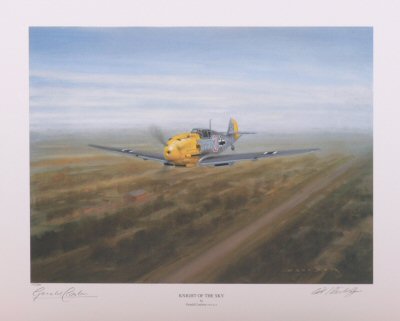
Knight of the Sky by Gerald Coulson. - Cranston Military Prints

Knight of the Sky by Gerald Coulson.


Knight of the Sky by Gerald Coulson.

Item Code : DHM6087Knight of the Sky by Gerald Coulson. - Editions AvailableExtra....

A photograph of an edition of the print :

DESCRIPTIONSIZESIGNATURESOFFERSPRICEPURCHASINGPACKS
Limited edition of 300 prints. Image size 13.5 inches x 10 inches (35cm x 25cm)
Rudorffer, Erich

Died : 2016
Major Erich Rudorffer (deceased)
Erich Rudorffer was born on November 1st 1917 in the town of Zwickau in Saxony. Erich Rudorffer joined the Luftwaffes I./JG2 Richthofen in November 1939, and was soon flying combat patrols in January 1940 and was assigned to I/JG 2 Richthofen with the rank of Oberfeldwebel. He took part in the Battle of France, scoring the first of his many victories over a French Hawk 75 on May 14th, 1940. He went on to score eight additional victories during the Battle of France and the Battle of Britain.
Signature Value : £70
CLICK HERE FOR FULL PROFILE
 
+ Artist : Gerald Coulson


Signature(s) value alone : £70
£15 Off!
Add any two items on this offer to your basket, and the lower priced item will be half price in the checkout!
Now : £85.00

Quantity:


Some other related items available from this site.

 Gunther Rall scored almost all of his huge tally of 275 victories on the eastern front.  Here, his Me109 <i>Black 13</i> is shown over the snowy landscape that JG52 often operated in.

Black 13 - Gunther Rall by Ivan Berryman.
 James Edgar (Johnnie) Johnson was the Royal Air Forces top fighter ace in Europe with 38 confirmed victories during the War. Johnson was called up in 1939 following his training with the RAF Volunteer Reserve. Having been hospitalized for much of the Battle of Britain, Johnsons first serious action was in mid-1941 when he often flew with Douglas Baders section. Johnson was promoted quickly and was awarded the Distinguished Flying Cross following his fifth victory in 1941. In early 1943 Johnson was put in command of a wing of the Royal Canadian Air Force. Flying the high-performance Supermarine Spitfire Mark IX, Johnson achieved 18 victories in seven months of flying. Many of Johnsons victories were achieved against the Messersmitt Bf-109. Promoted to Group Captain in early 1945, Johnson was put in command of the 125 Wing for the duration of the War. The Supermarine Spitfire is the only Allied fighter to have been continuously produced from before 1939 to after 1945. In total more than 22,000 of these splendid aircraft were built. The chief designer of the Spitfire was R.J. Mitchell, a brilliant engineer who joined the Supermarine company in 1916, and by 1920 was its chief engineer. Mitchell fashioned a number of high performance maritime aircraft, culminating with the sleek S series of float planes. This is the float plane which ultimately won permanent possession of the coveted Schneider Trophy for Britain, and established a new world speed record in excess of 400 MPH in 1931. In that same year the Air Ministry issued a specification for a new high-performance day/night fighter. Mitchells design, the Type 224, lost out in the competition to the Gloster Gladiator biplane. In 1936 the new Rolls Royce Merlin engine was fitted to a prototype 224, and the Spitfire was born. Achieving a speed of 396 MPH, the RAF was impressed, and initial orders for the first Spitfires were placed. Sadly, R.J. Mitchell succumbed to cancer in 1937 at the age of only 42. With the onset of the War, Spitfire production soared, and the aircraft was steadily improved. The Mark IX, as depicted in Stan Stokes painting entitled Canadian Heroes, first entered service in July 1942. The Mark IX was identifiable because of its four-bladed prop and its twin radiators. Introduced partially in response to Germanys introduction of the Focke Wolfe FW 190, the Mark IX was produced in greater numbers (5,665) than any other particular Spitfire model. As depicted in Stokes painting Johnnie Johnson has just attained another victory over a Bf-109 while flying with the Royal Canadian Air Force in 1944. The painting is dedicated to the many Canadians which served with the RAF during the War.

Canadian Heroes by Stan Stokes.
Cape Malyj-Korabelnye, Russia, 18th August 1943.  While escorting Fw190s to attack Soviet shipping, ObLt. Schuck's flight of Me109G2s from 8./JG5 attacked the four Soviet Hurricanes of 78 IAP/VVS which were on patrol over the boats.  The Soviet formation leader, Mladshiy Leytenant Valeriy Kiritshenko, ordered his men to form a defensive Lufbery circle but this proved inadequate protection against Schucks determined attack.  Breaking into the Ring he first downed Kitshenko, and then pursued and shot down a second Hurricane.

Breaking the Ring by David Pentland.
 Me109s attack a raiding formation of American B-17 Flying Fortress bombers.  The additional portrait is of German Ace Gunther Rall.

In Defence of the Reich by Jason Askew.
Signatures on these products
*The value given for each signature has been calculated by us based on the historical significance and rarity of the signature and is for the unmatted version where available. Values of many pilot signatures have risen in recent years and will likely continue to rise as they become more and more rare.
NameInfo


Major Erich Rudorffer (deceased)
Died : 2016
*Signature Value : £70

Editions signed :

Limited edition of 300 prints.


Rudorffer, Erich
(Major Erich Rudorffer (deceased))

Erich Rudorffer was born on November 1st 1917 in the town of Zwickau in Saxony. Erich Rudorffer joined the Luftwaffes I./JG2 Richthofen in November 1939, and was soon flying combat patrols in January 1940 and was assigned to I/JG 2 Richthofen with the rank of Oberfeldwebel. He took part in the Battle of France, scoring the first of his many victories over a French Hawk 75 on May 14th, 1940. He went on to score eight additional victories during the Battle of France and the Battle of Britain. Rudorffer recalled an incident in August 1940 when he escorted a badly damaged Hurricane across the Channel - ditching in the English Channel was greatly feared by pilots on both sides. As fate often does, Rudorffer found the roles reversed two weeks later, when he was escorted by an RAF fighter after receiving battle damage. By May 1st 1941 Rudorffer had achieved 19 victories, which led to the award of the Knights Cross. In June 1941 Rodorffer became an Adjutant of II./JG2. In 1942 Rudorffer participated in Operation Cerberus (known as the Channel Dash) and flew over the Allied landings at Dieppe. Erich Rudorffer along with JG2 was transferred to North Africa in December 1942. It was in North Africa that Rudorffer showed his propensity for multiple-victory sorties. He shot down eight British aircraft in 32 minutes on February 9th 1943 and seven more in 20 minutes six days later. After scoring a total of 26 victories in Tunisia, Rudorffer returned to France in April 1943 and was posted to command II./JG54 in Russia, after Hauptmann Heinrich Jung, its Kommodore, failed to return from a mission on July 30th 1943. On August 24th 1943 he shot down 5 Russian aircraft on the first mission of the day and followed that up with three more victories on the second mission. He scored seven victories in seven minutes on October 11th but his finest achievement occurred on November 6th when in the course of 17 minutes, he shot down thirteen Russian aircraft. Rudorffer became known to Russian pilots as the fighter of Libau. On October 28th 1944 while about to land, Rudorffer spotted a large formation of Il-2 Sturmoviks. He quickly aborted the landing and moved to engage the Russian aircraft. In under ten minutes, nine of the of the II-2 Sturmoviks were shot down causing the rest to disperse. Rudorffer would later that day go on and shoot down a further two Russian aircraft. These victories took his total to 113 and he was awarded the Oak Leaves on April 11th 1944. Rudorffer would on the 26th January 1945 on his 210th victory receive the addition of the Swords. In February 1945 Rudorffer took command of I./JG7 flying the Me262. He was one of the first jet fighter aces of the war, scoring 12 victories in the Me262. He shot down ten 4-engine bombers during the 'Defense of the Reich missions'. He was the master of multiple scoring - achieving more multiple victories than any other pilot. Erich Rudorffer never took leave, was shot down 16 times having to bail out 9 times, and ended the war with 222 victories from over 1000 missions. He was awarded the Knights Cross, with Oak Leaves and Swords. Erich Rudorffer died on 8th April 2016.
Aircraft Related to This Print
Me109

Contact Details
Shipping Info
Terms and Conditions
Cookie Policy
Privacy Policy

Sign Up To Our Newsletter!

Stay up to date with all our latest offers, deals and events as well as new releases and exclusive subscriber content!

This website is owned by Cranston Fine Arts.  Torwood House, Torwoodhill Road, Rhu, Helensburgh, Scotland, G848LE

Contact: Tel: (+44) (0) 1436 820269.  Email: cranstonorders -at- outlook.com

Return to Home Page