Cranston Military Prints .com Home Page
Customer Helpline (UK) : 01436 820269
Subscribe to our Newsletter!

You currently have no items in your basket

Payment Options Display
Buy with confidence and security!
Publishing historical art since 1985


Navigation Menus
Military
Art Index
Aviation
Art Index
Naval
Art Index
Artists
Index
Product Search         
Aviation
History Archive
Naval
History Archive
HALF PRICE AND FREE PRINT SPECIAL OFFERS
ALWAYS GREAT OFFERS :
20% FURTHER PRICE REDUCTIONS ON HUNDREDS OF LIMITED EDITION ART PRINTS
BUY ONE GET ONE HALF PRICE ON THOUSANDS OF PAINTINGS AND PRINTS
FOR MORE OFFERS SIGN UP TO OUR FREE NEWSLETTER
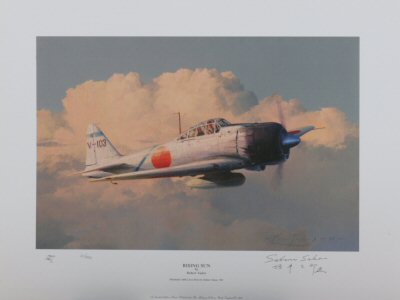
Rising Sun by Robert Taylor. - Cranston Military Prints

Rising Sun by Robert Taylor.


Rising Sun by Robert Taylor.

Rising Sun is normally a companion print to The Legend of Colin Kelly.

Item Code : DHM6434Rising Sun by Robert Taylor. - Editions AvailableExtra....


A photograph of the print.

DESCRIPTIONSIZESIGNATURESOFFERSPRICEPURCHASINGPACKS
Artist proof edition of 75 prints. (LAST 2 AVAILABLE) Size 16 inches x 11 inches (41cm x 28cm)
Sakai, Saburo

Died : 2000
Saburo Sakai (deceased)
This legendary Zero pilot graduated into the Japanese air force in 1937 and he scored his first victory in the China War. On December 8, 1941, Sakai participated in the raid on Clark Field and, on December 10, led the attack on Kellys B-17. He fought in New Guinea against the 8th Fighter Group, B-26s of the 22nd Bomb Group, and 75 Sqn RAAF. Badly wounded in August 1942 over Guadalcanal he was hospitalized and lost the sight of his right eye. He was pressed back into service and claimed 5 Hellcat
Signature Value : £70
CLICK HERE FOR FULL PROFILE
 
+ Artist : Robert Taylor


Signature(s) value alone : £70
£110.00

Quantity:


Some other related items available from this site.

 Colin P. Kelly, Americas first hero of WW II, was born in Florida in 1915. He was accepted to the U.S. Military Academy at West Point, and following graduation Kelly married the former Marian Wick. Kelly received his primary flight instruction at Randolph Field in San Antonio, and after earning his wings he moved across town to Kelly Field for advanced pilot training. Unlike many would-be fighter pilots, Kelly was not disappointed with being assigned as a bomber pilot. Kelly received a letter of commendation from The Secretary of War when he crash landed a Northrop A-17A he was ferrying to Mitchel field in a vacant street in Brooklyn. In September of 1940 Kelly was promoted to Captain, and was assigned to the 42nd Bomb Squadron as commander of a B-17. Kelly trained in Hawaii, and was later made Operations Officer for the 14th Bomb Squadron. In September of 1941 Kelly and his crew flew from Hawaii to Clark Field in the Philippines. The B-17s were an important addition to the woefully inadequate and obsolete air forces which America had in the Philippines. The Japanese Imperial forces attacked the Philippines only hours following the attack on Pearl Harbor. Mitsubishi Zero fighters, flying to maximize their range, were able to accompany Japanese bombers from bases in Formosa. The initial attack on Clark Field damaged or destroyed many American aircraft. Kellys squadron had been moved south to another field and had escaped damage. On December 10, Kellys squadron was ordered to fly north to Clark Field where they would refuel and arm their aircraft for attacks on the Japanese invasion fleet. Kellys regular B-17D was out of service, so his crew was assigned a B-17C. At Clark Field three 600-pound armor piercing bombs were loaded on Kellys B-17 when an air raid hastened their departure. Kelly flew northward to the northern most tip of the island of Luzon. Kelly spotted a number of Japanese ships which were supporting an amphibious landing. The young Captain dropped his three bombs hoping to destroy the largest of the Japanese ships. One bomb struck the vessel, igniting a tremendous blaze. On returning to Clark Field, the B-17 was attacked by a number of Japanese fighters, including a Zero flown by Saburo Sakai. Sakai would become the highest scoring Japanese ace to survive the War with 64 victories. Amazed by the speed of the Flying Fortress, the Zeros needed full throttle to make passes at the B-17.  Kellys B-17 was eventually hit and set afire. Captain Kelly ordered his crew to abandon ship. Kelly remained with the aircraft, and he did not survive the crash landing. With America desperate for any good news on the war front, and with Army brass in the Philippines anxious to claim some positive results, Colin Kellys exploits became exaggerated in many news accounts. By the time the story was publicized stateside, many believed he had dived his B-17 down the funnel of a Japanese battleship. While Kelly was indeed an American hero,  the unfortunate gross exaggeration of his exploits, should not tarnish the fact that Kelly, like many that would follow him in the years ahead, had made the ultimate sacrifice for his country in the line of duty.

Birth of a Legend by Stan Stokes.
 As dawn breaks across South Pacific skies, a group of Mitsubishi A6M5 Zeros of the 201st Air Group head outbound from their base at Rabaul on a raiding sortie in November 1944.

Zero Hour by Ivan Berryman.
 Nicolas Trudgians action packed painting shows an attack on Rabaul during the fall of 1943. B-24 Liberators of the Army Air Force pound the harbor and docks below whilst the Marines Corps pilots of VMF 214 - the famous Black Sheep Squadron - provide top cover in their F4U Corsairs. A fierce dog-fight has developed between the F4U pilots and Japanese Zeros. One Zero, already smoking, begins to roll out of control, while the two F4U pilots turn their attentions on to a second. Below further dog-fights are in progress, the air filled with aerial combat.

Gunfight Over Rabaul by Nicolas Trudgian.
 As dawn breaks across South Pacific skies, a group of Mitsubishi A6M5 Zeros of the 201st Air Group head outbound from their base at Rabaul on a raiding sortie in November 1944.

Zero Hour by Ivan Berryman.
Signatures on these products
*The value given for each signature has been calculated by us based on the historical significance and rarity of the signature and is for the unmatted version where available. Values of many pilot signatures have risen in recent years and will likely continue to rise as they become more and more rare.
NameInfo


Saburo Sakai (deceased)
Died : 2000
*Signature Value : £70

Editions signed :

Artist proof edition of 75 prints. (LAST 2 AVAILABLE)


Sakai, Saburo
(Saburo Sakai (deceased))

This legendary Zero pilot graduated into the Japanese air force in 1937 and he scored his first victory in the China War. On December 8, 1941, Sakai participated in the raid on Clark Field and, on December 10, led the attack on Kellys B-17. He fought in New Guinea against the 8th Fighter Group, B-26s of the 22nd Bomb Group, and 75 Sqn RAAF. Badly wounded in August 1942 over Guadalcanal he was hospitalized and lost the sight of his right eye. He was pressed back into service and claimed 5 Hellcats in the final days. In over 200 combats, Sakai never lost a wingman and destroyed 64 enemy aircraft. Saburo Sakai is the Highest-scoring Japanese ace to survive the War. Sakal flew with the Imperial Navy as a noncommissioned officer in China where he attained two victories. While stationed at Tainan on Formosa, Sakais unit was involved in the attacks on American airfields in the Philippines shortly after the attack on Pearl Harbor. Japanese pilots had developed fuel-saving, low-speed, tactics with their Mitsubishi Zero fighters, which allowed them to make the 1200-mile round-trip flight to the Philippines, while accompanying Japanese bombers. The appearance of Japanese aircraft from bases which were thought to be out of range came as an unpleasant surprise to American forces. During this mission S akal bagged a p-40 over Clark field. During the days that would follow, Sakai's squadron would repeatedly make the long flight to the Philippines to support the advancing Japanese invasion force that was disembarking. On December 10, 1941 while patrolling at 18,000 feet, Sakal saw several bombs explode near Japanese convoy ships. Noticing a lone B-17 Flying Fortress, Sakal and nine other Zeros made for the American Bomber at full throttle. Overtaking the bomber, believed to be the one piloted by Colin Kelly, Sakal and the other Japanese fighters poured fire into the aircraft from behind. Finally, the overmatched bomber began to go down. Eight of its crew bailed out before the aircraft crashed short of Clark Field. Sakal would later have another encounter with b- 1 7s over Borneo. However, these would be later model aircraft fitted with a rear gunner's turret, and would prove to be much more difficult to bring down. In early 1942 Sakai's unit was shifted to supporting the Japanese invasion of Java. Encountering outclassed Brewster Buffaloes, P-36s, P-40s, and some Hurricanes, the Japanese fighter forces wreaked havoc in the skies. Sakai's victory tally rose to thirteen. A few months later Sakal was involved in fighting around Rabaul. This was the first time the Japanese would meet stiff resistance. In many months of fighting the Japanese forces sustained meaningful casualties. On July 22, 1942 Sakal chased a Lockheed Hudson, whose pilot put on a daring series of aerial maneuvers, before finally being downed by the Japanese ace, for his 4C Victory. In late July the morale of the Japanese fighter forces suffered a serious setback with the realization that American carrierbased aircraft were now involved in the battles in New Guinea. The Japanese forces had in fact not obtained the decisive victory that they had been told was achieved at the Battle of Midway. With the American attack on Guadalcanal, Sakai's unit was refocused on flying 11 00-mile escort missions for Japanese Bombers attacking American forces at Guadalcanal. On one of these missions Sakai mistakenly attacked a formations of Avengers. Hit by fire from the rear gunners of the torpedo bombers, Sakal was badly injured, losing sight in one eye. He successfully nursed his aircraft back to Rabaul. After recovering from his injuries, Sakai would be involved as a flight instructor and test pilot until the Japanese surrender. Saburo Sakai passed away 22nd September 2000.
Aircraft Related to This Print
Zero

Contact Details
Shipping Info
Terms and Conditions
Cookie Policy
Privacy Policy

Sign Up To Our Newsletter!

Stay up to date with all our latest offers, deals and events as well as new releases and exclusive subscriber content!

This website is owned by Cranston Fine Arts.  Torwood House, Torwoodhill Road, Rhu, Helensburgh, Scotland, G848LE

Contact: Tel: (+44) (0) 1436 820269.  Email: cranstonorders -at- outlook.com

Return to Home Page