Cranston Military Prints .com Home Page
Customer Helpline (UK) : 01436 820269
Subscribe to our Newsletter!

You currently have no items in your basket

Payment Options Display
Buy with confidence and security!
Publishing historical art since 1985


Navigation Menus
Military
Art Index
Aviation
Art Index
Naval
Art Index
Artists
Index
Product Search         
Aviation
History Archive
Naval
History Archive
HALF PRICE AND FREE PRINT SPECIAL OFFERS
ALWAYS GREAT OFFERS :
20% FURTHER PRICE REDUCTIONS ON HUNDREDS OF LIMITED EDITION ART PRINTS
BUY ONE GET ONE HALF PRICE ON THOUSANDS OF PAINTINGS AND PRINTS
FOR MORE OFFERS SIGN UP TO OUR FREE NEWSLETTER
Blackburn Iris by Michael Turner. - Cranston Military Prints

Blackburn Iris by Michael Turner.


Blackburn Iris by Michael Turner.

A 209 Squadron Blackburn Iris taxiing out from Calshot in 1931.
Item Code : GT0101Blackburn Iris by Michael Turner. - Editions Available
DESCRIPTIONSIZESIGNATURESOFFERSPRICEPURCHASINGPACKS
Open edition print. Paper size 21 inches x 17 inches (53cm x 43cm)none£24.00

Quantity:


Some other related items available from this site.

 In early May 1941, in conditions of strict secrecy because the United States was not yet at war, seventeen pilots of the US Navy had arrived in Britain and been attached to Catalina squadrons of Coastal Command.  These experienced PBY pilots were there to assist the Royal Air Force to become familiar with the Catalina, and also to gain operational experience for the US Navy.  On 26th May 1941 Catalina Z of No.209 Sqn, commanded by Flying Officer Dennis Briggs RAF, with Ensign Leonard B Smith USN as co-pilot, joined the search for the Bismarck.  At 1015 the aircraft was being flown in poor visibility at an altitude of 500ft when Ensign Smith sighted the Bismarck at a range of eight miles.  The Catalina was flown towards the contact so that a positive identification could be made and emerged from the cloud only 500 yards from the German ship.  The aircraft met a hail of anti-aircraft fire but was able to make its escape.  As a result of the sighting report from Catalina Z the Bismarck was again engaged by ships and aircraft of the Royal Navy and was sunk at 1040 on 27th May 1941.  Leonard Smith can be considered therefore, the first American to be directly involved in action in World War Two.  He was awarded the Distinguished Flying Cross (American) for his actions.

The Aircraft That Found the Bismarck by Ivan Berryman.
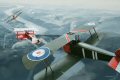
 Mystery still surrounds just why Manfred von Richthofen risked so much in chasing the novice pilot Wilfred Wop May into Allied-occupied territory on the morning of Sunday, 21st April 1918, but it was to be his last flight, this error of judgement costing him his life. Von Richthofen had broken from the main fight involving Sopwith Camels of 209 Sqn to chase Mays aircraft, but found himself under attack from the Camel of Captain Roy Brown. All three aircraft turned and weaved low along the Somme River, the all red Triplane coming under intense fire from the ground as well as from Browns aircraft. No one knows exactly who fired the crucial bullet, but Manfred von Richthofens aircraft was seen to dive suddenly and impact with the ground. The Red Baron was dead and his amazing run of 80 victories was over. The painting shows Mays aircraft (D3326) in the extreme distance, pursued by DR.1 (425/17) and Browns Camel (B7270) in the foreground.

Captain Roy Brown engages the Red Baron, 21st April 1918 by Ivan Berryman.
 In early May 1941, in conditions of strict secrecy because the United States was not yet at war, seventeen pilots of the US Navy had arrived in Britain and been attached to Catalina squadrons of Coastal Command.  These experienced PBY pilots were there to assist the Royal Air Force to become familiar with the Catalina, and also to gain operational experience for the US Navy.  On 26th May 1941 Catalina Z of No.209 Sqn, commanded by Flying Officer Dennis Briggs RAF, with Ensign Leonard B Smith USN as co-pilot, joined the search for the Bismarck.  At 1015 the aircraft was being flown in poor visibility at an altitude of 500ft when Ensign Smith sighted the Bismarck at a range of eight miles.  The Catalina was flown towards the contact so that a positive identification could be made and emerged from the cloud only 500 yards from the German ship.  The aircraft met a hail of anti-aircraft fire but was able to make its escape.  As a result of the sighting report from Catalina Z the Bismarck was again engaged by ships and aircraft of the Royal Navy and was sunk at 1040 on 27th May 1941.  Leonard Smith can be considered therefore, the first American to be directly involved in action in World War Two.  He was awarded the Distinguished Flying Cross (American) for his actions.

The Aircraft That Found the Bismarck by Ivan Berryman.
 Mystery still surrounds just why Manfred von Richthofen risked so much in chasing the novice pilot Wilfred Wop May into Allied-occupied territory on the morning of Sunday, 21st April 1918, but it was to be his last flight, this error of judgement costing him his life. Von Richthofen had broken from the main fight involving Sopwith Camels of 209 Sqn to chase Mays aircraft, but found himself under attack from the Camel of Captain Roy Brown. All three aircraft turned and weaved low along the Somme River, the all red Triplane coming under intense fire from the ground as well as from Browns aircraft. No one knows exactly who fired the crucial bullet, but Manfred von Richthofens aircraft was seen to dive suddenly and impact with the ground. The Red Baron was dead and his amazing run of 80 victories was over. The painting shows Mays aircraft (D3326) in the extreme distance, pursued by DR.1 (425/17) and Browns Camel (B7270) in the foreground.

Captain Roy Brown engages the Red Baron, 21st April 1918 by Ivan Berryman.
Squadrons Related to This Print
No.209 Sqn
Aircraft Related to This Print
Iris

Contact Details
Shipping Info
Terms and Conditions
Cookie Policy
Privacy Policy

Sign Up To Our Newsletter!

Stay up to date with all our latest offers, deals and events as well as new releases and exclusive subscriber content!

This website is owned by Cranston Fine Arts.  Torwood House, Torwoodhill Road, Rhu, Helensburgh, Scotland, G848LE

Contact: Tel: (+44) (0) 1436 820269.  Email: cranstonorders -at- outlook.com

Return to Home Page