|
|
|
|
||
|
|
|
|
||
| Navigation Menus |
|
Military Art Index |
Aviation Art Index |
Naval Art Index |
Artists Index |
Aviation History Archive |
Naval History Archive |
|
| HALF PRICE AND FREE PRINT SPECIAL OFFERS | ||||||
|
| |||||||||||||||||||||||||||||||||||||||||||
Some other related items available from this site. | ||||
  Tribute to the Crews of the Stirling by Graeme Lothian |   Stirling Work by Ivan Berryman. |   Clipped Signature - Geoffrey Tyson. |  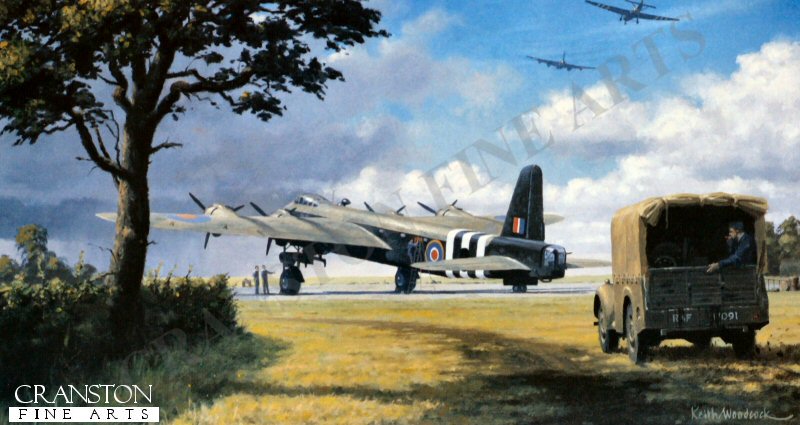 Stirlings by Keith Woodcock. | |
| Signatures on these products | |
| *The value given for each signature has been calculated by us based on the historical significance and rarity of the signature and is for the unmatted version where available. Values of many pilot signatures have risen in recent years and will likely continue to rise as they become more and more rare. | |
| Name | Info |
  Group Captain Graham Baptie Blacklock OBE DFC (deceased) Died : 2011 *Signature Value : £40 Editions signed : Blacklock signature edition of 260 prints. | Blacklock, Graham Baptie (Group Captain Graham Baptie Blacklock OBE DFC (deceased)) On completion of a tour of operations on the Wellington in July 1940, Blacklock joined three other pilots at Boscombe Down to form the Stirling Development Flight. Once they had become used to flying the ungainly aircraft, the small team left for an airfield in Yorkshire as the nucleus of No 7 Squadron, as it was re-equipping with the Stirling. On February 10 1941 three of the bombers took off to attack oil storage tanks at Rotterdam, the RAF's first bombing operation in the Second World War by a four-engine bomber. Blacklock flew as a second pilot, but all his subsequent operations were as a captain. He bombed Berlin on the night of April 9th, but most of No 7 Squadron's operations during this period were in daylight, sometimes with a fighter escort but on other occasions relying on cloud cover to mask their outbound route. On June 28th three Stirlings took off for a daylight attack on Bremen. One soon turned back, but Blacklock and his flight commander pressed on despite the lack of cloud. As they approached the target, they were attacked by nine enemy fighters. Blacklock skilfully manoeuvred his aircraft to allow his gunners to engage the enemy; at least one was shot down, and probably a second. On the return flight, he realised that the second Stirling had been severely damaged and he turned back to escort it. Eventually the crippled aircraft was forced to ditch near the Frisian Islands, and, despite the threat of more enemy fighters appearing on the scene, Blacklock orbited the spot for 10 minutes looking for survivors. The Stirling had, however, disappeared along with its crew. Blacklock was awarded an immediate DFC. On July 23rd there was a report that the battlecruiser Scharnhorst had left Brest for La Pallice, and three Stirlings – flown by the three original pilots to join No 7 Squadron – were sent to attack with armour-piercing bombs. They encountered heavy flak and were attacked by fighters, forcing an escape at very low level. This was the last daylight raid by the Stirlings, and Blacklock completed his tour of operations at night attacking industrial centres in the Ruhr. On August 28th, after his last operation to Duisburg, he was rested, having completed two full tours. Graham Baptie Blacklock, always known as Gerry, was born on June 23rd 1914 near Skipton, Yorkshire, and educated at Queen Mary's Royal Grammar School, Clitheroe. In 1931 he joined the RAF as an aircraft apprentice and trained as a metal rigger. After service in England and at the RAF's aircraft depot at Aboukir, near Alexandria, he volunteered for pilot training during the rapid expansion of the Service prior to the Second World War. He was posted to No 99 Squadron to fly the Heyford, a biplane bomber he described as 'a mechanical praying mantis'. In 1938 it was replaced by the Wellington, and on the outbreak of war the squadron moved to the Rowley Mile on Newmarket racecourse. Operations during the Phoney War were limited, but an attack on December 14th 1939 met with disaster when six of the 12 Wellingtons were shot down. Blacklock, however, returned safely. He continued to fly North Sea sweeps and also dropped leaflets on German cities. After the German invasion of Norway he attacked Stavanger airfield, and on May 10th bombed the recently captured airfield at Rotterdam. On May 23rd his squadron was diverted to support the retreating British Expeditionary Force, before attacks were resumed against oil targets in Germany. At the end of his tour he was awarded a DFM. After completing his time on the Stirling, Blacklock, as an ex-aircraft apprentice, was well-qualified to establish the formal training of a new aircrew category, the flight engineer. For the remainder of the war he filled numerous technical training appointments. After the war he was an instructor on bombers before being appointed to the Far East to survey potential staging posts on the Indian Ocean islands of Gan, Diego Garcia and Christmas Island. At the works and finance branch of the Air Ministry in 1956, he helped to relocate RAF forces from Egypt to Cyprus. In October 1958 he conducted a survey of Ascension Island. On promotion to group captain, Blacklock commanded the RAF airfield at Hullavington, where the RAF's air electronic officers were trained. He took retirement in 1961. In addition to his gallantry awards, Blacklock was appointed OBE in 1953. Group Captain Blacklock died on 28th April 2011. |
| Aircraft Related to This Print |
| Stirling |
|
Contact Details |
Sign Up To Our Newsletter!
This website is owned by Cranston Fine Arts. Torwood House, Torwoodhill Road, Rhu, Helensburgh, Scotland, G848LE Contact: Tel: (+44) (0) 1436 820269. Email: cranstonorders -at- outlook.com |



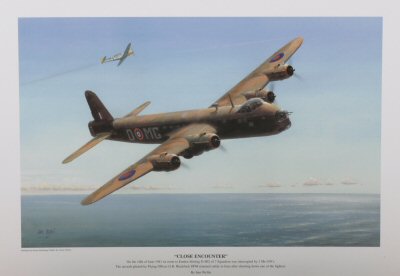


 Signature(s) value alone : £40