|
|
|
|
||
|
|
|
|
||
| Navigation Menus |
|
Military Art Index |
Aviation Art Index |
Naval Art Index |
Artists Index |
Aviation History Archive |
Naval History Archive |
|
| HALF PRICE AND FREE PRINT SPECIAL OFFERS | ||||||
|
| ||||||||||||||||||||||||||||||||||||||||||||
Some other related items available from this site. | ||||
  Fields of Glory by Richard Taylor. |   The Battle for Britain by Robert Taylor |   Battle of Britain by Graeme Lothian. |   Clipped Signature - Jim Goodson. | |
| Signatures on these products | |
| *The value given for each signature has been calculated by us based on the historical significance and rarity of the signature and is for the unmatted version where available. Values of many pilot signatures have risen in recent years and will likely continue to rise as they become more and more rare. | |
| Name | Info |
  Air Vice Marshal Johnnie Johnson CB, CBE, DSO**, DFC* (deceased) Died : 2001 *Signature Value : £70 Editions signed : Signed limited edition of 850 prints. | Johnson, Johnnie (Air Vice Marshal Johnnie Johnson CB, CBE, DSO**, DFC* (deceased)) James Edgar Johnson was born in Barrow on Soar near Loughborough on 9th March 1915. He lived in Melton, the first house on the left of Welby Lane as you leave Nottingham Road, with his parents - his father being a local Police Inspector. Johnnie qualified as a Civil Engineer at Nottingham University in 1937. He joined the RAFVR and did his flying training at 21 E&RFTS, Stapleford before enlisting for full-time service in the RAF at the beginning of WWII. He first went to ITW at Jesus College, Cambridge, completed his ab initio flying at 22 EFTS, Cambridge and his intermediate and advanced flying at 5 FTS, Sealand. Johnnie Johnson joined 92 Spitfire squadron in August 1940, but it was with 616 squadron that he scored his first victory on June 26th 1941 while flying with Douglas Baders Tangmere Wing. He was squadron leader of 610 squadron in July 1942, but it was as Wing Commander of the Kenley Wing in 1943 that his scores really started to mount. He was W/C of 144 wing during D-Day and led 127 and 125 wings until the end of the war when we has the topscoring allied fighter pilot with 38 air victories. Inspired by the great British WW 1 aces like Bishop and Ball, Johnnie Johnson dreamed often as a child of becoming an R.A.F. pilot. The young Johnson enthusiastically joined the Volunteer Reserve at the first opportunity. After completing his initial flight training Johnson was posted to 616 Squadron at Kenley. However, this Squadron had been hit hard with the loss of six pilots and five wounded, and the unit was withdrawn to Coltishall prior to Johnson encountering combat. With only 12 hours of flight time in a Spitfire this was no doubt advantageous. In February 1941 Billy Burton moved the Squadron to Tangmere. Douglas Bader then arrived to take over the Tangmere Wing, and fly with the 616 Squadron. Johnnie, Alan Smith and Cocky Dundas were chosen to fly with Bader. During the summer of 1940 the Battle of Britain was at its peak. Bader took the time to instruct Johnson carefully in both the art of flying and the skills necessary to attain success in aerial combat. Baders idea of an afternoon off duty, according to Johnson, was to take his section over the Channel in hopes of running into Adolph Galland and his Abbeyville Boys. On August 19, 1941 Bader failed to return from a mission when 616 Squadron was hit hard by a group of Messerschmitt 109s. Johnson flew on in Baders absence, and in the summer of 1942 he was promoted to command of the 610 Squadron. In 1943 he was promoted again to Wing Commander of the Canadian Spitfire Wing in Kenley. By that time Johnson had attained eight confirmed victories. During the spring and summer of 1943 Johnnie led the Canadian unit on more than 140 missions over Northwest Europe. Johnsons squadron attained more than 100 victories during this period, and Johnnies own personal score rose to 25. After a short leave, Johnson was posted to lead the 144 Canadian Spitfire Wing. On D-Day Johnson led his Wing on four missions in support of the Allied invasion. On June 8, Johnsons Wing was the first Spitfire group to land in newly liberated France. Johnson continued fighting in France through September 1944 when he achieved his 38th and final victory. Patrolling the Rhine Johnsons unit jumped nine 109s which were flying beneath them in the opposite direction. Five of the 109s were downed. Early in 1945 Johnson was promoted to Group Captain and put in command of the 125 Wing, which was equipped with the Spitfire XIV. Flying from former Luftwaffe airfields the 125 Wing assisted in the final Allied push to Berlin. Johnson attributed much of his aerial combat success to his ability to make tight turning maneuvers. Johnsons tightest call came on August 19, 1942 when he was unable to dislodge an Me-109 from his tail during the raid on Diepppe. Johnson raced his Spitfire flat out at a group of Royal Navy ships. The usual barrage of flak and tracer fire came right at him, and fortunately for the ace, missed his Spitfire but effectively eliminated the brave pilot on his tail. During the Korean War Johnson flew fighter-bombers with the USAF. Following his retirement from the R.A.F. in 1966 Johnson founded the Johnnie Johnson Housing Trust that has provided homes for more than 4000 disabled and elderly persons, and his sixth book Winged Victory was published in 1995. Johnson flew many of the Spitfire models. His favorite was the beautiful Mark IX, the best of them all. Johnnie passed away in 2001 at the age of 85, in Derbyshire, England. |
 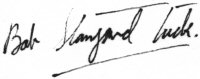 Wing Commander Bob Stanford Tuck DSO DFC** (deceased) Died : 1987 *Signature Value : £85 Editions signed : Signed limited edition of 850 prints. | Stanford-Tuck, Bob (Wing Commander Bob Stanford Tuck DSO DFC** (deceased)) Bob Stanford Tuck was a flamboyant fighter pilot, his dashing good looks, courage, and success in the air coming to epitomise the young flyers who fought and won the Battle of Britain. To the British public he was a hero in the mould of the knights of old, and today his name is legend. In the early stages of the Battle of Britain Bob fought with 92 Squadron flying Spitfires, quickly becoming one of the leading aces. Promoted to command 257 Squadron, now flying Hurricanes, Bobs dashing style of leadership inspired his pilots to great success. He went on to command the Duxford and Biggin Hill Wings, taking his personal score to 29 air victories before being shot down by ground fire over Northern France in 1942. He died on 5th May 1987. |
| Aircraft Related to This Print |
| Spitfire |
|
Contact Details |
Sign Up To Our Newsletter!
This website is owned by Cranston Fine Arts. Torwood House, Torwoodhill Road, Rhu, Helensburgh, Scotland, G848LE Contact: Tel: (+44) (0) 1436 820269. Email: cranstonorders -at- outlook.com |


 Signature(s) value alone : £155