Cranston Military Prints .com Home Page
Customer Helpline (UK) : 01436 820269
Subscribe to our Newsletter!

You currently have no items in your basket

Payment Options Display
Buy with confidence and security!
Publishing historical art since 1985


Navigation Menus
Military
Art Index
Aviation
Art Index
Naval
Art Index
Artists
Index
Product Search         
Aviation
History Archive
Naval
History Archive
HALF PRICE AND FREE PRINT SPECIAL OFFERS
ALWAYS GREAT OFFERS :
20% FURTHER PRICE REDUCTIONS ON HUNDREDS OF LIMITED EDITION ART PRINTS
BUY ONE GET ONE HALF PRICE ON THOUSANDS OF PAINTINGS AND PRINTS
FOR MORE OFFERS SIGN UP TO OUR FREE NEWSLETTER
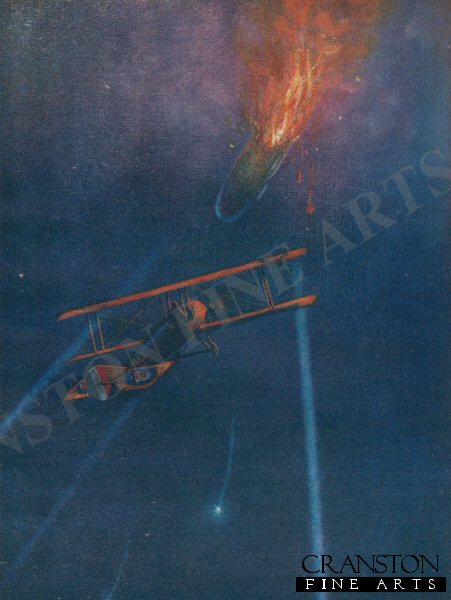
Moonlight Renegade by Stan Stokes. - Cranston Military Prints

Moonlight Renegade by Stan Stokes.


Moonlight Renegade by Stan Stokes.

On July 2, 1900 Count Ferdinand von Zeppelin piloted his first rigid-framed, lighter-than-air ship over Lake Constance in Germany. Seventeen years later, on June 16, 1917, Zepellins latest creation, the L-48, was readied at Nordholz, Germany for its first combat mission. The huge L-48 was one of the newest and most technically advanced German airships. Powered by five 250 HP Maybach engines, the great airship could carry 6,000 pounds in bombs, and was manned by a crew of nineteen. For this maiden mission the commodore of the North Sea Airship Division, Victor Schutze, would be joining the L-48s skipper Kapitain-lieutenant Franz George Eichler. Early in the afternoon the L-48 commenced its mission along with several other airships from the Nordholz base. The great Zeppelin would cruise at 60 MPH at 5,000 to 10,000 feet and would ascend to approximately 20,000 feet when approaching its target. This altitude would provide an effective defense against both anti-aircraft or British fighters. RAF Captain Robert Saundby, had returned from the front, to be put in charge of a very small RFC squadron at Oxford Ness. June 16 was a cloudless night, perfect for a Zeppelin attack., and at 11:15 PM Saundby launched his two active aircraft equipped with incendiary machine gun bullets. As he gazed up at the stars at 1:00 AM Saundby was startled to see a huge zeppelin outlined by searchlights only a few miles away. Awakening two of his mechanics, Saundby instructed them to fire up his single-seat DH2 fighter. Although obsolete and not equipped for night fighting, Saundby, who had never flown at night, got the little pusher-propeller fighter in the air, and began a long ascent. After fifteen minutes of flying Saundby spotted the L-48, which was by now attracting anti-aircraft fire which was exploding several thousand feet below the great airships altitude. For an hour or so, Saundby tried to coax every bit of altitude out of his little DH2, but he could not get in range. At around 3:00AM the L-48 completed its bombing runs, and the Captain set a due north course. With dawn only an hour away, Captain Eichler was anxious to get out of British airspace. A report from an observation airship which had accompanied the strike force that evening indicated favorable winds at 13,000 feet. Captain Eichler gave the orders to descend. Meanwhile, Captain Saundby who had fought the cold and wind while tailing the L-48 for nearly three hours, was startled to see the great airship descending. Pushing his DH2 to the limit, Saundby emptied 8 canisters of incendiaries at the L-48. Recognizing the attack the L-48 dumped ballast, and immediately began to ascend. Saundbys last few round met their target and the L-48 erupted. Saundby felt the surge of heat and light, and struggled to keep his little craft under control. Within minutes the L-48s maiden mission was over, as Saundby circled the 750 foot long fireball which had come down at Westford. Amazingly, two of the L-48s crewmembers survived, the only people to ever survive a zeppelin which had been ignited. One of these survivors, Kapitanlieuntenant Meith wrote a letter describing the L-48s fateful misssion, providing much of the historical basis for this incident.
Item Code : STK0003Moonlight Renegade by Stan Stokes. - Editions Available
DESCRIPTIONSIZESIGNATURESOFFERSPRICEPURCHASINGPACKS
Signed limited edition of 4750 prints. Print size 16 inches x 11.5 inches (41cm x 30cm) Artist : Stan Stokes£15 Off!
Add any two items on this offer to your basket, and the lower priced item will be half price in the checkout!
Now : £35.00

Quantity:
In 1 Pair
View


Some other related items available from this site.

At 0620 hours covered by a brief barrage from 1000 guns, the tanks of C and F Battalions in MkIV tanks advanced alongside the men of the British 12th Division against the impregnable German Hindenburg line at Cambrai.  Supported in the air by 4 RFC squadron flying ground attack missions, the general offensive had broken through 3 trench lines and penetrated 5 miles on a 6 mile front by lunchtime.  Although these gains were not exploited and later retaken by a German counter offensive, Cambrai showed the full potential of the tank on the battlefield.

Battle of Cambrai, France, 20th November 1917 by David Pentland.
At 0620 hours covered by a brief barrage from 1000 guns, the tanks of C and F Battalions in MkIV tanks advanced alongside the men of the British 12th Division against the impregnable German Hindenburg line at Cambrai.  Supported in the air by 4 RFC squadron flying ground attack missions, the general offensive had broken through 3 trench lines and penetrated 5 miles on a 6 mile front by lunchtime.  Although these gains were not exploited and later retaken by a German counter offensive, Cambrai showed the full potential of the tank on the battlefield.

Battle of Cambrai, France, 20th November 1917 by David Pentland.
 On the night of September 2nd-3rd 1916. Lieutenant William Leefe Robinson, of the Worcester Regiment and Royal Flying Corps, attacked an enemy airship under circumstances of great difficulty and danger, and sent it crashing to the ground as a flaming wreck at Cuffley, near Enfield. He had been in the air for more than two hours, and had previously attacked another airship during his flight. For this act of most conspicuous bravery he was deservedly rewarded with the VC.

Lieutenant W L Robinson Attacks an Enemy Airship and Brings it Down in Flames by W Avis
Albert Ball in his Nieuport 17 having just shot down a German LVG.  His aircraft, A134, was distinctive in having a bright red spinner.  He was the first Royal Flying Corps pilot to score a hat-trick (3 kills on a single mission) and, in the course of his career, scored another two on his way to his outstanding 44 victories.

Albert Ball by Ivan Berryman.
Squadrons Related to This Print
Royal Flying Corps
Aircraft Related to This Print
DH2

Contact Details
Shipping Info
Terms and Conditions
Cookie Policy
Privacy Policy

Sign Up To Our Newsletter!

Stay up to date with all our latest offers, deals and events as well as new releases and exclusive subscriber content!

This website is owned by Cranston Fine Arts.  Torwood House, Torwoodhill Road, Rhu, Helensburgh, Scotland, G848LE

Contact: Tel: (+44) (0) 1436 820269.  Email: cranstonorders -at- outlook.com

Return to Home Page