Cranston Military Prints .com Home Page
Customer Helpline (UK) : 01436 820269
Subscribe to our Newsletter!

You currently have no items in your basket

Payment Options Display
Buy with confidence and security!
Publishing historical art since 1985


Navigation Menus
Military
Art Index
Aviation
Art Index
Naval
Art Index
Artists
Index
Product Search         
Aviation
History Archive
Naval
History Archive
HALF PRICE AND FREE PRINT SPECIAL OFFERS
ALWAYS GREAT OFFERS :
20% FURTHER PRICE REDUCTIONS ON HUNDREDS OF LIMITED EDITION ART PRINTS
BUY ONE GET ONE HALF PRICE ON THOUSANDS OF PAINTINGS AND PRINTS
FOR MORE OFFERS SIGN UP TO OUR FREE NEWSLETTER
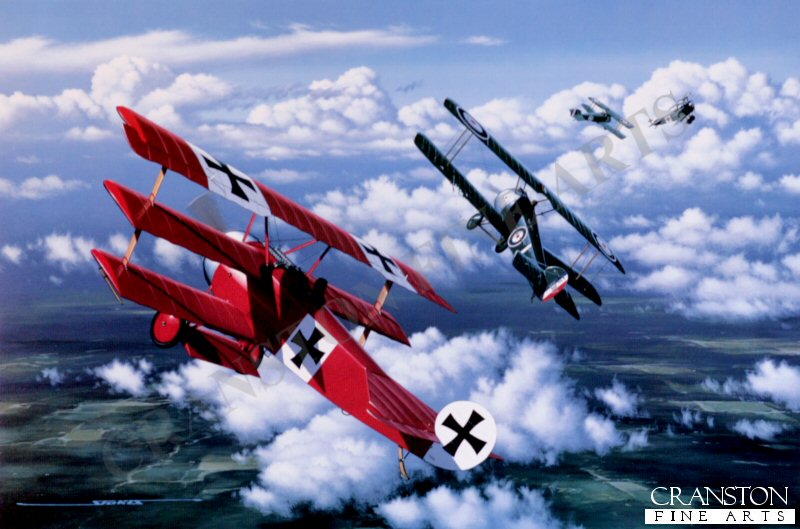
The Ringmaster by Stan Stokes. - Cranston Military Prints

The Ringmaster by Stan Stokes.


The Ringmaster by Stan Stokes.

Born in Prussia to wealthy aristocratic parents, Manfred Freherr von Richtofen, The Red Baron, was to become the top ace of World War I, with 80 confirmed kills, and probably another 40-50 which took place over enemy lines and could not be confirmed. Richtofen was originally a cavalry officer, but with great persistence he was transferred to the air arm. After a brief period on the eastern front Richtofen was transferred to the western front in August 1915. His first confirmed victory was recorded in September 1916 and by November he recorded eleven kills, including Major Lance Hawker, the top British fighter pilot. With his keen reflexes and eyesight he quickly ascended, and by June 1917 Richtofen took control of a unit near Coutrai. This unit became known as Richtofens Circus. By July the ringmaster had his fifty-seventh victim. Despite his successes Richtofen shunned publicity and became increasingly withdrawn. Richtofen was wounded in combat and spent three weeks in the hospital recuperating. After his return to duty Manfred became a vocal proponent of the Fokker triplane. The bright red paint scheme utilized on one of Richtofens aircraft is what earned him the nick-name, The Red Baron. Richtofens brother, Lothar, was also an ace with forty victories to his credit. By April of 1918, aided by Americas entry into the War, Germany was facing overwhelming numbers of enemy aircraft, and many with performance capabilities the equal to, and in some cases superior to, their own. The Germans mounted a final desperate offensive, and on April 21,1918 The Red Baron finally fell victim to the perils of combat. Although there is considerable controversy over the Red Barons demise, it appears that Richtofen was either killed by Captain Arthur Brown, a Canadian flying with the RAF, or was shot down by Australian machine gunners while evading Captain Brown. Richtofen was provided a full military funeral by the Allies, and on the evening following his funeral a single RAF fighter dropped a small package containing photos of the funeral onto the Circus headquarters. By Wars end the Circus was credited with the destruction of 644 aircraft, but 56 of its airmen had been killed, 32 seriously wounded, and 6 captured. Richtofen is pictured in July of 1917 tangling with Sopwith Camels in the skies over Belgium. Flying his beloved Fokker triplane, the infamous Red Baron is shown positioning his aircraft for yet another victory.
Item Code : STK0014The Ringmaster by Stan Stokes. - Editions AvailableExtra....


A photo of an edition of the print.

DESCRIPTIONSIZESIGNATURESOFFERSPRICEPURCHASINGPACKS
Signed limited edition of 4750 prints. Print size 16 inches x 11.5 inches (41cm x 30cm) Artist : Stan Stokes£15 Off!
Add any two items on this offer to your basket, and the lower priced item will be half price in the checkout!
Now : £35.00

Quantity:

and 2 Packs
View


Some other related items available from this site.

 The LFG Roland D.VI did not enjoy the success of its contemporaries, the Fokker D.VII and Pfalz D.XII, but was nonetheless a potent and capable fighter. Its unique Klinkerrumpf  fuselage construction made it both lightweight and robust although, despite its qualities, it was not built in large numbers. This particular example, a D.VIa, is shown chasing down a damaged Sopwith Camel  whilst being flown by Gefreiter Jakob Tischner of Jasta 35b. Tischner later wrote off this aircraft in a landing accident when he rolled into a parked Pfalz D.III, destroying both machines.

Gefreiter Jakob Tischner - Roland D.VIa by Ivan Berryman.
 Germays greatest exponent of the Fokker Dr1 Triplane, Leutnant Josef Jacobs is depicted chatting with colleagues of Jasta 7 before a sortie in the spring of 1918.  His black Triplane became well known to allied pilots, not least because of his formidable kill rate.  By the end of the war, still aged just 24, Jacobs had claimed 48 enemy aircraft destroyed.  The unusual practice of applying the black cross to the upper sides of the lower wings was to counter friendly fire from other German aircraft who frequently mistook the Dr1 for a Sopwith Triplane.

Leutnant Josef Jacobs by Ivan Berryman.
 The LFG Roland D.VI did not enjoy the success of its contemporaries, the Fokker D.VII and Pfalz D.XII, but was nonetheless a potent and capable fighter. Its unique Klinkerrumpf  fuselage construction made it both lightweight and robust although, despite its qualities, it was not built in large numbers. This particular example, a D.VIa, is shown chasing down a damaged Sopwith Camel  whilst being flown by Gefreiter Jakob Tischner of Jasta 35b. Tischner later wrote off this aircraft in a landing accident when he rolled into a parked Pfalz D.III, destroying both machines.

Gefreiter Jakob Tischner - Roland D.VIa by Ivan Berryman.
Von Richthofens Fokker DR 1 Triplane (Serial No 425/17) in company with his wingman in a Fokker D.VII over the fields of the Western Front early in April 1918, peeling off to attack a flight of three British fighters.

In For The Kill by Ivan Berryman.
Aircraft Related to This Print
Camel
Fokker Dr.I

Contact Details
Shipping Info
Terms and Conditions
Cookie Policy
Privacy Policy

Sign Up To Our Newsletter!

Stay up to date with all our latest offers, deals and events as well as new releases and exclusive subscriber content!

This website is owned by Cranston Fine Arts.  Torwood House, Torwoodhill Road, Rhu, Helensburgh, Scotland, G848LE

Contact: Tel: (+44) (0) 1436 820269.  Email: cranstonorders -at- outlook.com

Return to Home Page