Cranston Military Prints .com Home Page
Customer Helpline (UK) : 01436 820269
Subscribe to our Newsletter!

You currently have no items in your basket

Payment Options Display
Buy with confidence and security!
Publishing historical art since 1985


Navigation Menus
Military
Art Index
Aviation
Art Index
Naval
Art Index
Artists
Index
Product Search         
Aviation
History Archive
Naval
History Archive
HALF PRICE AND FREE PRINT SPECIAL OFFERS
ALWAYS GREAT OFFERS :
20% FURTHER PRICE REDUCTIONS ON HUNDREDS OF LIMITED EDITION ART PRINTS
BUY ONE GET ONE HALF PRICE ON THOUSANDS OF PAINTINGS AND PRINTS
FOR MORE OFFERS SIGN UP TO OUR FREE NEWSLETTER
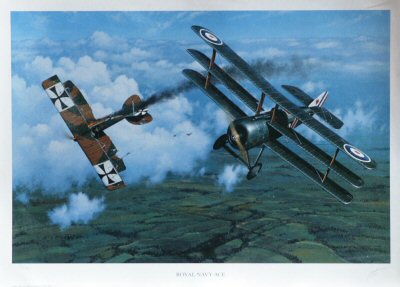
Royal Navy Ace by Stan Stokes. - Cranston Military Prints

Royal Navy Ace by Stan Stokes.


Royal Navy Ace by Stan Stokes.

Tommy Sopwith was born in 1888. He became the second person to fly the English Channel, and he established the Sopwith Aviation Company in 1912. His first successful aircraft design was the Sopwith Tabloid. This was a very modern aircraft when introduced in 1913. With its top speed of 92-MPH the Tabloid won the 1914 Schneider Trophy race. Two other early Sopwith designs were the Bat Boat, one of the first flying boats flown by the Naval Wing, and the Three-Seater, a large observation aircraft. Sopwith proliferated many other designs during the Great War, including the Snipe, Pup, Dolphin, Salamander, Strutter, and Camel. Sopwiths triplane was introduced in 1917. It evolved from the need for an aircraft with a superior rate of climb. By reducing the length and width of the wings, and by adding a third wing, the desired results were achieved. The triplane was a sound design with good rate of climb and very good maneuverability. It was somewhat underpowered when compared with its German adversaries. It was powered with either a 110-HP or 130-HP Clerget engine. The Sopwith Triplane utilized a convention design with I-sections and longertrons made of spruce wood. The fabric was separated from the structural members by thin strips of spruce, and the forward section of the fuselage was covered with sheet aluminum. The Triplane had a steerable tailskid, and the undercarriage was built with streamlined steel tubing. This diminutive aircraft was 26 feet 6 inches in span and just under 19 feet in length. The maximum speed of the aircraft was 117-MPH; attainable at 5,000 feet altitude. With a service ceiling of 20,500 feet the Triplane had a maximum endurance of 90 minutes. Maneuverability was a hallmark of Sopwith designs and the triplane was no exception to this rule. Many Royal Naval Air Service pilots flew the Triplane. For most of 1917 the pilots of Navy 1, 8, and 10 squadrons in Flanders flew Triplanes. Sopwith also produced a 200-HP Hispano-Suiza powered triplane that had larger wings to compensate for the increased engine weight. More than 20,000 aircraft were built of Sopwith design prior to the companys merger with Hawker in 1933. Captain R.A. Little was the RNASs highest-scoring ace with a total of 47 victories. He had fifteen victories (Nos 22-36) that were attained while flying the Sopwith Triplane with No 8 Squadron RNAS between April 1917 and July 1917.
Item Code : STK0022GSRoyal Navy Ace by Stan Stokes. - Editions AvailableExtra....


A photo of an edition of the print.

DESCRIPTIONSIZESIGNATURESOFFERSPRICEPURCHASINGPACKS
Signed limited edition of 4750 prints. Print size 16 inches x 11.5 inches (41cm x 30cm) Artist : Stan Stokes£15 Off!
Add any two items on this offer to your basket, and the lower priced item will be half price in the checkout!
Now : £35.00

Quantity:
Limited edition of 100 giclee art prints. Size 21 inches x 14 inches (53cm x 36cm)Artist : Stan Stokes£145.00

Quantity:
Limited edition of 100 giclee canvas prints. Size 27 inches x 18 inches (69cm x 46cm)noneSOLD
OUT
NOT
AVAILABLE


Some other related items available from this site.

 With a final 47 victories to his credit, Robert Alexander Little was one of the highest-scoring British aces of World War 1, beginning his career with the famous No 8 (Naval) Squadron in 1916, flying Sopwith Pup N5182, as shown here. On 21st April 1917, he was attacked and shot down by six aircraft of Jasta Boelke, Little being thrown from the cockpit of his Sopwith Camel on impact with the ground. As the German aircraft swooped in to rake the wreckage with machine gun fire, Little pulled his Webley from its holster and began returning fire before being assisted by British infantry with their Lewis guns. Such was the character of this great pilot who finally met his death whilst attacking Gotha bombers on the night of 27th May 1918.

Captain Robert Little by Ivan Berryman.
 Two Bristol Brigand B1s of 8 Squadron RAF based at Khormaksar are depicted off the Aden Peninsula in 1950.  Nearest aircraft is VS814 (L), flown by Sgt Pilot Vic Campden.

8 Sqn Bristol Brigands by Ivan Berryman.
 Two Bristol Brigand B1s of 8 Squadron RAF based at Khormaksar are depicted off the Aden Peninsula in 1950.  Nearest aircraft is VS814 (L), flown by Sgt Pilot Vic Campden.

8 Sqn Bristol Brigands by Ivan Berryman.
 In this painting, the Sopwith Triplane N5468 named ANGEL of No.8 Naval Squadron is depicted around the time it was flying from St. Eloi in France in the summer of 1917.  This aircraft clocked up more than 150 flying hours here before being sent to a training squadron at the end of the year.  During this time, Captain Charles Jenner-Parson claimed at least two victories in this aircraft.

Tribute to 8 Naval Squadron by Ivan Berryman.
Squadrons Related to This Print
No.8 Sqn
Aircraft Related to This Print
Sopwith Triplane

Contact Details
Shipping Info
Terms and Conditions
Cookie Policy
Privacy Policy

Sign Up To Our Newsletter!

Stay up to date with all our latest offers, deals and events as well as new releases and exclusive subscriber content!

This website is owned by Cranston Fine Arts.  Torwood House, Torwoodhill Road, Rhu, Helensburgh, Scotland, G848LE

Contact: Tel: (+44) (0) 1436 820269.  Email: cranstonorders -at- outlook.com

Return to Home Page