Cranston Military Prints .com Home Page
Customer Helpline (UK) : 01436 820269
Subscribe to our Newsletter!

You currently have no items in your basket

Payment Options Display
Buy with confidence and security!
Publishing historical art since 1985


Navigation Menus
Military
Art Index
Aviation
Art Index
Naval
Art Index
Artists
Index
Product Search         
Aviation
History Archive
Naval
History Archive
HALF PRICE AND FREE PRINT SPECIAL OFFERS
ALWAYS GREAT OFFERS :
20% FURTHER PRICE REDUCTIONS ON HUNDREDS OF LIMITED EDITION ART PRINTS
BUY ONE GET ONE HALF PRICE ON THOUSANDS OF PAINTINGS AND PRINTS
FOR MORE OFFERS SIGN UP TO OUR FREE NEWSLETTER
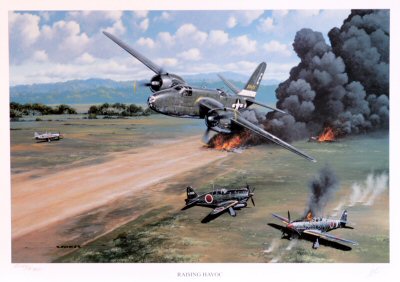
Raising Havoc by Stan Stokes. - Cranston Military Prints

Raising Havoc by Stan Stokes.


Raising Havoc by Stan Stokes.

In 1936, under the supervision of Jack Northrop and Ed Heinemann, Douglas Aircraft began work on a new twin-engine light attack/observation aircraft designated the Model 7A. Powered by two R985 Wasp radials mounted in wing nacelles, the A-20 also utilized a tricycle landing gear configuration. The aircrafts fuselage was quite narrow and there was room for only 1 pilot and 1 crewmember. As the project proceeded it became clear that the 7A was not going to meet the Armys objectives. In early 1938, Northrop left Douglas to form his own company, and Heinemann began work on upgrading their design. One interesting feature was the use of interchangeable nose sections. A clear nose could be fitted with a bombardiers compartment, or alternatively a solid nose section could be fitted with an impressive total of 8 machine guns. More powerful Pratt and Whitney radials were incorporated into the design. Now designated the DB-7 by Douglas, a prototype aircraft was completed by October 1938. The new aircraft proved very fast, highly maneuverable, and capable of carrying a 2000 pound bomb load. While impressed with the aircrafts specs, the Army placed no immediate orders. The French, however, were impressed with this aircraft, and anxious to match the build-up of the Luftwaffe, they ordered more than 270 aircraft. The Havoc first saw combat in 1939 flying with the French Air Forces during the Battle of France. The French had received about 64 aircraft, and following the fall of France a decision was made to divert the balance of the French order to the RAF. By mid-1939 the Army placed an initial order for 63 A-20s. The A-20B variant was built in significant numbers with most being sent to Russia. (Almost 50% of the A-20s produced during the War were sent to Russia where they were utilized in many combat roles, including torpedo bombing.) The most significant variant was the G model with nearly 3000 produced. The G variant was produced with a solid nose section with lots of firepower. Many of the G models were fitted with an electrically driven Martin gun turret. More fuel tank capacity was added and with twin 1600-HP radials the A-20Gs were capable of a range in excess of 1000 miles, and could attain top speeds in excess of 340-MPH. The maximum bomb load was increased to 4000 pounds. The A-20 was the ideal low-level attack bomber. With its high speed, excellent maneuverability, and heavy firepower, Havocs were well suited for pinpoint bombing attacks on airfields, ammo dumps, etc. With their incredible forward firing power a flight of A-20s could easily overwhelm shipboard anti-aircraft guns. A-20s saw a lot of service in the Pacific. The Allied campaign of slowly retaking key islands was aided by the capabilities of the Havoc. Attacks on Japanese airfields with the A-20 were made with disastrous consequences to the Japanese, and there are several instances where flights of A-20s virtually wiped out Japanese ship convoys. Some A-20s were modified into night fighters (designated P-70) prior to the use of P-61 Black Widows. In Stan Stokes painting an A-20 in service with the 386th Bomb Squadron of the 312th Bomb Group rips up a Japanese airfield in Dutch New Guinea.
Item Code : STK0094Raising Havoc by Stan Stokes. - Editions AvailableExtra....


A photo of an edition of the print.

DESCRIPTIONSIZESIGNATURESOFFERSPRICEPURCHASINGPACKS
Signed limited edition of 4750 prints. Print size 16 inches x 11.5 inches (41cm x 30cm)Artist : Stan Stokes£15 Off!
Add any two items on this offer to your basket, and the lower priced item will be half price in the checkout!
Now : £35.00

Quantity:


Some other related items available from this site.

 It is January 1945, and its cold. The German advance in the Ardennes is nearly over, but the Panzer Army is desperately throwing more troops into the breach who try to keep their momentum going in The Battle of the Bulge. Tasked with preventing German reinforcements from reaching the battle front, the Ninth Air Force launched a series of low-level attacks on enemy ground forces as they wind their way through the Ardennes. Flying conditions were not easy, cloud bases were low, and snow was in the air. Nicolas Trudgians new painting recreates an attack on January 23, 1945, by Douglas A-20 Havocs of the 410th Bomb Group. Locating an enemy convoy in open space near the German town of Blankenheim, the Havoc pilots make a swift attack diving from 8000 feet, catching the German force by surprise: Hurtling down the line of vehicles at 320mph they release their parafrag bombs from 300 feet then, dropping just above the roofs of the army trucks continue down the column blasting everything in sight with their forward-firing .50mm caliber machine guns. In the space of a few minutes the attack is completed and the convoy decimated. With ammunition expended and fuel running low the A-20 Havocs climb out of the zone and head for base in France. A 20mm shell has hit the lead aircraft wounding the Bombardier/Navigator Gordon Jones, which will seriously hamper their return through a blizzard, but all aircraft make it safely home - the lead aircraft, on landing, counting over 100 holes of various sizes. For their part in leading the successful attack the Lead Pilot Russell Fellers and Bombardier/Navigator Gordon G. Jones received the Silver Star. <br><br><b>Published 2001.<br><br>Signed by A-20 Havoc combat aircrews, including two Silver Star recipients, from World War Two.</b>

Raising Havoc in the Ardennes by Nicolas Trudgian.
  It is January 1945, and its cold. The German advance in the Ardennes is nearly over, but the Panzer Army is desperately throwing more troops into the breach who try to keep their momentum going in The Battle of the Bulge. Tasked with preventing German reinforcements from reaching the battle front, the Ninth Air Force launched a series of low-level attacks on enemy ground forces as they wind their way through the Ardennes. Flying conditions were not easy, cloud bases were low, and snow was in the air. Nicolas Trudgians new painting recreates an attack on January 23, 1945, by Douglas A-20 Havocs of the 410th Bomb Group. Locating an enemy convoy in open space near the German town of Blankenheim, the Havoc pilots make a swift attack diving from 8000 feet, catching the German force by surprise: Hurtling down the line of vehicles at 320mph they release their parafrag bombs from 300 feet then, dropping just above the roofs of the army trucks continue down the column blasting everything in sight with their forward-firing .50mm caliber machine guns. In the space of a few minutes the attack is completed and the convoy decimated.  With ammunition expended and fuel running low the A-20 Havocs climb out of the zone and head for base in France. A 20mm shell has hit the lead aircraft wounding the Bombardier/Navigator Gordon Jones, which will seriously hamper their return through a blizzard, but all aircraft make it safely home - the lead aircraft, on landing, counting over 100 holes of various sizes. For their part in leading the successful attack the Lead Pilot Russell Fellers and Bombardier/Navigator Gordon G. Jones received the Silver Star. <br><br><b>Published 2001.<br><br>Signed by A-20 Havoc combat aircrews, including two Silver Star recipients, from World War Two.</b>

Raising Havoc in the Ardennes by Nicolas Trudgian.
 The B-32 Dominator was produced by Consolidated Aircraft in parallel with Boeings development of the B-29 Superfortress. While both of these long-range heavy strategic bomber development programs encountered some difficulties, the B-29 was completed sooner, and was ordered in far larger quantities than the B-32. About one hundred Dominators were ultimately built and the aircraft saw some service very late in WW II. Powered by the same engines as the B-29, the B-32 had a distinctive very tall stabilizer. Four B-32s from the 386th BS of the 312th BG based at Yontan, Okinawa were given a three-day photoreconnaissance mission near the end of the War. On the third day of the mission, August 18, 1945, two aircraft were forced to turn back and only two aircraft, the Hobo Queen and the Hobo Queen II made it to Japan. The mission involved photographing an area north and east of Tokyo. The aircraft were unescorted, as the War was for all practical purposes over. As the two aircraft prepared to head home they were jumped by a large group of Japanese fighters including Imperial Navy A6M2 Zeros and Army Ki44 Tojos. The first attacks occurred at 1:30 PM while the aircraft were at 20,000 feet. The enemy planes made ten passes on the Hobo Queen II with little or no damage. About twenty-five passes were made at the Hobo Queen, which was under the command of Lt. John R. Anderson. Seven passes were made at the tail of the B-32 and one of the attackers blew-up. One fighter pass was made at the ball turret from below with no success, and another six were made at the forward upper turret. About six more were made at the nose turret position, and several more at the upper rear turret. Another enemy fighter blew up, and a third was seen going down smoking. The pilots went to full mix and full throttle and power-dived the B-32 from 20,000 to 10,000 feet. The Hobo Queen absorbed a lot of damage during these attacks. The radioman got the Hobo Queen II to regroup with the badly damaged Hobo Queen to provide some cover. Three men were wounded including Sgt. Anthony J. Marchione, SSgt. Joseph M. Lacharite, and Sgt. John T. Houston. Marchione and Lacharite were at the camera hatch at the rear of the aircraft when that section of the plane was riddled. Both men were hit. Despite his own wounds, SSgt. Lacharite began administering first aid to Marchione, but a second fighter pass wounded Marchione again. Despite the valiant efforts of his crewmates to keep him alive, Marchione passed away at 2:00PM. Sgt. Marchione may have been the last USAAF combat casualty of the War. SSgt. Chevalier administered first aid to SSgt. Lacharite during the long ride home. Despite being unable to bank his aircraft due a feathered prop, Lt. Anderson got the Hobo Queen down successfully.

Hobo Queens by Stan Stokes.
 Flew 66 missions as a pilot on the A-20 Havoc with 668th Bomb Squadron, 416th Bomb Group in England.  He died in 2004. <br><br>Supplied together with the signature of Dick Wheeler : A pilot of the A-20 Havoc with the 416th Bomb Group in England, he flew 69 missions in Europe, including D-Day.  Remaining with the Air Force after the war, he set a world record for a high altitude bail out, retiring in 1968.  He died in 2009.

Clipped Signature - Daniel F Shea.
Squadrons Related to This Print
386th Bomb Squadron
Aircraft Related to This Print
Havoc

Contact Details
Shipping Info
Terms and Conditions
Cookie Policy
Privacy Policy

Sign Up To Our Newsletter!

Stay up to date with all our latest offers, deals and events as well as new releases and exclusive subscriber content!

This website is owned by Cranston Fine Arts.  Torwood House, Torwoodhill Road, Rhu, Helensburgh, Scotland, G848LE

Contact: Tel: (+44) (0) 1436 820269.  Email: cranstonorders -at- outlook.com

Return to Home Page