Cranston Military Prints .com Home Page
Customer Helpline (UK) : 01436 820269
Subscribe to our Newsletter!

You currently have no items in your basket

Payment Options Display
Buy with confidence and security!
Publishing historical art since 1985


Navigation Menus
Military
Art Index
Aviation
Art Index
Naval
Art Index
Artists
Index
Product Search         
Aviation
History Archive
Naval
History Archive
HALF PRICE AND FREE PRINT SPECIAL OFFERS
ALWAYS GREAT OFFERS :
20% FURTHER PRICE REDUCTIONS ON HUNDREDS OF LIMITED EDITION ART PRINTS
BUY ONE GET ONE HALF PRICE ON THOUSANDS OF PAINTINGS AND PRINTS
FOR MORE OFFERS SIGN UP TO OUR FREE NEWSLETTER
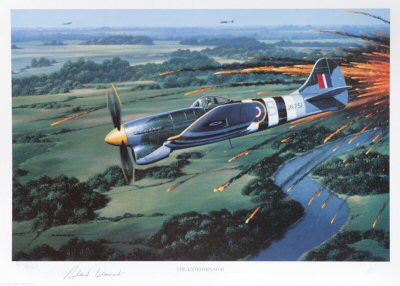
The Exterminator by Stan Stokes. - Cranston Military Prints

The Exterminator by Stan Stokes.


The Exterminator by Stan Stokes.

By mid-1941 it was clear that Hitlers plans to invade Britain were in disarray. The RAF had fought the Luftwaffe to a standoff, and many of Germanys top pilots had been killed or captured. Not willing to admit defeat in his campaign against Britain, Hitler approved the development of a pilotless terror weapon, the VF-1 Vergeltungswaffe (retaliation weapon). Designed by the Feiseler Company, the small pilotless Fi-103 was at times referred to in Britain as the doodlebug, buzz bomb, or farting fury. These flying bombs were inexpensive to build and were capable of carrying an 1870-pound warhead. The Fi-103 was powered by a ram-jet engine, and utilized three air driven gyroscopes to orient the aircraft. A rudimentary pre-set propeller device was utilized to determine when the VF-1 would land. Lacking the accuracy necessary to make it an effective weapon against military targets these doodlebugs were primarily targeted at large population centers. Therefore, they were primarily used as civilian terror weapons, and the RAF was given the assignment of providing the defense against these terror weapons. Early testing revealed many problems with the VF-1, and it was not until March 1944 that most of these problems had been worked out. The final VF-1 production models were capable of speeds in excess of 400 MPH . The high speed of the VF-1, coupled with its small size and large warhead, made it difficult for the RAF to shoot down these doodlebugs. The doodlebug had strong sheet steel skin which deflected machine gunfire, making it necessary to utilize cannon fire. Cannons had more than twice the range of machine guns, but the attacking fighters had to get in close to hit these small, fast targets. If the pilot got in too close the explosion of the VF-1s heavy warhead often disabled the attacking fighter. An alternative was to deflect the doodlebug by maneuvering alongside it, and then by executing a gentle banking maneuver, flip the VF-1, and disrupt its gyros. Generally, this caused the doodlebug to crash in an unpopulated area with little damage. Less than 10% of the buzz bombs were destroyed in this manner, and this technique was only utilized when the pilot had depleted his ammunition. One of the top buzz-bomb exterminators was Wing Commander Roland Beamont who destroyed 32 doodlebugs during his tour of duty. He flew the Tempest V with 150 Wing, which he commanded. The three squadrons of 150 Wing were credited with destroying 630 buzz bombs between June and August of 1944. The Hawker Tempest was the fastest interceptor available, and provided its pilots a highly stable platform for its four 20mm cannon. The Meteor, the RAFs first jet, was utilized briefly as a buzz bomb interceptor, but with only nine kills, it was withdrawn as being unsuitable for this purpose. As depicted in Stan Stokes painting appropriately entitled The Exterminator, Wing Commander Beamont is depicted flying his Tempest V through the debris created by a successful hit on a buzz bomb in July, 1944. The action takes place southeast of London over the tranquil English countryside.
Item Code : STK0136GSThe Exterminator by Stan Stokes. - Editions AvailableExtra....


A photo of an edition of the print.

DESCRIPTIONSIZESIGNATURESOFFERSPRICEPURCHASINGPACKS
Signed limited edition of 4750 prints. Print size 16 inches x 11.5 inches (41cm x 30cm) Artist : Stan Stokes£15 Off!
Add any two items on this offer to your basket, and the lower priced item will be half price in the checkout!
Now : £35.00

Quantity:
In 1 Pair
View
225 prints from the signed limited edition of 4750 prints, with signature of Stan Stokes and pilot, and a remarque.Image size 16 inches x 11.5 inches (41cm x 30cm)
Beamont, Roland

Died : 2001
Wing Commander Roland Bee Beamont CBE DSO DFC DL (deceased)
One of World War IIs great characters, Bee flew Hurricanes with 87 Squadron, later leading a Tempest Wing. He had 8 victories plus a further 32 VIs destroyed. After the war he became a highly respected Chief Test Pilot.Wing Commander Roland Beamont, one of the RAFs top buzz bomb interceptors, was born in Enfield England on August 10, 1920. Educated at Eastborne College, Beamont accepted a short service commission with the Royal Air Force in 1938. He commenced flying in 1939 at the the No. 13 R
Signature Value : £65
CLICK HERE FOR FULL PROFILE
 
+ Artist : Stan Stokes


Signature(s) value alone : £65
£10 Off!Now : £140.00

Quantity:
In 2 Pairs
and 1 Pack
View
Prints from the 225 prints from the signed limited edition of 4750 prints, with signature of Stan Stokes and pilot. Image size 16 inches x 11.5 inches (41cm x 30cm)
Beamont, Roland

Died : 2001
Wing Commander Roland Bee Beamont CBE DSO DFC DL (deceased)
One of World War IIs great characters, Bee flew Hurricanes with 87 Squadron, later leading a Tempest Wing. He had 8 victories plus a further 32 VIs destroyed. After the war he became a highly respected Chief Test Pilot.Wing Commander Roland Beamont, one of the RAFs top buzz bomb interceptors, was born in Enfield England on August 10, 1920. Educated at Eastborne College, Beamont accepted a short service commission with the Royal Air Force in 1938. He commenced flying in 1939 at the the No. 13 R
Signature Value : £65
CLICK HERE FOR FULL PROFILE
 
+ Artist : Stan Stokes


Signature(s) value alone : £65
£40 Off!
Add any two items on this offer to your basket, and the lower priced item will be half price in the checkout!
Now : £90.00

Quantity:
Limited edition of 100 giclee canvas prints. Size 36 inches x 24 inches (91cm x 61cm)noneSOLD
OUT
NOT
AVAILABLE
Limited edition of 100 giclee canvas prints. Size 27 inches x 18 inches (69cm x 46cm)none£450.00

Quantity:


Some other related items available from this site.

 Whilst flying with other Hawker Tempests of 274 Sqn on 11th February 1945, Sqn Ldr David Fairbanks spotted a lone Arado Ar234 of the Kommando Sperling 1 (F) / 123 flown by Hauptmann Hans Felde returning to its base at Rheine.  A desperate chase commenced through the cloudbase until the German jet prepared to land, whereupon Fairbanks sent 4U+DH down in flames after a single short burst of his four 20mm cannon.

Tribute to Sqn Ldr David Fairbanks by Ivan Berryman.
 The Tempest of Wing Commander Roland Beamont DSO and Bar DFC and Bar, June 1944.

Lull Before the Storm by Keith Aspinall.
 Hurricanes of 87 Squadron return to their West Country base after repelling attacks by Luftwaffe bombers on nearby aircraft factories, August 1940. Flight Lieutenant Ian Gleeds Hurricane, in which he scored 20 victories, leads the Squadron pilots back to base to refuel, re-arm, and get airborne without delay. <br><br><b>Published 2000.<br><br>Signed by three famous Hurricane pilots who fought in the Battle of Britain.  These are three fantastic rare  signatures to have on one art print  and sadly all three have since passed away.</b>

Hurricane Heroes by Nicolas Trudgian
 Whilst flying with other Hawker Tempests of 274 Sqn on 11th February 1945, Sqn Ldr David Fairbanks spotted a lone Arado Ar234 of the Kommando Sperling 1 (F) / 123 flown by Hauptmann Hans Felde returning to its base at Rheine.  A desperate chase commenced through the cloudbase until the German jet prepared to land, whereupon Fairbanks sent 4U+DH down in flames after a single short burst of his four 20mm cannon.

Tribute to Sqn Ldr David Fairbanks by Ivan Berryman.
Signatures on these products
*The value given for each signature has been calculated by us based on the historical significance and rarity of the signature and is for the unmatted version where available. Values of many pilot signatures have risen in recent years and will likely continue to rise as they become more and more rare.
NameInfo


Wing Commander Roland Bee Beamont CBE DSO DFC DL (deceased)
Died : 2001
*Signature Value : £65

Editions signed :

225 prints from the signed limited edition of 4750 prints, with signature of Stan Stokes and pilot, and a remarque.
Prints from the 225 prints from the signed limited edition of 4750 prints, with signature of Stan Stokes and pilot.


Beamont, Roland
(Wing Commander Roland Bee Beamont CBE DSO DFC DL (deceased))

One of World War IIs great characters, Bee flew Hurricanes with 87 Squadron, later leading a Tempest Wing. He had 8 victories plus a further 32 VIs destroyed. After the war he became a highly respected Chief Test Pilot.Wing Commander Roland Beamont, one of the RAFs top buzz bomb interceptors, was born in Enfield England on August 10, 1920. Educated at Eastborne College, Beamont accepted a short service commission with the Royal Air Force in 1938. He commenced flying in 1939 at the the No. 13 Reserve Flying School at White Waltham. His initial duty was with the Group Fighter Pool at St. Athan where he learned to fly the Hurricane. Beamont was soon posted with the No. 87 Squadron which was part of the Advanced Air Striking Force in France. Seeing action in both France and Belgium prior to the Allied withdrawl, Beamont rejoined 87 Squadron in England during the Battle of Britain. In the spring of 1941 Beamont was awarded the Distinguished Flying Cross after destroying five enemy aircraft. As Commanding Officer of 609 Squadron, Beamont pioneered both day and night ground attack missions utilizing the Typhoon. Beamont was credited with destroying 25 trains in a three month period. He was then made responsible for organizing and commanding the first Tempest Wing at Newchurch. Three days after D-Day Bearnont shot down an Me-109, marking the first aerial combat victory for the Hawker Tempest. In the summer of 1944 Beamont destroyed 32 buzz bombs prior to leading his wing to a Dutch Airfield at Volkel on the Continent. In October of 1944 Beamont was shot down during a ground attack mission over Germany, and he remained a prisoner of war until wars end. Following repatriation Beamont became an experimental test pilot with the Gloster Aircraft Company, which had developed the RAFs first jet aircraft. Turning down a permanent commission with the RAF, Beamont then joined English Electric Company in Wharton as the Chief Test Pilot for the B3/45 (Canberra) jet bomber program. He managed all prototype testing on the Canberra, and in the process set two Atlantic speed records. Later Beamont was involved with the supersonic P1/Lightning program, and became the first British pilot to fly at twice the speed of sound. From 1965 until 1970 he was a founding member of Britains highly succesful Saudi Arabian export program. For several years prior to his retirement in 1979, Beamont was Director of Operations for British Aerospace and Panavia where he was in charge of flight testing for the Tornado. Since his retirement Beamont has authored nine books, and published numerous magazine articles. He is a Fellow of the Royal Aeronautical Scociety and an Honorary Fellow of the Society of Experimental Test Pilots in America. He died 19th November 2001.
Aircraft Related to This Print
Tempest

Contact Details
Shipping Info
Terms and Conditions
Cookie Policy
Privacy Policy

Sign Up To Our Newsletter!

Stay up to date with all our latest offers, deals and events as well as new releases and exclusive subscriber content!

This website is owned by Cranston Fine Arts.  Torwood House, Torwoodhill Road, Rhu, Helensburgh, Scotland, G848LE

Contact: Tel: (+44) (0) 1436 820269.  Email: cranstonorders -at- outlook.com

Return to Home Page