Cranston Military Prints .com Home Page
Customer Helpline (UK) : 01436 820269
Subscribe to our Newsletter!

You currently have no items in your basket

Payment Options Display
Buy with confidence and security!
Publishing historical art since 1985


Navigation Menus
Military
Art Index
Aviation
Art Index
Naval
Art Index
Artists
Index
Product Search         
Aviation
History Archive
Naval
History Archive
HALF PRICE AND FREE PRINT SPECIAL OFFERS
ALWAYS GREAT OFFERS :
20% FURTHER PRICE REDUCTIONS ON HUNDREDS OF LIMITED EDITION ART PRINTS
BUY ONE GET ONE HALF PRICE ON THOUSANDS OF PAINTINGS AND PRINTS
FOR MORE OFFERS SIGN UP TO OUR FREE NEWSLETTER
Wings Over Waikiki by Stan Stokes. - Cranston Military Prints

Wings Over Waikiki by Stan Stokes.


Wings Over Waikiki by Stan Stokes.

The Consolidated PBY Catalina, the sea going flying workhorse of the US Navy during WW II, is with no doubt the most successful flying boat ever produced. Produced for more than ten years, it was built in greater numbers (3,300) than any other flying boat in history. In the early days of aviation flying boats made a lot of sense because of the relatively limited number of prepared airfields. Any estuary, river, or lake could become an airfield for an aircraft designed as a flying boat. Consolidated Aircraft got into the flying boat business rather late in the game. In 1928 the company won a bid to produce a prototype of a new high-wing monoplane flying boat for the Navy which would utilize aluminum in its fabrication. The XPY prototype was successfully flown in early 1929, but the Glen L. Martin Co., one of the pioneers in flying boat production, won the production contract. Not deterred by this setback, Consolidated utilized the expertise it had developed on this project to introduce a commercial 28-passenger flying boat called the Commodore. This aircraft was utilized by a number of airlines including Pan Am. Concurrent with work on the Commodore the Consolidated design team set about developing an improved version of the XPY. This design (the P2Y-1) had an enclosed cockpit, and was designed to handle either two or three engines. A total of 47 P2Ys were put in service. As production commenced on the P2Y, Consolidated began work on another improved flying boat which would be considerably larger than the P2Y. The prototype of this new aircraft (the XPY-3) utilized retractable wing floats. In 1935 Consolidated won the initial production order for the first PBY-1s in 1935. In 1936 another fifty aircraft were ordered as the PBY-2 derivative. A PBY-2 based in Hawaii is depicted in its pre-war markings over Diamond Head, in Stan Stokes painting entitled Wings Over Waikiki. This version lacked the fuselage window blisters which would be used on later variants. The PBY-2 had a wing span of 104 feet, and was nearly 64 feet in length. Powered by two 850-HP Pratt and Whitney R-1830-64s, the PBY-2 had a maximum speed of 178-MPH, and a range of more than 2,000 miles. The British ordered more than 100 PBYs in 1939. They called the aircraft Catalina. Also in 1939 a number of Catalinas were modified into amphibians by adding a retractable tricycle undercarriage. This added more than 2,000 pounds to the weight of the aircraft, but also improved its versatility. In the first few days following the Japanese attack on Pearl Harbor, many of the PBYs deployed throughout the Pacific were damaged or destroyed. The PBYs were vulnerable to enemy fighter attack when in the air. Despite these early setbacks, the Navy learned to make good use of the PBY as the war progressed. One of the most effective uses of the aircraft was in night search and attack missions, where the aircraft were generally painted all black. These Black Cats operated from island bases and seaplane tenders and effectively hampered night time movement of enemy supplies. The Catalina also flew many Dumbo missions during the war rescuing downed allied aviators. Many thousands of lives were saved during these missions.
Item Code : STK0157GSWings Over Waikiki by Stan Stokes. - Editions AvailableExtra....


A photo of an edition of the print.

DESCRIPTIONSIZESIGNATURESOFFERSPRICEPURCHASINGPACKS
Signed limited edition of 4750 prints. Print size 16 inches x 11.5 inches (41cm x 30cm) Artist : Stan Stokes£15 Off!
Add any two items on this offer to your basket, and the lower priced item will be half price in the checkout!
Now : £35.00

Quantity:
In 1 Pair
View
225 prints from the signed limited edition of 4750 prints, with signature of Stan Stokes and pilot, and a remarque.Image size 16 inches x 11.5 inches (41cm x 30cm)
Windham, Cole
NO
PHOTO
AVAILABLE

Cdr Cole Windham USN
Cole Windham was born in West Columbia, South Carolina on April 29, 1912. At the age of six Cole remembers standing on a brick wall in front of his home and watching a platoon of WW1 soldiers marching toward him. As they came abreast he saluted, and the platoon leader returned the salute. It was a vivid memory that lasted a life time. His family moved to Gastonia, North Carolina in the early 1920s. Cole finished high school there, and was awarded a full academic scholarship to attend Davidson Co
Signature Value : £40
CLICK HERE FOR FULL PROFILE

+ Artist : Stan Stokes


Signature(s) value alone : £40
£20 Off!Now : £110.00

Quantity:
Limited edition of 100 giclee art prints. Size 21 inches x 14 inches (53cm x 36cm)Artist : Stan Stokes£145.00

Quantity:
Prints from the 225 prints from the signed limited edition of 4750 prints, with signature of Stan Stokes and pilot. Image size 16 inches x 11.5 inches (41cm x 30cm)
Windham, Cole
NO
PHOTO
AVAILABLE

Cdr Cole Windham USN
Cole Windham was born in West Columbia, South Carolina on April 29, 1912. At the age of six Cole remembers standing on a brick wall in front of his home and watching a platoon of WW1 soldiers marching toward him. As they came abreast he saluted, and the platoon leader returned the salute. It was a vivid memory that lasted a life time. His family moved to Gastonia, North Carolina in the early 1920s. Cole finished high school there, and was awarded a full academic scholarship to attend Davidson Co
Signature Value : £40
CLICK HERE FOR FULL PROFILE

+ Artist : Stan Stokes


Signature(s) value alone : £40
£25 Off!
Add any two items on this offer to your basket, and the lower priced item will be half price in the checkout!
Now : £100.00

Quantity:
Limited edition of 100 giclee canvas prints. Size 27 inches x 18 inches (69cm x 46cm)noneSOLD
OUT
NOT
AVAILABLE


Some other related items available from this site.

 Jimmy Doolittles attack on Japan with B-25s launched from the USS Hornet was a blow to Japanese morale, and it gave Admiral Yamamoto the leverage he needed to push for a grandiose plan to inflict a decisive military blow to American forces in the Pacific. Yamamotos grand scheme would have several elements. A huge fleet would be sent to Midway Island to lure American carrier forces into combat. The force would include seven battleships, ten aircraft carriers, some two dozen cruisers and more than seventy destroyers. A separate strikeforce would be sent to the Aleutians under the command of Vice Admiral Hosogaya Moshiro. The plan was for the the northern force to strike first and divert American carrier forces northward away from Midways air support forces where they could be dispatched by Yamamotos overwhelming force. Fortunately for the US Navy a highly skilled group of cryptographers had broken portions of the Japanese Navys secret code. The Americans sent a bogus message to trick the Japanese into revealing the true target of their massive force. While not surprised, the American forces in the Midway area were sadly outnumbered, and good fortune would be needed to offset the Japanese advantage in numbers. The three primary US carriers in the Pacific (Enterprise, Hornet and Yorktown) were readied for the action. Shortly after 9:00 AM on the morning of June 3, 1942, Ensign Jack Reid of VP-44, piloting a PBY Catalina flying boat, spotted the main Japanese invasion force, and shadowed the fleet at low altitude for several hours. Later that day B-17s from Midway Island would attack the invasion fleet followed by a torpedo attack by other PBYs. Early in the morning of June 4 the Japanese launched their first aerial attack on Midway. As the 108 Japanese aircraft approached the island a hodgepodge of all air worthy American aircraft were launched including PBYs, B-17s, Wildcat and Buffalo fighters, Vindicator bombers, B-26 Marauders and SBD Dauntless divebombers.

Main Body by Stan Stokes.
Royal Air Force catalina over flys a Royal Navy Cruiser of Gibraltar while on patrol.

On the Prowl by Timothy OBrien.
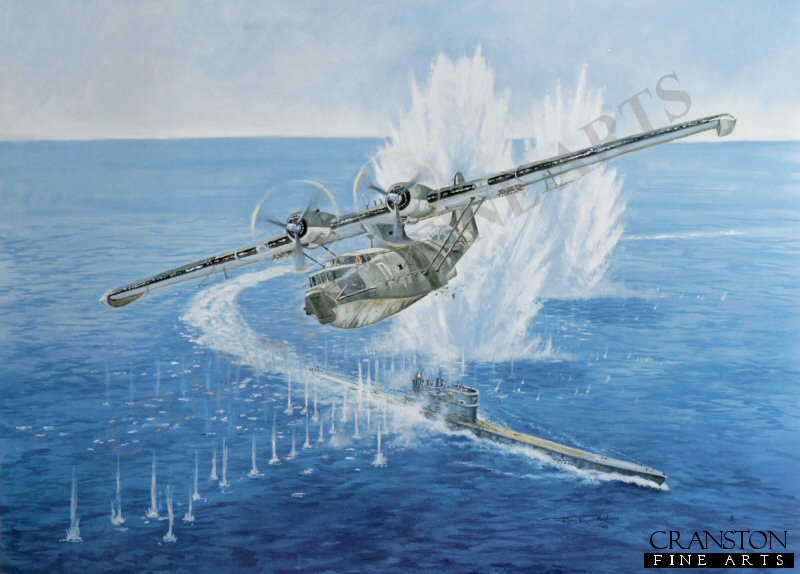
 D for Donald of 270 squadron, Royal Air Force, out of Freetown, West Africa operating in the Atlantic Ocean. It was during routine operation search that D for Donald surprised U515 on the surface and immediately attacked the submarine. U515 in putting up stiff resistance blew a large hole in the hull of D for Donald and the magazine of the starboard side 0.5 twin Browning was hit and the subsequent shrapnel wounded both blister gunners. U515 escaped but was sunk by an American naval hunter group a year later. D for Donald limped back to base and managed to make the beach before it would sink completely.

Catalina Attack by John Wynne Hopkins
 On February 15, 1944, flying his Navy PBY Catalina on air-sea rescue duty, Lt. Nathan Gordon received an urgent call. Several 345th BG B25s were down following a major attack on Kavieng, and crews were in the water just offshore. Under intense gunfire, Gordon made no fewer than four perilous water landings to pick up survivors, returning to make an emergency landing at Cape Gloucester with 25 people aboard, an just 10 gallons of fuel in his tanks. Gordon was awarded the Medal of Honor.

Black Cat Rescue by Nicolas Trudgian
Signatures on these products
*The value given for each signature has been calculated by us based on the historical significance and rarity of the signature and is for the unmatted version where available. Values of many pilot signatures have risen in recent years and will likely continue to rise as they become more and more rare.
NameInfo


Cdr Cole Windham USN
*Signature Value : £40

Editions signed :

225 prints from the signed limited edition of 4750 prints, with signature of Stan Stokes and pilot, and a remarque.
Prints from the 225 prints from the signed limited edition of 4750 prints, with signature of Stan Stokes and pilot.


Windham, Cole
(Cdr Cole Windham USN)

Cole Windham was born in West Columbia, South Carolina on April 29, 1912. At the age of six Cole remembers standing on a brick wall in front of his home and watching a platoon of WW1 soldiers marching toward him. As they came abreast he saluted, and the platoon leader returned the salute. It was a vivid memory that lasted a life time. His family moved to Gastonia, North Carolina in the early 1920s. Cole finished high school there, and was awarded a full academic scholarship to attend Davidson College. Following his graduation in 1936, Cole joined the Navy as an aviation cadet. After earning his wings, Cole's first assignment was with VP-19 flying P2Y-3s out of Seattle, Washington and Sitka, Alaska. In 1939 he was reassigned to VP-33 flying PBYs out of Panama. When war broke out in Europe in 1939, President Rooselvelt, fearing for the safety of American shipping in neutral waters, organized 'The Neutrality Patrol'. Cole was sent with a detachment of aircraft to Key West, Florida. There he remained busy, flying every day, and reporting the positions and information on all shipping in the area. In 1940 he was transferred to VP-71 flying the PBY-5. This squadron operated from British Guyana to Iceland. Cole flew a number of antisubmarine patrols around lend lease convoys carrying supplies to England and Russia. He also flew survey flights out of Guyana to recommend a location for a search and rescue seaplane base. In May of 1941 eleven aircraft in Cole's squadron were enlisted in the search for the German Battleship Bismarck. In an unsuccessful flight of more than seventeen hours in duration, Cole experienced some very difficult weather conditions which required constant instrument flying. The aircraft were only able to return safely by radioing their ship for a bearing. Under the conditions, it was remarkable that all eleven aircraft and crews made it back safely. With America's entry into the War in December of 1941, Cole was assigned to Kaneohe Bay in Hawaii. There he would fly long 700 mile patrols to protect the islands from any additional attacks. He was then transferred to the Coral Sea to fly patrols for the U.S fleet prior to the Battle of the Coral Sea. Upon return to Hawaii in 1942, Cole was transferred back to the States and given Staff Duty with the Amphibious Forces. At war's end in 1946, he returned to civilian life, and joined Pan American Airways as a pilot. Following a successful career in commercial aviation, Cole has settled down in Asheville, North Carolina with his bride of fifty years. He enjoys telling his treasured 'sea stories' to his two daughters, three grandchildren and great grandson.
Aircraft Related to This Print
Catalina

Contact Details
Shipping Info
Terms and Conditions
Cookie Policy
Privacy Policy

Sign Up To Our Newsletter!

Stay up to date with all our latest offers, deals and events as well as new releases and exclusive subscriber content!

This website is owned by Cranston Fine Arts.  Torwood House, Torwoodhill Road, Rhu, Helensburgh, Scotland, G848LE

Contact: Tel: (+44) (0) 1436 820269.  Email: cranstonorders -at- outlook.com

Return to Home Page