Cranston Military Prints .com Home Page
Customer Helpline (UK) : 01436 820269
Subscribe to our Newsletter!

You currently have no items in your basket

Payment Options Display
Buy with confidence and security!
Publishing historical art since 1985


Navigation Menus
Military
Art Index
Aviation
Art Index
Naval
Art Index
Artists
Index
Product Search         
Aviation
History Archive
Naval
History Archive
HALF PRICE AND FREE PRINT SPECIAL OFFERS
ALWAYS GREAT OFFERS :
20% FURTHER PRICE REDUCTIONS ON HUNDREDS OF LIMITED EDITION ART PRINTS
BUY ONE GET ONE HALF PRICE ON THOUSANDS OF PAINTINGS AND PRINTS
FOR MORE OFFERS SIGN UP TO OUR FREE NEWSLETTER
On the Prowl by Timothy OBrien. - Cranston Military Prints

On the Prowl by Timothy OBrien.


On the Prowl by Timothy OBrien.

Royal Air Force catalina over flys a Royal Navy Cruiser of Gibraltar while on patrol.
Item Code : TO0002PCOn the Prowl by Timothy OBrien. - Editions AvailableExtra....

A photo of this edition of the print :

DESCRIPTIONSIZESIGNATURESOFFERSPRICEPURCHASINGPACKS
Open edition print. Image size 14.5 inches x 9.5 inches (37cm x 23cm)noneAdd any two items on this offer to your basket, and the lower priced item will be half price in the checkout!£20.00

Quantity:
In 3 Pairs
View
Victoria Cross signature edition of 210 prints.Image size 14.5 inches x 9.5 inches (37cm x 23cm)
Cruickshank, John

Flight Lieutenant John Cruickshank VC
Joined the Territorial Army in April 1939 and was mobilized for active service at the outbreak of World War II. He served mostly in south east England. In July 1941 he transferred to the RAF for aircrew duties, undergoing pilot training with the US Navy at Pensacola, Florida and gaining his pilot's wings in June 1942. Following a short period with the RAF Ferry Command in Canada and further operational training in the UK he joined 210 Sqdn based at Pembroke Dock, South Wales and later Poo
Signature Value : £75
CLICK HERE FOR FULL PROFILE


Signature(s) value alone : £75
£10 Off!
Add any two items on this offer to your basket, and the lower priced item will be half price in the checkout!
Now : £85.00

Quantity:
Collectable Greetings Card (No envelope supplied)Front image and overall size 8.75 inches x 6 inches (22cm x 15cm)none£2.90

Quantity:

and 15 Packs
View


Some other related items available from this site.

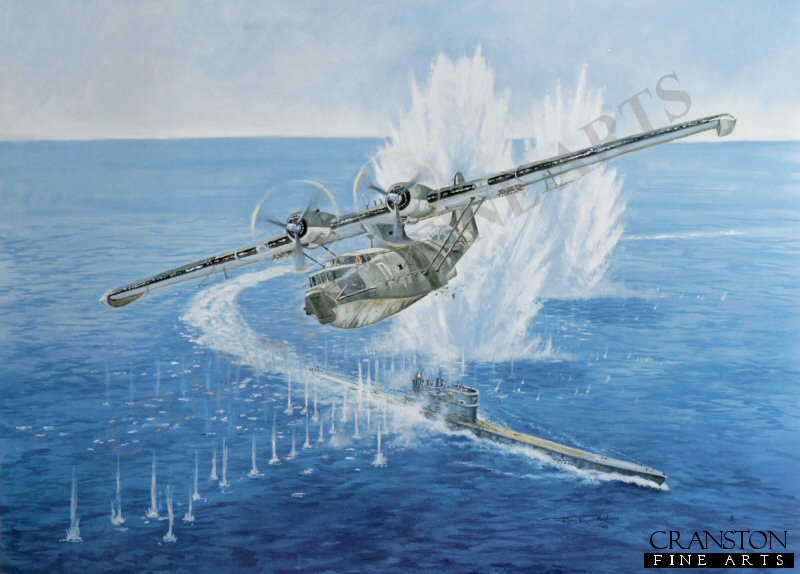
 D for Donald of 270 squadron, Royal Air Force, out of Freetown, West Africa operating in the Atlantic Ocean. It was during routine operation search that D for Donald surprised U515 on the surface and immediately attacked the submarine. U515 in putting up stiff resistance blew a large hole in the hull of D for Donald and the magazine of the starboard side 0.5 twin Browning was hit and the subsequent shrapnel wounded both blister gunners. U515 escaped but was sunk by an American naval hunter group a year later. D for Donald limped back to base and managed to make the beach before it would sink completely.

Catalina Attack by John Wynne Hopkins.
 D for Donald of 270 squadron, Royal Air Force, out of Freetown, West Africa operating in the Atlantic Ocean. It was during routine operation search that D for Donald surprised U515 on the surface and immediately attacked the submarine. U515 in putting up stiff resistance blew a large hole in the hull of D for Donald and the magazine of the starboard side 0.5 twin Browning was hit and the subsequent shrapnel wounded both blister gunners. U515 escaped but was sunk by an American naval hunter group a year later. D for Donald limped back to base and managed to make the beach before it would sink completely.

Catalina Attack by John Wynne Hopkins.
 In early May 1941, in conditions of strict secrecy because the United States was not yet at war, seventeen pilots of the US Navy had arrived in Britain and been attached to Catalina squadrons of Coastal Command.  These experienced PBY pilots were there to assist the Royal Air Force to become familiar with the Catalina, and also to gain operational experience for the US Navy.  On 26th May 1941 Catalina Z of No.209 Sqn, commanded by Flying Officer Dennis Briggs RAF, with Ensign Leonard B Smith USN as co-pilot, joined the search for the Bismarck.  At 1015 the aircraft was being flown in poor visibility at an altitude of 500ft when Ensign Smith sighted the Bismarck at a range of eight miles.  The Catalina was flown towards the contact so that a positive identification could be made and emerged from the cloud only 500 yards from the German ship.  The aircraft met a hail of anti-aircraft fire but was able to make its escape.  As a result of the sighting report from Catalina Z the Bismarck was again engaged by ships and aircraft of the Royal Navy and was sunk at 1040 on 27th May 1941.  Leonard Smith can be considered therefore, the first American to be directly involved in action in World War Two.  He was awarded the Distinguished Flying Cross (American) for his actions.

The Aircraft That Found the Bismarck by Ivan Berryman.
 In early May 1941, in conditions of strict secrecy because the United States was not yet at war, seventeen pilots of the US Navy had arrived in Britain and been attached to Catalina squadrons of Coastal Command.  These experienced PBY pilots were there to assist the Royal Air Force to become familiar with the Catalina, and also to gain operational experience for the US Navy.  On 26th May 1941 Catalina Z of No.209 Sqn, commanded by Flying Officer Dennis Briggs RAF, with Ensign Leonard B Smith USN as co-pilot, joined the search for the Bismarck.  At 1015 the aircraft was being flown in poor visibility at an altitude of 500ft when Ensign Smith sighted the Bismarck at a range of eight miles.  The Catalina was flown towards the contact so that a positive identification could be made and emerged from the cloud only 500 yards from the German ship.  The aircraft met a hail of anti-aircraft fire but was able to make its escape.  As a result of the sighting report from Catalina Z the Bismarck was again engaged by ships and aircraft of the Royal Navy and was sunk at 1040 on 27th May 1941.  Leonard Smith can be considered therefore, the first American to be directly involved in action in World War Two.  He was awarded the Distinguished Flying Cross (American) for his actions.

The Aircraft That Found the Bismarck by Ivan Berryman.
Signatures on these products
*The value given for each signature has been calculated by us based on the historical significance and rarity of the signature and is for the unmatted version where available. Values of many pilot signatures have risen in recent years and will likely continue to rise as they become more and more rare.
NameInfo


Flight Lieutenant John Cruickshank VC
*Signature Value : £75

Editions signed :

Victoria Cross signature edition of 210 prints.


Cruickshank, John
(Flight Lieutenant John Cruickshank VC)

Joined the Territorial Army in April 1939 and was mobilized for active service at the outbreak of World War II. He served mostly in south east England. In July 1941 he transferred to the RAF for aircrew duties, undergoing pilot training with the US Navy at Pensacola, Florida and gaining his pilot's wings in June 1942. Following a short period with the RAF Ferry Command in Canada and further operational training in the UK he joined 210 Sqdn based at Pembroke Dock, South Wales and later Poole Bay, Dorset. As captain of a Catalina flying boat, he carried out Anti-U-boat patrols in the Bay of Biscay and the Eastern Atlantic Ocean until December 1943. During this period, he carried out a detachment to Gibraltar for similar duties. In early 1944 elements of his Sqdn were moved to Sullom Voe in the Shetland Islands for Anti U-boat duties and General Maritime Reconnaissance in northern waters. In mid July 1944, while on an Anti U-boat patrol west of the Lofoten Islands, they sighted and attacked a surfaced German U-boat. During the attack, the aircraft received extensive damage from the U-boat's armaments also suffering crew casualties. The aircraft remained airborne and returned to base. For this action three members of the crew were decorated with the Distinguished Flying Cross, the Distinguished Flying Medal, and the Victoria Cross. Following this episode, Cruickshank became tour expired and moved to staff duties at Headquarters, Coastal Command, Northwood, near London. He was released from active service in early 1946 and returned to a civilian occupation.
Aircraft Related to This Print
Catalina

Contact Details
Shipping Info
Terms and Conditions
Cookie Policy
Privacy Policy

Sign Up To Our Newsletter!

Stay up to date with all our latest offers, deals and events as well as new releases and exclusive subscriber content!

This website is owned by Cranston Fine Arts.  Torwood House, Torwoodhill Road, Rhu, Helensburgh, Scotland, G848LE

Contact: Tel: (+44) (0) 1436 820269.  Email: cranstonorders -at- outlook.com

Return to Home Page