Cranston Military Prints .com Home Page
Customer Helpline (UK) : 01436 820269
Subscribe to our Newsletter!

You currently have no items in your basket

Payment Options Display
Buy with confidence and security!
Publishing historical art since 1985


Navigation Menus
Military
Art Index
Aviation
Art Index
Naval
Art Index
Artists
Index
Product Search         
Aviation
History Archive
Naval
History Archive
HALF PRICE AND FREE PRINT SPECIAL OFFERS
ALWAYS GREAT OFFERS :
20% FURTHER PRICE REDUCTIONS ON HUNDREDS OF LIMITED EDITION ART PRINTS
BUY ONE GET ONE HALF PRICE ON THOUSANDS OF PAINTINGS AND PRINTS
FOR MORE OFFERS SIGN UP TO OUR FREE NEWSLETTER
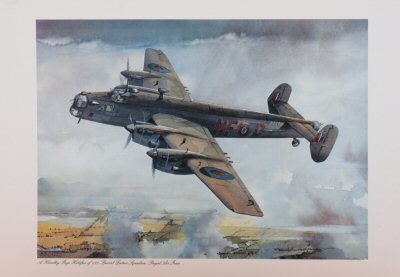
Handley Page Halifax by Stanley Gleed. - Cranston Military Prints

Handley Page Halifax by Stanley Gleed.


Handley Page Halifax by Stanley Gleed.

138 Special Duties Squadron. Missions included dropping SOE and other Resistance Operatives into enemy held territory.
Item Code : VAR0322Handley Page Halifax by Stanley Gleed. - Editions AvailableExtra....


A photograph of the print.

DESCRIPTIONSIZESIGNATURESOFFERSPRICEPURCHASINGPACKS
Open edition print. Image size 18 inches x 14 inches (46cm x 36cm)none£10 Off!
Add any two items on this offer to your basket, and the lower priced item will be half price in the checkout!
Now : £40.00

Quantity:


Some other related items available from this site.

 A cold winters morning, as dawn breaks over RAF Lissett, revealing that last nights biting wind has once again brought a covering of snow to the airfield.  But, with conditions forecast to improve, tonights operation to bomb industrial targets in Germany is set to proceed, and ground crew start to prepare Halifax Mk3 LV907 F-Freddy, simply known as Friday 13th, for action.  This iconic aircraft flew an impressive total of 128 operational sorties with 158 Squadron between March 1944 and April 1945.

Action This Day by Richard Taylor.
 Halifax Tugs Towing Hamilcar Gliders.  Halifax glider tugs of 644 Squadron based at Tarrant Rushton head out across the English Channel with their Hamilcar gliders as part of Operation Overlord in June 1944.  The mighty Hamilcar was capable of carrying an 8-ton payload, which was the equivalent of two Tetrarch light tanks, and was used both in the Normandy invasion and at Arnhem.

Operation Mallard by Ivan Berryman.
On August 15th 1942, under the leadership of Don Bennet, a new group was formed from Bomber Command to develop specialised target finding and target  marking. Made up purely from experienced volunteers, this elite and highly trained group of men were known as the Pathfinders. Up until this point the means available to Bomber Command of accurately finding their targets were totally lacking and the task of the Pathfinders was to develop techniques to precisely define these targets ahead of the main force.  Initially made up of four Squadrons  Nos. 7 (Stirlings) 35 (Halifax) 83 (Lancaster) and 156 (Wellingtons)  they were based at a clutch of airfields between Cambridge and Huntingdon. Originally part of No.3 Group Bomber Command the Pathfinder Force was directly answerable to C-in-C Air Marshal Arthur Harris until January 1943 when it became a separate group, No.8 (PFF)  .  Personally selected for the task by Arthur Harris, the Australian born Don Bennet, just 32 years of age proved to be and inspired choice to form the Pathfinders. A navigation expert without peers he was widely experienced in flying all types of aircraft including fighters, flying boats and bombers and already an experienced operational bomber captain. Along with many of his colleagues, such as Hamish Mahaddie and John Searby he was responsible for instilling in his men the Pathfinder Spirit - an intangible quality of dedication which bonded them together.  Pathfinder crews used a combination of personal skill and technical equipment to locate their targets. Often flying against overwhelming odds and in appalling conditions they transformed the performance of a bomber force that in 1941 was dropping almost half its bombs on open countryside.  The first Pathfinder unit to fly the Halifax was 35 Squadron based at Graveley. With some of the greatest Bomber Aircrew amongst their number the unit quickly gained a reputation for excellence that was second to none.  This superb painting from one of the worlds most highly regarded Aviation Artists, Gerald Coulson, depicts a Halifax B.MkII series 1A of 35 (PFF) Squadron on an operation over occupied Europe. Flying at around 20,000 feet and completely alone and unprotected, the crew navigate their bomber well ahead of the main force, leading the way to their target.

Leading the Way by Gerald Coulson.
 One of 6,176 Halifaxes built during World War II, NA337(2P-X) was shot down over Norway on 23rd April 1945.  In 1995 it was recovered from the lake that had been its watery home for fifty years and has now been restored by the Halifax Aircraft Association in Ontario, Canada.

Halifax Mk.III NA337 by Ivan Berryman.
Aircraft Related to This Print
Halifax

Contact Details
Shipping Info
Terms and Conditions
Cookie Policy
Privacy Policy

Sign Up To Our Newsletter!

Stay up to date with all our latest offers, deals and events as well as new releases and exclusive subscriber content!

This website is owned by Cranston Fine Arts.  Torwood House, Torwoodhill Road, Rhu, Helensburgh, Scotland, G848LE

Contact: Tel: (+44) (0) 1436 820269.  Email: cranstonorders -at- outlook.com

Return to Home Page