|
|
|
|
||
|
|
|
|
||
| Navigation Menus |
|
Military Art Index |
Aviation Art Index |
Naval Art Index |
Artists Index |
Aviation History Archive |
Naval History Archive |
|
| HALF PRICE AND FREE PRINT SPECIAL OFFERS | ||||||
|
| Aviation Art Collecton - No.57 Sqn |
| ||||||||||||||||||||||||||||||||||||||||||||||||||||||||||||||||||||||||||||||||||||||||||||||||||||||||||||||||||||||||||||||||||||||||||||||||||||||||||||||||||||||||||||||||||||||||||||||||||||||||||||||||||||||||||||||||||||||||||||||||
| ||||||||||||||||||||||||||||||||||||||||||||||||||||
| ||||||||||||||||||||||||||||||||||||||||||||||||||||
| Aircraft for : No.57 Sqn RAF | ||
| A list of all aircraft known to have been flown by No.57 Sqn RAF. A profile page including a list of all art prints for the aircraft is available by clicking the aircraft name. | ||
| Squadron | Info | |
Anson
Manufacturer : Avro | Anson Full profile not yet available. | |
Black Hawk
| Black Hawk Full profile not yet available. | |
Blenheim
Manufacturer : Bristol | Blenheim The Bristol Blenheim, the most plentiful aircraft in the RAFs inventory when WWII began, was designed by Frank Barnwell, and when first flown in 1936 was unique with its all metal monoplane design incorporating a retractable undercarriage, wing flaps, metal props, and supercharged engines. A typical bomb load for a Blenheim was 1,000 pounds. In the early stages of the war Blenheims were used on many daylight bombing missions. While great heroism was displayed by the air crews, tremendous losses were sustained during these missions. The Blenhiem was easy pickings at altitude for German Bf-109 fighters who quickly learned to attack from below. To protect the vulnerable bellies of the Blenheims many missions were shifted to low altitude, but this increased the aircrafts exposure to anti-aircraft fire. | |
Lancaster 
Manufacturer : Avro Production Began : 1942 Retired : 1963 Number Built : 7377 | Lancaster The Avro Lancaster arose from the avro Manchester and the first prototype Lancaster was a converted Manchester with four engines. The Lancaster was first flown in January 1941, and started operations in March 1942. By March 1945 The Royal Air Force had 56 squadrons of Lancasters with the first squadron equipped being No.44 Squadron. During World War Two the Avro Lancaster flew 156,000 sorties and dropped 618,378 tonnes of bombs between 1942 and 1945. Lancaster Bomberss took part in the devastating round-the-clock raids on Hamburg during Air Marshall Harris' Operation Gomorrah in July 1943. Just 35 Lancasters completed more than 100 successful operations each, and 3,249 were lost in action. The most successful survivor completed 139 operations, and the Lancaster was scrapped after the war in 1947. A few Lancasters were converted into tankers and the two tanker aircraft were joined by another converted Lancaster and were used in the Berlin Airlift, achieving 757 tanker sorties. A famous Lancaster bombing raid was the 1943 mission, codenamed Operation Chastise, to destroy the dams of the Ruhr Valley. The operation was carried out by 617 Squadron in modified Mk IIIs carrying special drum shaped bouncing bombs designed by Barnes Wallis. Also famous was a series of Lancaster attacks using Tallboy bombs against the German battleship Tirpitz, which first disabled and later sank the ship. The Lancaster bomber was the basis of the new Avro Lincoln bomber, initially known as the Lancaster IV and Lancaster V. (Becoming Lincoln B1 and B2 respectively.) Their Lancastrian airliner was also based on the Lancaster but was not very successful. Other developments were the Avro York and the successful Shackleton which continued in airborne early warning service up to 1992. | |
Wellington 
Manufacturer : Vickers Production Began : 1938 Retired : 1953 | Wellington The Vickers Wellington was a Bomber aircraft and also used for maritime reconnaissance. and had a normal crew of six except in the MKV and VI where a crew of three was used. Maximum speed was 235 mph (MK1c) 255 mph (MK III, X) and 299 mph (MK IIII), normal operating range of 1805 miles (except MK III which was 1470miles) The Wellington or Wimpy as it was known, was the major bomber of the Royal Air Force between 1939 and 1943. The Royal Air Force received its first Wellingtons in October 1938 to 99 squadron. and by the outbreak of World war two there were 6 squadrons equipped with the Vickers Wellington. Due to heavy losses on daylight raids, the Wellington became a night bomber and from 1940 was also used as a long range bomber in North Africa. and in 1942 also became a long range bomber for the royal Air Force in India. It was well used by Coastal Command as a U-Boat Hunter. The Wellington remained in service with the Royal Air Force until 1953. Probably due to its versatile use, The aircraft was also used for experimental work including the fitting of a pressure cabin for High altitude tests. The Vickers Wellington could sustain major damage and still fly, probably due to its construction of its geodesic structure and practical application of geodesic lines. Designed by Sir Barnes Wallis | |
| Signatures for : No.57 Sqn RAF | |||
| A list of all signatures from our database who are associated with this squadron. A profile page is available by clicking their name. | |||
| Name | Info | ||
Flt Lt Phil Ainley DFC Click the name above to see prints signed by Flt Lt Phil Ainley DFC
| Flt Lt Phil Ainley DFC Phil was 15 when war was declared on the 3rd September 1939. He had always wanted to be a pilot and the only way to do this was to join the RAF or the RAF Volunteer Reserve. However, he couldn’t join until he was 17 and so he took up an engineering apprenticeship. When Phil tried to join up again he was told he couldn’t because he was in a reserved occupation. Phil finally joined the RAF in November 1941 when he opted for aircrew as this was the only way he could get out of his apprenticeship. However, he couldn’t start his flying training until he was 17½. In November 1942, Phil was sent to St John’s Wood, to the Air Crew Receiving Centre. Here he was given a uniform and white flashes to put in his cap to show that he was aircrew. He and his colleagues spent five weeks marching around London and having inoculations. After St John’s Wood, Phil was sent to Manchester’s Heaton Park. This was a holding centre for volunteer aircrew and from here everyone was sent for specialist training as pilots, navigators, bombardiers and wireless operators. Phil was sent for pilot training in Silloth, Cumbria. Here he received just a few hours of flying in Tiger Moths and then when he was safe to fly he was passed back to Manchester. From here, Phil was selected for pilot training and was sent with a batch of naval ratings to the US Air Base Gross Ille, Michigan, USA. It was extremely cold, but even so physical exercise had to be carried out at 5.30 in the morning and in singlet and shorts! Phil passed out from his basic flying training and then proceeded to the US Aviation Base, Pensacola, Florida. Here, Phil learned to fly single engine aircraft of various types. In December 1942, Pearl Harbour was attacked and American patriotism was everywhere even on the pats of butter. Any Britons were treated as honoured guests and were adopted by local families. It was decided that Phil was better suited to multi-engine rather than single-engined aircraft and so he was sent to train on Catalina, flying boats. In May 1943 he passed out as a pilot and was awarded his American Naval Gold Wings. The advantage of Phil’s training was that he learned seamanship as well as airmanship. Once back in Great Britain Phil went to Moss Bros to purchase his brand new Pilot Officer’s uniform. His pay had gone up from 5 shillings a day to 10 shilling and 6 pence and beer was only 9d to 10d (old pence) a pint! Unfortunately, there was no need for more flying boat pilots but as Phil had multi-engined experience, he was sent to fly 4 engined aircraft. This meant further training as landing aircraft on land rather than the sea required a different technique. Once this new technique had been mastered Phil was sent to a Wellington Operation Training Unit. Here people were either picked or they did the picking of aircrew. Phil picked a Pilot Officer from the Canadian airforce as his Navigator and a fellow British Pilot Officer as his bomb aimer. It was when training on Short Stirling aircraft that Phil met the rest of his crew; a wireless operator, a Canadian mid-upper gunner, a rear gunner and a flight engineer. Phil’s wireless operator was only 17 ½ as was his rear gunner. Although they had flown in the aircraft for only a few hours, they were seen to be ready to fly Lancaster bombers and were sent to Nottinghamshire for training. This consisted of 14 hours flying time on the Lancaster, 7 hours during daylight and 7 hours at night. On the 15th May 1944, Phil and his crew were sent to 57 Squadron East Kirby, Lincolnshire. He then experienced his first operational flight, sitting alongside a ‘veteran’ pilot. They flew to Amiens where they were due to deposit bombs on marshalling yards. However, they returned with their bomb load! Phil’s first operational flight with his crew was on the 24th May. Their target was the marshalling yards in Antwerp. Things were building up for the D Day landings and so the aim of the bombing raids was to cause maximum disruption to the Germans. Although the crew were not told when D Day was to happen, they returned from a mission in the early morning on the 4th June and saw numerous ships and barges, so they knew something was occurring. By July, Phil and his crew had flown 14 missions and they were flying almost every other night. After the troops had been landed in France there were more trips into Germany and more aircraft went missing. In the summer of 1944, Phil’s logbook recorded two trips, one with 31 missing and one with 49 missing and each of those aircraft had a crew of 7 men. On the 16th August 1944 the crew were briefed to do a ‘gardening’ mission. Gardening was code for dropping sea mines. The area to be mined was the Stettin Bay Canal in Germany. The mines had to be dropped from only 250 feet and this area was fiercely guarded. Only 6 crews had been detailed to fly down the canal and Phil’s was one of them. Command had laid on an attack on the town of Stettin itself to draw attention away from the Canal. However, the bombing was delayed as the marking for the bombs was off track and the aircraft had the terrifying prospect of orbiting the target at only 250 feet, whilst marking was relaid. The aircraft in front of Phil was blown up and they had to negotiate the debris. Out of the 6 aircraft earmarked to bomb the Stettin Canal, one was blown up, one did not reach Stettin and one went missing. It was for this mission and pressing home the attack that Phil was awarded the Distinguished Flying Cross. Having successfully completed 33 missions Phil and his crew left the Squadron on the 6th October. In 2002, after 58 years Phil was re-united with his Navigator at a Re-union at East Kirkby, the Station from where they flew during the war. Sadly, Phil Ainley passed away on 19th September 2011. | ||
  Marshal of the Royal Air Force Sir Michael Beetham GCB CBE DFC AFC FRAeS Click the name or photo above to see prints signed by Marshal of the Royal Air Force Sir Michael Beetham GCB CBE DFC AFC FRAeS | Marshal of the Royal Air Force Sir Michael Beetham GCB CBE DFC AFC FRAeS Michael Beetham volunteered for the RAFVR in May 1941. After pilot training he was commissioned, and in November 1943 posted to 50 Squadron flying Lancasters at Skellingthorpe. At this time the bomber offensive was at its height, culminating in the Battle of Berlin. Sir Michael and his crew made ten trips to Berlin, lost an engine over Augsburg and took heavy damage during an attack on Leipzig. After completing his first tour and a period of instructing, Sir Michael started his second tour with 57 Squadron at East Kirby, taking part in Operation Exodus, bringing home Prisoners of War from Germany. After a distinguished post war career, Sir Michael received the RAFs top job, Chief of the Air Staff, where he was deeply involved in the Falklands War. | ||
  Flt Sergeant Stan Bradford DFM Click the name or photo above to see prints signed by Flt Sergeant Stan Bradford DFM | Flt Sergeant Stan Bradford DFM A mid-upper gunner on Lancaster ED308 D-Donald of 57 squadron RAF Bomber Command, then based at Scampton. By the end of his tour in March 1944 Stan had become an air Ace, credited by 5 Group with the shooting down of 6 enemy fighters, including a Bf109 over France on his very first operation on the night of August 27th 1943. | ||
Flight Sergeant Ken Jenkinson Click the name above to see prints signed by Flight Sergeant Ken Jenkinson | Flight Sergeant Ken Jenkinson Initially on Lancasters with 57 Sqn, as Radio Operator to pilot Ian Ross, he remained with the crew when they joined 617 Sqn and their aircraft crash landed in Russia after the first raid on the Tirpitz. | ||
Warrant Offier Ron Legg Click the name above to see prints signed by Warrant Offier Ron Legg | Warrant Offier Ron Legg Joined the RAF at Lord Cricket on 12th July 1943. Prior to that he was an engineering apprentice with a well known Bristol company. He was called to the Aircrew Selection Board at Oxford and chose to become a Flight Engineer and following a minor operation on his nose, he went to Lords Cricket Ground. After three weeks initial training in London, he went to Torquay and then to St Athans for the six months training as a Flight Engineer. He passed out in March 1944 having never flown in an aeroplane. When on his first leave, friends would say What's it like up there? he was embarrassed to admit that he had not yet flown. After his leave, he was posted to Scampton where he met the lads that had been crewed up at OTU and were destined for the Lancaster. His next posting was to Winthorpe, 1661 Heavy Conversion Unit. The aircraft was the Stirling and he flew with Sgt Anscombe for a full course; this was mainly to gain air experience. He was then crewed up with F/L Oldacre and did the same course again as the F/E. An experienced F/E flew with them until he was satisfied that they were competent. The next posting was with his crew to Syerston for a conversion on the Lancaster and then to 9 Squadron, Bardney where they did a total of about 12 hours on training flights. The pilot had to do one operation as a 2nd pilot, on that trip he was shot down but he baled out and evaded capture. They then returned to another HCU 1654 Wigsley, once again on the Stirling and another pilot W/O Ross. From there the course was completed and they went through the Lancaster finishing course once again, then to 57 Squadron East Kirkby for operational flying. the first op was a daylight raid on Wilhelmshaven 5th October 1944 and the last on 7th April 1945. His total was 31 operations. He was then posted to a holding unit for redundant aircrew and never flew again with the RAF. | ||
Flight Lieutenant Harry Lemarchant Click the name above to see prints signed by Flight Lieutenant Harry Lemarchant | Flight Lieutenant Harry Lemarchant Trained on Whitleys and was then attached to an anti-submarine unit in Cornwall. After an 11 hour flight in Dec1942, the crew were forced to bale out over Bodmin Moor. He was with 57 Sqn and then returned at the request of his CO to 97 Sqn to serve out his RAF career. | ||
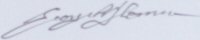
Sergeant Len Manning Click the name above to see prints signed by Sergeant Len Manning | Sergeant Len Manning As a Rear Gunner on Lancasters with 57 Sqn, his aircraft was shot down by a German Night Fighter on only his 3rd Operation on 18th April 1944. Taken in by local French civilians, they kept him in hiding until the Allies advanced through Northern France before he finally got back to Britain on 5th September 1944. | ||
Flight Lieutenant Ronald W Meeking Click the name above to see prints signed by Flight Lieutenant Ronald W Meeking | Flight Lieutenant Ronald W Meeking Undertook flying training at Heany, Southern Rhodsia and at Nakuru, Kenya, before joining 55 Squadron in the Western Desert where he flew Mark IV Blenheims and Baltimores. Following an injury, he was repatriated to the UK and eventually joined 57 Squadron at East Kirkby in December 1944. From then until 1945 he completed 16 operational flights, the last being on April 25th 1945 when he was engaged in dropping mines in Oslo fjord and upon returning to East Kirkby, the aircraft he was flying, Lancaster LM231 was the last Lancaster to return to East Kirkby from an operational flight. | ||
 Squadron Leader E Gray Ward DFC Click the name above to see prints signed by Squadron Leader E Gray Ward DFC | Squadron Leader E Gray Ward DFC After joining the RAF in November 1940, Gray Ward trained as a pilot. His first operational squadron was 50 Squadron flying Lancasters, before he joined 57 Squadron as a Flight Commander. In late 1944 he was selected to join 617 Squadron, and took part in the 22,000lb Grand Slam raids on the Bielefeld and Arnsberg viaducts. | ||
|
Contact Details |
Sign Up To Our Newsletter!
This website is owned by Cranston Fine Arts. Torwood House, Torwoodhill Road, Rhu, Helensburgh, Scotland, G848LE Contact: Tel: (+44) (0) 1436 820269. Email: cranstonorders -at- outlook.com |