Cranston Military Prints .com Home Page
Customer Helpline (UK) : 01436 820269
Subscribe to our Newsletter!

You currently have no items in your basket

Payment Options Display
Buy with confidence and security!
Publishing historical art since 1985


Navigation Menus
Military
Art Index
Aviation
Art Index
Naval
Art Index
Artists
Index
Product Search         
Aviation
History Archive
Naval
History Archive
HALF PRICE AND FREE PRINT SPECIAL OFFERS
ALWAYS GREAT OFFERS :
20% FURTHER PRICE REDUCTIONS ON HUNDREDS OF LIMITED EDITION ART PRINTS
BUY ONE GET ONE HALF PRICE ON THOUSANDS OF PAINTINGS AND PRINTS
FOR MORE OFFERS SIGN UP TO OUR FREE NEWSLETTER
No.61 Sqn - Cranston-Military-Prints.com Aviation Art Store
Aviation Art Collecton - No.61 Sqn

On July 1917 at RAF Rochford in Essex No.61 Squadron was formed and along with two other squadrons formed the London Air Defence Area intended to counter the daylight air raids. 61 squadron was equipped with the Sopwith Pup. The squadron first went into action on 12 thAugust, when a formation of 10 German Gotha bombers were seen over the Thames. Sixteen Sopwith Pups of No.61 Squadron took off to intercept them and succeeded in turning the enemy back, but not before two bombs had been dropped near No.61s hangars on Rochford Aerodrome. In 1918, 61 squadron was re-equipped with SE5s. When the armistice had been signed and the war was over 61 squadron was disbanded on 13th June 1919. No. 61 Squadron was re-formed on 8th March 1937 as a bomber squadron, and initially flying Hawker Audax, then the Avro Anson, followed by the Bristol Blenheim and during World War II flew with No. 5 Group, Bomer Command flying the Handley Page Hampden. The squadrons first operational mission was on 25th December 1939. The squadron then was equipped with the Avro Manchester. The slow delivery of the Manchester meant that the squadron operated both aircraft from July 1941 when the first Manchesters arrived, through to October 1941 when the use of the last of the Hampdens stopped. The squadron struggled on with the Manchester before converting to the Avro Lancaster in 1942, which 61 squadron flew for the rest of the war. Four of its Lancasters; ED860 N-Nan, EE176, JB138, and LL483, each served on more than 100 operational sorties. Records show that in the case of the first three aircraft, the long road to their centuries included participation in the raid on 3/4 November 1943, when Flt Lt William Reid of No. 61 Squadron won the Victoria Cross. After the war No. 61 Squadron re-equipped with Avro Lincolns in May 1946 and saw action in Malaya during Operation Firedog and during the Mau Mau uprising in Kenya. In 1954 at RAF Wittering, 61 Squadron was equipped with the new English Electric Canberra. The Canberras of the squadron were used during the Suez Crisis in 1956. Finally on March 31st 1958, 61 squadron wasd disbanded.


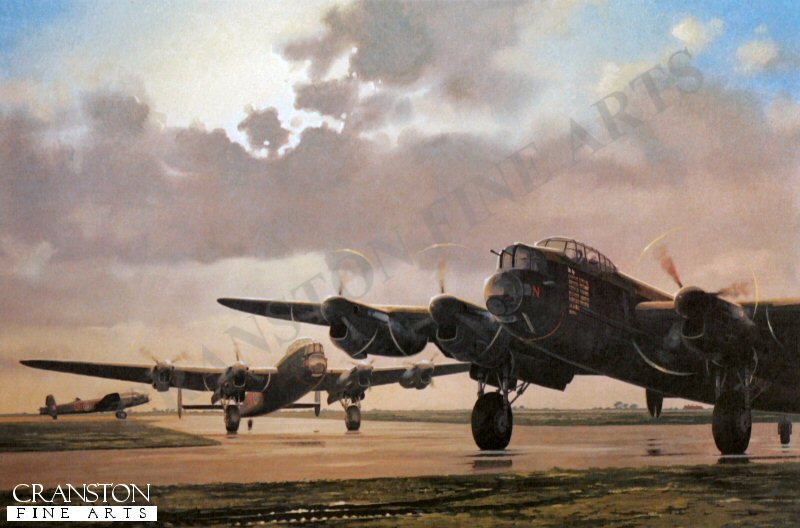
Lancaster BIIIs of 61 Sqn RAF by Keith Woodcock.


Lancaster BIIIs of 61 Sqn RAF by Keith Woodcock.

Item Code : WC0010Lancaster BIIIs of 61 Sqn RAF by Keith Woodcock. - Editions Available
FULL DETAILS
DESCRIPTIONSIZESIGNATURESOFFERSPRICEPURCHASINGPACKS
Open edition print. Image size 11 inches x 7 inches (28cm x 18cm)noneAdd any two items on this offer to your basket, and the lower priced item will be half price in the checkout!£10.00

Quantity:


No Turning Back by Robert Taylor.


No Turning Back by Robert Taylor.

A Lancaster of No. 61 Squadron, RAF, piloted by Flt. Lt. Bill Reid, under attack from a German Fw190 en route to Dusseldorf on the night of November 3rd, 1943. Already injured in a previous attack, Bill Reid was again wounded but pressed on for another 50 minutes to bomb the target, then fly his badly damaged aircraft on the long journey home. The courage and devotion to duty that earned Bill Reid the Victoria Cross, was a hallmark of RAF bomber crews throughout their long six year campaign.
Item Code : RT0304No Turning Back by Robert Taylor. - Editions Available
FULL DETAILS
DESCRIPTIONSIZESIGNATURESOFFERSPRICEPURCHASINGPACKS
Aircrew edition. Signed limited edition of 600 prints.
Great value : Value of signatures exceeds price of item!
Paper size 32 inches x 24 inches (81cm x 61cm)
Reid, Bill

Died : 2001
Flight Lieutenant Bill Reid VC (deceased)
Volunteering for RAF aircrew in 1940, Bill Reid learned to fly in California, training on the Stearman, Vultee and Harvard. After gaining his pilots wings back in England he flew Wellingtons before moving on to Lancasters in 1943. On the night of Nov 3rd 1943, his Lancaster suffered two severe attacks from Luftwaffe night fighters, badly wounding Reid, killing his navigator and radio operator, and severely damaging the aircraft. Bill flew on 200 miles to accurately bomb the target and get his
Signature Value : £80
CLICK HERE FOR FULL PROFILE
 
Broom, Ivor

Died : 2003
Air Marshal Sir Ivor Broom KCB CBE DSO DFC AFC (deceased)
Entering the RAF in 1940 he joined No 114 Squadron as a sergeant pilot flying Blenheims. After 12 operations he and his crew were allocated to No 105 Squadron and then No 107 Squadron, the last remaining Blenheim Squadron in Malta. The Squadron remained there without relief for five months carrying out low level attacks on the shipping. Very few of the original crews survived the detachment, in fact he was commissioned during this period, when 107 Squadron had lost all their officers and for
Signature Value : £50
CLICK HERE FOR FULL PROFILE
 
Burnett, Wilf
NO
PHOTO
AVAILABLE

Died : 2006
Air Commodore Wilf Burnett DSO OBE DFC AFC (deceased)
Canadian Wilf Burnett joined the RAF before the war and at the outbreak of hostilities was flying Hampdens. He completed his first tour of 30 operations in September 1940, flying with 49 Sqn at Scampton. His crew had bombed invasion barges in the Channel ports, mined enemy waters, operated against the Ruhr, and taken part in the first raids against Berlin. In July 1941 he was posted to 408 (Goose) Sqn RCAF, at Syerston, where one night in January 1942, returning from Hamburg, their Hampden cr
Signature Value : £50
CLICK HERE FOR FULL PROFILE
 
Iveson, Tony

Died : 2013
Squadron Leader Tony Iveson DFC (deceased)
Tony Iveson fought in the Battle of Britain with RAF Fighter Command, as a Sergeant pilot, joining 616 Squadron at Kenley flying Spitfires on 2 September 1940. On the 16th of September, he was forced to ditch into the sea after running out of fuel following a pursuit of a Ju88 bomber. His Spitfire L1036 ditched 20 miles off Cromer in Norfolk, and he was picked up by an MTB. He joined No.92 Sqn the following month. Commissioned in 1942, Tony undertook his second tour transferring to RAF Bomber
Signature Value : £45
CLICK HERE FOR FULL PROFILE
 
+ Artist : Robert Taylor
£60 Off!Now : £210.00

Quantity:
In 5 Pairs
and 1 Pack
View
Aircrew edition artist proofs. Limited edition of 25 artist proofs. Paper size 32 inches x 24 inches (81cm x 61cm)
Reid, Bill

Died : 2001
Flight Lieutenant Bill Reid VC (deceased)
Volunteering for RAF aircrew in 1940, Bill Reid learned to fly in California, training on the Stearman, Vultee and Harvard. After gaining his pilots wings back in England he flew Wellingtons before moving on to Lancasters in 1943. On the night of Nov 3rd 1943, his Lancaster suffered two severe attacks from Luftwaffe night fighters, badly wounding Reid, killing his navigator and radio operator, and severely damaging the aircraft. Bill flew on 200 miles to accurately bomb the target and get his
Signature Value : £80
CLICK HERE FOR FULL PROFILE
 
Burnett, Wilf
NO
PHOTO
AVAILABLE

Died : 2006
Air Commodore Wilf Burnett DSO OBE DFC AFC (deceased)
Canadian Wilf Burnett joined the RAF before the war and at the outbreak of hostilities was flying Hampdens. He completed his first tour of 30 operations in September 1940, flying with 49 Sqn at Scampton. His crew had bombed invasion barges in the Channel ports, mined enemy waters, operated against the Ruhr, and taken part in the first raids against Berlin. In July 1941 he was posted to 408 (Goose) Sqn RCAF, at Syerston, where one night in January 1942, returning from Hamburg, their Hampden cr
Signature Value : £50
CLICK HERE FOR FULL PROFILE
 
Broom, Ivor

Died : 2003
Air Marshal Sir Ivor Broom KCB CBE DSO DFC AFC (deceased)
Entering the RAF in 1940 he joined No 114 Squadron as a sergeant pilot flying Blenheims. After 12 operations he and his crew were allocated to No 105 Squadron and then No 107 Squadron, the last remaining Blenheim Squadron in Malta. The Squadron remained there without relief for five months carrying out low level attacks on the shipping. Very few of the original crews survived the detachment, in fact he was commissioned during this period, when 107 Squadron had lost all their officers and for
Signature Value : £50
CLICK HERE FOR FULL PROFILE
 
Iveson, Tony

Died : 2013
Squadron Leader Tony Iveson DFC (deceased)
Tony Iveson fought in the Battle of Britain with RAF Fighter Command, as a Sergeant pilot, joining 616 Squadron at Kenley flying Spitfires on 2 September 1940. On the 16th of September, he was forced to ditch into the sea after running out of fuel following a pursuit of a Ju88 bomber. His Spitfire L1036 ditched 20 miles off Cromer in Norfolk, and he was picked up by an MTB. He joined No.92 Sqn the following month. Commissioned in 1942, Tony undertook his second tour transferring to RAF Bomber
Signature Value : £45
CLICK HERE FOR FULL PROFILE
 
+ Artist : Robert Taylor
£90 Off!Now : £325.00

Quantity:
Bomber Command Edition. Signed limited edition of 200 prints.
Great value : Value of signatures exceeds price of item!
Paper size 32 inches x 24 inches (81cm x 61cm)
Bradford, Stan

Died : 2017
Flt Sergeant Stan Bradford DFM (deceased)
A mid-upper gunner on Lancaster ED308 D-Donald of 57 squadron RAF Bomber Command, then based at Scampton. By the end of his tour in March 1944 Stan had become an air Ace, credited by 5 Group with the shooting down of 6 enemy fighters, including a Bf109 over France on his very first operation on the night of August 27th 1943. He died on 22nd June 2017.
Signature Value : £45
CLICK HERE FOR FULL PROFILE
 
Knights, Bob

Died : 2004
Flt Lieutenant Bob Knights DSO, DFC (deceased)
A member of the elite 617 Dambusters squadron, Bob Knights had a key role on the night before D-Day. With the rest of the squadron he flew on Operation Taxable which simulated the approach of the invasion across the Pas de Calais by dropping metal strips of window to a very precise pattern. The enemy was completely deceived and kept most of their best troops on the wrong side of the Seine. Bob Knights had already flown a full operational tour with 619 Squadron Lancasters, including eight trips
Signature Value : £45
CLICK HERE FOR FULL PROFILE
 
Woolley, Dennis
NO
PHOTO
AVAILABLE

Died : 2009
Flight Lieutenant Dennis Woolley DFC DFM (deceased)
Flight Lieutenant Dennis William, Woolley. DFC, DFM. 106 (5 Group) and 83 (S-PFF- Group) Squadrons. 1940 - Volunteered for air crew service. 1941 - Trained as an Air Observer in Manitoba. 1942 - Did 1st tour, on Manchesters (6 trips) and on Lancasters (27 trips). Awarded DFM. 1942 - 3 - Instructor at Winthorpe, Notts. 1943 - Engaged in special operations relating to the advancement of the Italian campaign. Based latterly in Sicily. 1944 - Did 2nd tour in Bomber Command in 83 (PFF) Squadron. 25 t
Signature Value : £45
CLICK HERE FOR FULL PROFILE
 
Curtis, Lawrence
NO
PHOTO
AVAILABLE

Died : 2008
Squadron Leader Lawrence Curtis DFC* (deceased)
Joining the RAF in 1939, he was posted as a wireless operator firstly to 149 Squadron and then 99 Squadron on Wellingtons. He then joined OTU on Whitleys before moving firstly to 158 Squadron, and then 617 Squadron on Lancasters, where he was Unit Signals Leader for 18 months. After bomber operations he joined Transport Command in 1944. He died on 21st June 2008.
Signature Value : £40
CLICK HERE FOR FULL PROFILE
 
Newham, Douglas

Died : 2022
Flight Lieutenant Douglas Newham LVO DFC (deceased)
Douglas Newham was a navigator with 156 and 150 Squadrons, completing a tour in the middle east on Wellingtons. On his return to Britain he would spend a year instructing at navigation school before transferring to the Lancasters of 10 Squadron. Unfortunately, Douglas passed away on March 14th, 2022.
Signature Value : £40
CLICK HERE FOR FULL PROFILE
 
Farquharson, William

Died : 2012
Group Captain William Farquharson DFC (deceased)
William Farquharson was a pilot with 115 Squadron and flew Lancasters with 195 Squadron. William Farqharson was born om September 28th 1919 in Malacca, Malaya. His father was a police officer in the Colonial Service. His early schooling was in Malaya and Australia, and he completed his education at Harris Academy, Dundee, and later went to the Birmingham Central Technical College. In January 1941 William Farqharson enlisted in the Royal Air Force to become a pilot. William Farqharson joine
Signature Value : £35
CLICK HERE FOR FULL PROFILE
 
Burnside, Dudley
NO
PHOTO
AVAILABLE

Died : 2005
Group Captain Dudley Burnside DSO OBE DFC* (deceased)
Dudley joined the RAF in 1935 and in 1937 went to India flying on the North West Frontier, and Iraq. At the outbreak of war he went to Burma and in 1942 was fortunate to escape when his airfield was overrun by the Japanese. Escaping back to England he took command of 195 Squadron RCAF flying Wellingtons. In 1943 he became CO of 427 Squadron on Halifaxs, later converting to Lancasters. In the Korean War he commanded a Flying Boat Wing operating Sunderlands. He retired from the RAF in 1962.
Signature Value : £25
CLICK HERE FOR FULL PROFILE
 
Wolstenholme, Kenneth
NO
PHOTO
AVAILABLE

Died : 2002
Flight Lieutenant Kenneth Wolstenholme DFC* (deceased)
Ken Wolstenholme was a pilot first with 107 Sqn flying Blenheims before joining 8 Group Pathfinders flying Mosquitos. He completed 100 ops. After the war he became a famous sports broadcaster with the BBC. He died 26th March 2002.
Signature Value : £35
CLICK HERE FOR FULL PROFILE
 
Reid, Bill

Died : 2001
Flight Lieutenant Bill Reid VC (deceased)
Volunteering for RAF aircrew in 1940, Bill Reid learned to fly in California, training on the Stearman, Vultee and Harvard. After gaining his pilots wings back in England he flew Wellingtons before moving on to Lancasters in 1943. On the night of Nov 3rd 1943, his Lancaster suffered two severe attacks from Luftwaffe night fighters, badly wounding Reid, killing his navigator and radio operator, and severely damaging the aircraft. Bill flew on 200 miles to accurately bomb the target and get his
Signature Value : £80
CLICK HERE FOR FULL PROFILE
 
Broom, Ivor

Died : 2003
Air Marshal Sir Ivor Broom KCB CBE DSO DFC AFC (deceased)
Entering the RAF in 1940 he joined No 114 Squadron as a sergeant pilot flying Blenheims. After 12 operations he and his crew were allocated to No 105 Squadron and then No 107 Squadron, the last remaining Blenheim Squadron in Malta. The Squadron remained there without relief for five months carrying out low level attacks on the shipping. Very few of the original crews survived the detachment, in fact he was commissioned during this period, when 107 Squadron had lost all their officers and for
Signature Value : £50
CLICK HERE FOR FULL PROFILE
 
Burnett, Wilf
NO
PHOTO
AVAILABLE

Died : 2006
Air Commodore Wilf Burnett DSO OBE DFC AFC (deceased)
Canadian Wilf Burnett joined the RAF before the war and at the outbreak of hostilities was flying Hampdens. He completed his first tour of 30 operations in September 1940, flying with 49 Sqn at Scampton. His crew had bombed invasion barges in the Channel ports, mined enemy waters, operated against the Ruhr, and taken part in the first raids against Berlin. In July 1941 he was posted to 408 (Goose) Sqn RCAF, at Syerston, where one night in January 1942, returning from Hamburg, their Hampden cr
Signature Value : £50
CLICK HERE FOR FULL PROFILE
 
Iveson, Tony

Died : 2013
Squadron Leader Tony Iveson DFC (deceased)
Tony Iveson fought in the Battle of Britain with RAF Fighter Command, as a Sergeant pilot, joining 616 Squadron at Kenley flying Spitfires on 2 September 1940. On the 16th of September, he was forced to ditch into the sea after running out of fuel following a pursuit of a Ju88 bomber. His Spitfire L1036 ditched 20 miles off Cromer in Norfolk, and he was picked up by an MTB. He joined No.92 Sqn the following month. Commissioned in 1942, Tony undertook his second tour transferring to RAF Bomber
Signature Value : £45
CLICK HERE FOR FULL PROFILE
 
+ Artist : Robert Taylor
£100 Off!Now : £295.00

Quantity:


Lancaster VC by Graeme Lothian.


Lancaster VC by Graeme Lothian.

Lancasters of 61 Squadron head out for the enemy coast during the night of 3rd November 1943. Seen in the lead Lancaster is Flt Lt Bill Reid flying QR-O. After sustaining two heavy attacks by enemy night fighters, killing two crew members and injuring Reid in the head, shoulders and hands. He carried on to the target, dropping accurately his bomb load. Navigating back by Pole Star and Moon, he lost consciousness on occasions due to blood loss. He managed to find his way Shipdharn. Upon landing the undercarriage collapsed but luckily did not catch fire. For his exploits that night he was awarded the Victoria Cross.
Item Code : DHM1227Lancaster VC by Graeme Lothian. - Editions Available
FULL DETAILS
DESCRIPTIONSIZESIGNATURESOFFERSPRICEPURCHASINGPACKS
Signed limited edition of 500 giclee art prints.
Great value : Value of signatures exceeds price of item!
Image size 25 inches x 14 inches (64cm x 36cm)
Harris, George

Died : 2018
Flt Lt George Harris DFC (deceased)
George Harris went to an Operational Training Unit flying old Wellingtons and, on his last flight of the course, a night practice bombing and fighter affiliation trip, suffered an engine fire just after take-off. He came down in darkness in Sherwood Forest and came to in hospital. A wooden propeller had shattered on impact, sheared through the airframe and his seat, taking a slice out of his back and leaving him with several broken ribs, a punctured lung and lacerated kidney. His parents were w
Signature Value : £50
CLICK HERE FOR FULL PROFILE
 
Kemp, Eric

Flt Lt Eric Kemp DFC (deceased)
Flew with 578 Squadron on Halifaxes
Signature Value : £45
CLICK HERE FOR FULL PROFILE
 
Lewis, Larry

Died : 2015
Sqd Ldr Larry Lewis DFC DFM (deceased)
Squadron Leader Larry Lewis (born October 25th 1918 in Bristol, died May 12th 2014) earned the DFM as an air gunner before training as a pilot. After picking up air crash survivors from behind Japanese-held lines in Siam, he was awarded the DFC. On May 29th 1945 Japanese fighters shot down a Liberator bomber of 358 Squadron over Siam (Thailand) during a flight to drop supplies and US Special Forces to the 'Seri Thai' (Free Thailand) Resistance movement. Some of the crew and passengers su
Signature Value : £45
CLICK HERE FOR FULL PROFILE
 
Thomson, George

Sgt George B Thomson
George Thomson was trained on Stirlings and Wellingtons before converting to Lancasters and joining No.15 Sqn. He flew most of his missions on Lancaster LS-P, including missions to Stettin and Paris rail yards. While on the Paris mission, LS-M developed engine problems and was left behind by the rest of the squadron. Luckily, two P-38 Lightnings high above spotted the the struggling Lancaster and came down to escort the bomber back to base at Mildenhall. On the night of 12th September 1944,
Signature Value : £40
CLICK HERE FOR FULL PROFILE

+ Artist : Graeme Lothian
£15 Off!
Add any two items on this offer to your basket, and the lower priced item will be half price in the checkout!
Now : £125.00

Quantity:
In 2 Pairs
View
Limited edition of 50 artist proofs. Image size 30 inches x 18 inches (76cm x 46cm)
Harris, George

Died : 2018
Flt Lt George Harris DFC (deceased)
George Harris went to an Operational Training Unit flying old Wellingtons and, on his last flight of the course, a night practice bombing and fighter affiliation trip, suffered an engine fire just after take-off. He came down in darkness in Sherwood Forest and came to in hospital. A wooden propeller had shattered on impact, sheared through the airframe and his seat, taking a slice out of his back and leaving him with several broken ribs, a punctured lung and lacerated kidney. His parents were w
Signature Value : £50
CLICK HERE FOR FULL PROFILE
 
Kemp, Eric

Flt Lt Eric Kemp DFC (deceased)
Flew with 578 Squadron on Halifaxes
Signature Value : £45
CLICK HERE FOR FULL PROFILE
 
Lewis, Larry

Died : 2015
Sqd Ldr Larry Lewis DFC DFM (deceased)
Squadron Leader Larry Lewis (born October 25th 1918 in Bristol, died May 12th 2014) earned the DFM as an air gunner before training as a pilot. After picking up air crash survivors from behind Japanese-held lines in Siam, he was awarded the DFC. On May 29th 1945 Japanese fighters shot down a Liberator bomber of 358 Squadron over Siam (Thailand) during a flight to drop supplies and US Special Forces to the 'Seri Thai' (Free Thailand) Resistance movement. Some of the crew and passengers su
Signature Value : £45
CLICK HERE FOR FULL PROFILE
 
Thomson, George

Sgt George B Thomson
George Thomson was trained on Stirlings and Wellingtons before converting to Lancasters and joining No.15 Sqn. He flew most of his missions on Lancaster LS-P, including missions to Stettin and Paris rail yards. While on the Paris mission, LS-M developed engine problems and was left behind by the rest of the squadron. Luckily, two P-38 Lightnings high above spotted the the struggling Lancaster and came down to escort the bomber back to base at Mildenhall. On the night of 12th September 1944,
Signature Value : £40
CLICK HERE FOR FULL PROFILE

+ Artist : Graeme Lothian
Add any two items on this offer to your basket, and the lower priced item will be half price in the checkout!£180.00

Quantity:
Limited edition of 50 giclee canvas prints. Image size 36 inches x 20 inches (91cm x 51cm)Artist : Graeme Lothian
(on separate certificate)
£100 Off!
Add any two items on this offer to your basket, and the lower priced item will be half price in the checkout!
Now : £500.00

Quantity:
Limited edition of 50 giclee canvas prints. Image size 30 inches x 17 inches (76cm x 43cm)Artist : Graeme Lothian
(on separate certificate)
£100 Off!
Add any two items on this offer to your basket, and the lower priced item will be half price in the checkout!
Now : £400.00

Quantity:
Original painting by Graeme Lothian. Image size 30 inches x 18 inches (76cm x 46cm)
Harris, George

Died : 2018
Flt Lt George Harris DFC (deceased)
George Harris went to an Operational Training Unit flying old Wellingtons and, on his last flight of the course, a night practice bombing and fighter affiliation trip, suffered an engine fire just after take-off. He came down in darkness in Sherwood Forest and came to in hospital. A wooden propeller had shattered on impact, sheared through the airframe and his seat, taking a slice out of his back and leaving him with several broken ribs, a punctured lung and lacerated kidney. His parents were w
Signature Value : £50
CLICK HERE FOR FULL PROFILE
 
+ Artist : Graeme Lothian
£1000 Off!Now : £2800.00

Quantity:
**Limited edition of 50 giclee canvas prints. (One reduced to clear) Image size 30 inches x 17 inches (76cm x 43cm)Artist : Graeme Lothian
(on separate certificate)
Half
Price!
Now : £240.00

Quantity:


Bill Reid VC by Graeme Lothian. (P)


Bill Reid VC by Graeme Lothian. (P)

Lancaster LM360, piloted by Bill Reid, is raked by fire from stem to stern by a Luftwaffe Fw190 fighter. Bill Reid had already sustained injuries to his head, torso and hands from a previous attack by an Me110, but, with this rest of his crew unscathed from the previous attack, he had not mentioned his injuries. In the attack depicted here, the Fw190 makes a lethal attack on the already damaged bomber, killing one crew member and fatally wounding a second. Despite this, Bill Reid flew on to his target of Dusseldorf - a further 200 miles - successfully dropped his bombs, then turned for home. With the aid of the bomb aimer and flight engineer, the Lancaster made it across the Channel and headed for an airfield, with one leg of the damaged undercarriage failing on landing. Bill Reid was awarded the Victoria Cross for this mission.
Item Code : B0256Bill Reid VC by Graeme Lothian. (P) - Editions Available
FULL DETAILS
DESCRIPTIONSIZESIGNATURESOFFERSPRICEPURCHASINGPACKS
Original pencil drawing by Graeme Lothian. Size 23 inches x 16 inches (58cm x 41cm) Entire sheet shown in image.
Reid, Bill

Died : 2001
Flight Lieutenant Bill Reid VC (deceased)
Volunteering for RAF aircrew in 1940, Bill Reid learned to fly in California, training on the Stearman, Vultee and Harvard. After gaining his pilots wings back in England he flew Wellingtons before moving on to Lancasters in 1943. On the night of Nov 3rd 1943, his Lancaster suffered two severe attacks from Luftwaffe night fighters, badly wounding Reid, killing his navigator and radio operator, and severely damaging the aircraft. Bill flew on 200 miles to accurately bomb the target and get his
Signature Value : £80
CLICK HERE FOR FULL PROFILE
 
Harris, George

Died : 2018
Flt Lt George Harris DFC (deceased)
George Harris went to an Operational Training Unit flying old Wellingtons and, on his last flight of the course, a night practice bombing and fighter affiliation trip, suffered an engine fire just after take-off. He came down in darkness in Sherwood Forest and came to in hospital. A wooden propeller had shattered on impact, sheared through the airframe and his seat, taking a slice out of his back and leaving him with several broken ribs, a punctured lung and lacerated kidney. His parents were w
Signature Value : £50
CLICK HERE FOR FULL PROFILE
 
Burnett, Wilf
NO
PHOTO
AVAILABLE

Died : 2006
Air Commodore Wilf Burnett DSO OBE DFC AFC (deceased)
Canadian Wilf Burnett joined the RAF before the war and at the outbreak of hostilities was flying Hampdens. He completed his first tour of 30 operations in September 1940, flying with 49 Sqn at Scampton. His crew had bombed invasion barges in the Channel ports, mined enemy waters, operated against the Ruhr, and taken part in the first raids against Berlin. In July 1941 he was posted to 408 (Goose) Sqn RCAF, at Syerston, where one night in January 1942, returning from Hamburg, their Hampden cr
Signature Value : £50
CLICK HERE FOR FULL PROFILE
 
Petrie-Andrews, John

Flight Lieutenant John Petrie-Andrews DFC DFM
John Petrie-Andrews joined the RAF in 1940. After training as a pilot, in January 1943 he was posted to join 102 (Ceylon) Squadron at Pocklington for his first tour, flying Halifaxes. In February 1943 he transferred to 158 Squadron, still on Halifaxes. John the joined 35 Squadron, one of the original squadrons forming the Pathfinder Force. Here he flew first Halifaxes before converting to Lancasters. John Petrie-Andrews completed a total of 70 operations on heavy bombers, including 60 with
Signature Value : £50
CLICK HERE FOR FULL PROFILE

Scrivener, Norman

Died : 2007
Squadron Leader Norman Scrivener DSO DFC (deceased)
One of the top RAF navigators of the war who went on more than 100 sorties in Bomber Command. Squadron Leader Norman Scrivener was born in Birmingham in November 1915 and joined the Royal Air Force in early 1939. Norman Scrivener trained at Staverton Aerodrome, in Gloucestershire, where he discovered he suffered from air sickness. He joined 97 (New Zealand ) Squadron, became a pilot officer and was one of the first navigators to use the developing radar systems and later flew with Wing Comma
Signature Value : £60
CLICK HERE FOR FULL PROFILE
 
James, B A Jimmy

Died : 2008
Squadron Leader B A Jimmy James MC (deceased)
Squadron Leader B. A. Jimmy James, MC, survivor of the Great Escape from Stalag Luft III. Bertram Arthur James was born in India on April 17th, 1915 where his father was a tea-planter. He was educated at Kings School, Canterbury, and worked in British Columbia from 1934 until volunteering for flying training with the RAF in 1939. He was commissioned and posted to 9 Sqn flying Wellingtons from Honington in Suffolk. In June 1940 his aircraft was badly hit by flak over Holland while on a bombin
Signature Value : £50
CLICK HERE FOR FULL PROFILE
 
Strong, David M
NO
PHOTO
AVAILABLE

Died : 2011
Air Commodore D M Strong CB, AFC (deceased)
Undergoing pilot training in 1936 David Strong joined Bomber Squadron in 1937. When war broke out he was flying Whitleys with 166 Sqn then went to 104 Sqn flying Wellingtons. In 1941 whilst returning from a bombing raid over Italy his aircraft was struck by lightning and he pulled out at 200 feet over the North Sea. Unable to continue he was forced to ditch and all the crew survived but were captured and sent to Stalag Luft III. After the war he remained in the RAF and after a distinguished
Signature Value : £45
CLICK HERE FOR FULL PROFILE
 
Newham, Douglas

Died : 2022
Flight Lieutenant Douglas Newham LVO DFC (deceased)
Douglas Newham was a navigator with 156 and 150 Squadrons, completing a tour in the middle east on Wellingtons. On his return to Britain he would spend a year instructing at navigation school before transferring to the Lancasters of 10 Squadron. Unfortunately, Douglas passed away on March 14th, 2022.
Signature Value : £40
CLICK HERE FOR FULL PROFILE
 
+ Artist : Graeme Lothian
Add any two items on this offer to your basket, and the lower priced item will be half price in the checkout!£500.00

Quantity:


Aircraft for : No.61 Sqn RAF
A list of all aircraft known to have been flown by No.61 Sqn RAF. A profile page including a list of all art prints for the aircraft is available by clicking the aircraft name.
SquadronInfo

Blenheim

Click the name above to see prints featuring Blenheim aircraft.

Manufacturer : Bristol

Blenheim

The Bristol Blenheim, the most plentiful aircraft in the RAFs inventory when WWII began, was designed by Frank Barnwell, and when first flown in 1936 was unique with its all metal monoplane design incorporating a retractable undercarriage, wing flaps, metal props, and supercharged engines. A typical bomb load for a Blenheim was 1,000 pounds. In the early stages of the war Blenheims were used on many daylight bombing missions. While great heroism was displayed by the air crews, tremendous losses were sustained during these missions. The Blenhiem was easy pickings at altitude for German Bf-109 fighters who quickly learned to attack from below. To protect the vulnerable bellies of the Blenheims many missions were shifted to low altitude, but this increased the aircrafts exposure to anti-aircraft fire.

Hampden


Click the name above to see prints featuring Hampden aircraft.

Manufacturer : Handley Page
Retired : 1942
Number Built : 1500

Hampden

The Handley Page HP.52 Hampden was a twin-engine medium bomber built for the Royal Air Force and was used by Bomber Command in the early years of world war two. Along with the other medium bombers the Whitley and Wellington, the Hampden bore the brunt of the early bombing war over Europe, taking part in the first night raid on Berlin and the first 1,000-plane raid on Cologne. The newest of the three medium bombers, the Hampden was known as the Flying Suitcase because of its cramped crew conditions. A total of 226 Hampdens were in service with eight Royal Air Force squadrons by the start of the Second World War. Despite its speed and agility, in operational use the Hampden was no match for the fighters of the Luftwaffe (ME109 and FW 190) and the Hampdens role as a day bomber was brief, but Hampdens continued to operate at night on bombing raids over Germany and in mine laying (code-named gardening) in the North Sea. Almost half of the Hampdens built – 714, were lost on operations, witht he loss of 1,077 crew killed and another 739 missing. German flak accounted for 108; with one Hampden being lost due to German Barrage balloons; 263 Hampdens crashed due to a variety of causes, and 214 others were classed as missing. Luftwaffe pilots claimed 128 Hampdens, shooting down 92 at night. The Hampden soon became obsolete for its roll as a medium modern bomber, after operating mainly at night, it was retired from Bomber Command service in late 1942. but continued with Coastal Command throughout 1943 as a long-range Torpedo Bomber (the Hampden TB Mk I which carried the Mk XII torpedo in an open bomb-bay and a single 500 lb (230 kg) bomb under each wing) The Hampden was also used by the Royal Canadian Air Force and Royal New Zealand Air Force.

Lancaster


Click the name above to see prints featuring Lancaster aircraft.

Manufacturer : Avro
Production Began : 1942
Retired : 1963
Number Built : 7377

Lancaster

The Avro Lancaster arose from the avro Manchester and the first prototype Lancaster was a converted Manchester with four engines. The Lancaster was first flown in January 1941, and started operations in March 1942. By March 1945 The Royal Air Force had 56 squadrons of Lancasters with the first squadron equipped being No.44 Squadron. During World War Two the Avro Lancaster flew 156,000 sorties and dropped 618,378 tonnes of bombs between 1942 and 1945. Lancaster Bomberss took part in the devastating round-the-clock raids on Hamburg during Air Marshall Harris' Operation Gomorrah in July 1943. Just 35 Lancasters completed more than 100 successful operations each, and 3,249 were lost in action. The most successful survivor completed 139 operations, and the Lancaster was scrapped after the war in 1947. A few Lancasters were converted into tankers and the two tanker aircraft were joined by another converted Lancaster and were used in the Berlin Airlift, achieving 757 tanker sorties. A famous Lancaster bombing raid was the 1943 mission, codenamed Operation Chastise, to destroy the dams of the Ruhr Valley. The operation was carried out by 617 Squadron in modified Mk IIIs carrying special drum shaped bouncing bombs designed by Barnes Wallis. Also famous was a series of Lancaster attacks using Tallboy bombs against the German battleship Tirpitz, which first disabled and later sank the ship. The Lancaster bomber was the basis of the new Avro Lincoln bomber, initially known as the Lancaster IV and Lancaster V. (Becoming Lincoln B1 and B2 respectively.) Their Lancastrian airliner was also based on the Lancaster but was not very successful. Other developments were the Avro York and the successful Shackleton which continued in airborne early warning service up to 1992.

Manchester

Click the name above to see prints featuring Manchester aircraft.

Manufacturer : Avro

Manchester

Full profile not yet available.
Signatures for : No.61 Sqn RAF
A list of all signatures from our database who are associated with this squadron. A profile page is available by clicking their name.
NameInfo

Wing Commander Arthur Doubleday DSO DFC MID
Click the name above to see prints signed by Wing Commander Arthur Doubleday DSO DFC MID
Wing Commander Arthur Doubleday DSO DFC MID

Flying Wellingtons then Lancasters on his 1st tour, Arthur Doubleday began his second tour on Lancasters at Waddington with 467 Sqn RAAF. From April 1944 he commanded 61 Sqn RAF Lancasters. He finished the war as Chief Instructor 75 OTU.


Warrant Officer Ken Johnson
Click the name or photo above to see prints signed by Warrant Officer Ken Johnson
Warrant Officer Ken Johnson

As a Mid-Upper Gunner he flew on Lancasters with 9 and 61 Squadrons taking part in many raids including the final attack to sink the Tirpitz in November 1944 along with attacks on Berchtesgaden, Hitlers alpine home.


Flying Officer Bill North
Click the name or photo above to see prints signed by Flying Officer Bill North

15 / 12 / 2011Died : 15 / 12 / 2011
Flying Officer Bill North

Flying Lancasters with 61 Squadron, in 1944 he was shot down over Northern France. With his aircraft badly hit, he gave the order to bale out, but as some of the crew had damaged parachutes, he elected to stay with the aircraft and crash land. Despite being badly wounded, he managed to land his Lancaster at night, and every crewmember walked away - two of them evading capture and returned to England. Bill spent the rest of the war as a POW.


Flight Lieutenant Bill Reid VC
Click the name or photo above to see prints signed by or with the mounted signature of Flight Lieutenant Bill Reid VC

28 / 11 / 2001Died : 28 / 11 / 2001
Flight Lieutenant Bill Reid VC

Volunteering for RAF aircrew in 1940, Bill Reid learned to fly in California, training on the Stearman, Vultee and Harvard. After gaining his pilots wings back in England he flew Wellingtons before moving on to Lancasters in 1943. On the night of Nov 3rd 1943, his Lancaster suffered two severe attacks from Luftwaffe night fighters, badly wounding Reid, killing his navigator and radio operator, and severely damaging the aircraft. Bill flew on 200 miles to accurately bomb the target and get his aircraft home. For this act of outstanding courage and determination he was awarded the Victoria Cross. Died 28th November 2001.


Citation for the Victoria Cross, gazetted 14th December 1943.

On the night of November 3rd, 1943, Flignt Lieutenant Reid was pilot and captain of a Lancaster aircraft detailed to attack Dusseldorf. Shortly after crossing the Dutch coast, the pilots windscreen was shattered by fire from a Messerschmitt. Owing to a failure in the heating circuit, the rear gunners hands were too cold for him to open fire immediately or to operate his microphone and so give warning of danger; but after a brief delay he managed to return the Messerschmitts fire and it was driven off. During the fight with the Messerschmitt, Flight Lieutenant Reid was wounded in the head, shoulders and hands. The elevator trimming tabs of the aircraft were damaged and it became difficult to control. The rear turret, too, was badly damaged and the communications system and compasses were put out of action. Flight Lieutenant Reid ascertained that his crew were unscathed and, saying nothing about his own injuries, he continued his mission. Soon afterwards, the Lancaster was attacked by a Focke Wulf 190. This time, the enemys fire raked the bomber from stem to stern. The rear gunner replied with his only serviceable gun but the state of his turret made accurate aiming impossible. The navigator was killed and the wireless operator fatally injured. The mid-upper turret was hit and the oxygen system put out of action. Flight Lieutenant Reid was again wounded and the flight engineer, though hit in the forearm, supplied him with oxygen from a portable supply. Flight Lieutenant Reid refused to be turned from his objective and Dusseldorf was reached some 50 minutes later. He had memorised his course to the target and had continued in such a normal manner that the bomb-aimer, who was cut off by the failure of the communications system, knew nothing of his captains injuries or of the casualties to his comrades. Photographs show that, when the bombs were released, the aircraft was right over the centre of the target. Steering by the pole star and the moon, Flight Lieutenant Reid then set course for home. He was growing weak from loss of blood. The emergency oxygen supply had given out. With the windscreen shattered, the cold was intense. He lapsed into semiconsciousness. The flight engineer, with some help from the bomb-aimer, kept the Lancaster in the air despite heavy anti-aircraft fire over the Dutch coast. The North Sea crossing was accomplished. An airfield was sighted. The captain revived, resumed control and made ready to land. Ground mist partially obscured the runway lights. The captain was also much bothered by blood from his head wound getting into his eyes. But he made a safe landing although one leg of the damaged undercarriage collapsed when the load came on. Wounded in two attacks, without oxygen, suffering severely from cold, his navigator dead, his wireless operator fatally wounded, his aircraft crippled and defenceless, Flight Lieutenant Reid showed superb courage and leadership in penetrating a further 200 miles into enemy territory to attack one of the most strongly defended targets in Germany, every additional mile increasing the hazards of the long and perilous journey home. His tenacity and devotion to duty were beyond praise.

London Gazette, 1943.


Flt Lt B S Turner DFC
Click the name above to see prints signed by Flt Lt B S Turner DFC
Flt Lt B S Turner DFC

Volunteered for the RAF in 1940 and trained as a Heavy Bomber pilot flying Tiger Moths, Airspeed Oxfords and Wellingtons at Hatfield, South Cerney and Pershore respectively. His first operational posting was to a grass field aerodrome at Feltwell where he flew Wellingtons with 75 NZ Sqn. After a tour of 37 trips mainly over Germany he then spent two and a half years as taxi driver with various navigation training flights and some two years later was posted to 61 Sqn at Skellingforth for a second tour of ops flying Lancasters - flying N for Nan on her 100th trip. After 21 ops he went to T.R.E. Defford as an experimental pilot. At that time the Air Force was preparing Tiger Force for the invasion of Japan, but because of the atomic bomb being dropped the invasion did not take place. Flying at Defford was with radar boffins testing their various offensive and defensive radar equipment in about ten different types of aircraft. In 1946 Fly Lt Turner left the Air Force.


Flight Lieutenant Murray Vagnolini
Click the name above to see prints signed by Flight Lieutenant Murray Vagnolini
Flight Lieutenant Murray Vagnolini

Completing his first tour as a Wireless Operator with 61 Sqn, he flew with 617 Sqn dropping the 12,000 lb 'Tallboy' and 22,000 lb 'Grand Slam' bombs. The war ended halfway through his second operational tour.


Flight Lieutenant Murray Valentine
Click the name above to see prints signed by Flight Lieutenant Murray Valentine
Flight Lieutenant Murray Valentine

Completing his first tour as a Wireless Operator with 61 Sqn, he flew with 617 Sqn dropping the 12,000 lb Tallboy and 22,000 lb Grand Slam bombs. The war ended halfway through his second operational tour.


Wing Commander Jim Wright DFC
Click the name or photo above to see prints signed by Wing Commander Jim Wright DFC
Wing Commander Jim Wright DFC

Upon completing his training in 1943 Jim Wright joined 61 Sqn at Syerston as a Navigator on Lancasters and served in the crew of Flight Lieutenant Ken Ames DFC and Bar. After completing 5 operations with 61 Sqn, F/L Ames and crew were posted to East Kirkby to join the newly formed 630 Squadron. After a brief spell in hospital, after a trip to Kassel on the 22 October 1943 and after completing 22 operations with 630 Squadron, Jim Wright joined 97 (Pathfinder) Squadron at Coningsby for the commencement of their 2nd tour. Jim and the crew completed 16 operations with 97 squadron with their last operation was on the 19th of September 1944. In January 1944 they completed trips to Stettin, Brunswick, Magdeburg and 4 to Berlin. Their next trip to Berlin was on 15th February 1944 followed by operations to Leipzig, Stuttgart and Augsburg. In March they went to Stuttgart, Charmand-Ferront, Stuttgart, Frankfurt and Nuremburg. In April to Toulouse, Pillau Canal (Konigsberg), Tours and Juvisy. In May, to finish their first tour, they went to Bourg. Following completion of operational duties with 97 Squadron Jim Wright was seconded to BOAC and served as an Operations Officer at Hurn and Heathrow in1945 until being demobed in October 1946. Then Jim worked for BOAC 1946 until December 1950 as an Air Traffic Control Officer (ATCO) in British West Africa (Yundum & Half Die, Gambia) and as a Flight Operations Officer at Prestwick and Heathrow before rejoining the RAF 1951 for ATCO duties until he retired in 1976.


Contact Details
Shipping Info
Terms and Conditions
Cookie Policy
Privacy Policy

Sign Up To Our Newsletter!

Stay up to date with all our latest offers, deals and events as well as new releases and exclusive subscriber content!

This website is owned by Cranston Fine Arts.  Torwood House, Torwoodhill Road, Rhu, Helensburgh, Scotland, G848LE

Contact: Tel: (+44) (0) 1436 820269.  Email: cranstonorders -at- outlook.com

Return to Home Page