|
|
|
|
||
|
|
|
|
||
| Navigation Menus |
|
Military Art Index |
Aviation Art Index |
Naval Art Index |
Artists Index |
Aviation History Archive |
Naval History Archive |
|
| HALF PRICE AND FREE PRINT SPECIAL OFFERS | ||||||
|
|
George B Thomson |
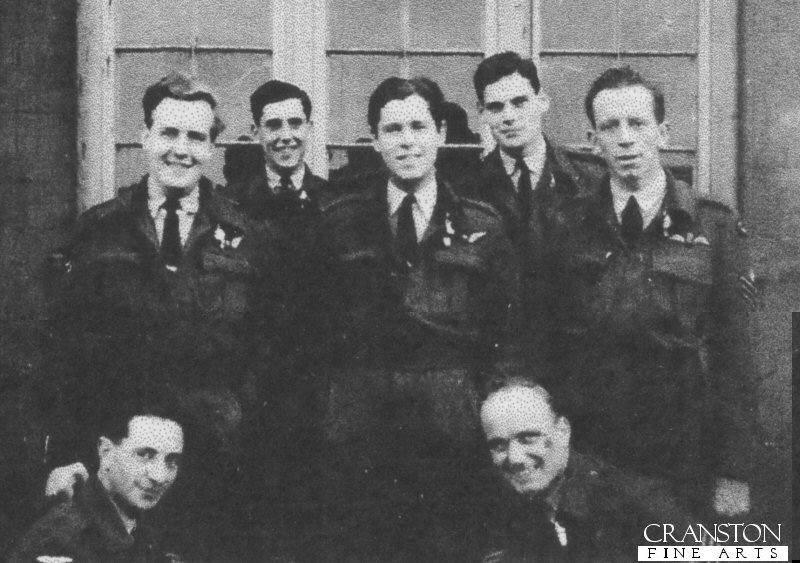
 Crew of Lancaster NF958. Name : George B Thomson |
George Thomson was trained on Stirlings and Wellingtons before converting to Lancasters and joining No.15 Sqn. He flew most of his missions on Lancaster LS-P, including missions to Stettin and Paris rail yards. While on the Paris mission, LS-M developed engine problems and was left behind by the rest of the squadron. Luckily, two P-38 Lightnings high above spotted the the struggling Lancaster and came down to escort the bomber back to base at Mildenhall. On the night of 12th September 1944, George was Navigator on Lancaster NF958 (LS-M) of No.15 Sqn, his usual aircraft LS-P grounded with engine trouble. This was to be his first and last mission on this aircraft as it was lost in the skies above Mannheim when it was attacked by the Messerschmitt Bf.110G-2 of Ofw Ludwig Schmidt of II/NGJ 6. Five of the seven crew of the aircraft, including George, managed to escape from the burning aircraft but two did not manage to escape the inferno. The aircraft came down in the vicinity of the railway station in Wieblingen, south of Mannheim. Having escaped the aircraft, he did not however manage to evade the enemy, and he was taken into captivity until the end of the war.First Op : I suppose all aircrew looked forward to their first operational flight with some trepidation, but in my own case I didn't have time to think about it, as this tale will tell. Having completed my navigation training I moved on to No. 11 O.T.U at Westcott, in December 1943, flying in Wellingtons and where I crewed up; from there it was on to 1657 Conversion Unit at Stradishall, where we flew Stirlings, then to NO.3 L.F.S. at Feltwell where we converted to Lancasters. Three rounds of circuits and bumps and one 'Bullseye' and then posted to Mildenhall in June 1944 to join XV Squadron. Arriving at Mildenhall, on my first day I reported to the Navigation Office. The Navigation Leader, F/Lt. Jack Fabian, a New Zealander, greeted me warmly enough, but was somewhat perplexed by the fact that he had another Scottish Navigator to deal with. As he said, there were already Scots known as 'Jock', 'Haggis', and 'Bagpipes', so henceforth he would call me 'Tommy'. As I was leaving his Office, he threw a fastball at me - 'Would I like to do an Op that night with a crew whose navigator had gone sick?' I was somewhat nonplussed and replied to the effect that I would have preferred to do my first Op with my own crew. To my surprise he simply said - 'That's O.K. Tommy, there will be plenty opportunities later on. 'Four days later we did a loaded climb and for some reason or another thought that we would perhaps do one or two more exercises before seeing our names on the Battle Order. Next day there seemed to be nothing on so we went our individual ways, with the Flight Engineer and myself deciding that we would go to the Camp Cinema that night. We were settled in our seats, and the big movie had just started - 'The Picture of Dorian Grey' - when a message flashed up on the screen for Sgts Howarth and Thomson to report to the Briefing Room immediately. We hurriedly left the Cinema and made our way to the Briefing Room, wondering what this was all about, when we met the aircrews coming out and getting aboard transport to be taken to their aircraft. Jack Fabian was at the door, and he handed me a Navigations Bag with the comment - You'll fmd everything in there; just follow the plane in front until you get sorted out.' We got transported out to the aircraft where the other members of the crew were already aboard, and I was still unpacking my bag as we trundled to the runway, taking off at 22.57. By the time we were in the air I had unfolded the chart and found where the target was - a 'P' Plane site at L Hey - the route there and back had already been plotted so, in effect, I was being spoon fed for my first Op.
|
Known Service Details : | |||||||
Squadron | Rank | Start of Service | End of Service | Known Dates | Aircraft | Airframes | Notes |
unknown | unknown | 12th September 1944 | |||||
Artwork signed by this Pilot or Aircrew |
  Preparing To Go - Crew of a Short Stirling by Ivan Berryman. |   Stirlings of No.90 Squadron by Ivan Berryman. |   Gunner's Moon by Ivan Berryman. (AP) |
  Stirling Work by Ivan Berryman. |   Incident over Mannheim by Ivan Berryman. |   Teamwork by Ivan Berryman. |
  The Attack on Villers Bocage by Ivan Berryman. |   MacRobert's Reply by Ivan Berryman. |   Last One Away by Ivan Berryman. |
  Operation Manna by Ivan Berryman. |   Under Cover of the Night by Simon Smith (AP) |   Last Long Shadow by Anthony Saunders (AP) |
  Jet Attack by David Pentland. (C) |   McRobert's Reply by Geoff Lea. (B) |   Distant Dispersal by Graeme Lothian. (E) |
  Lancaster VC by Graeme Lothian. |   Towards Victory by Philip West. |   Night of Strong Winds by David Pentland. |
  Outward Bound by Philip West (AP) |  In the Mists of Time by Philip West. (APB) |   Twos Company by Philip West. (AP) |
  Safely Home by Nicolas Trudgian. (B) |   Crewing Up by Graeme Lothian. |   Bombers by Keith Aspinall. (C) |
  Breaking the Silence by Keith Aspinall. (B) |   Last One Home by Keith Aspinall. (B) |   Climbing Out by Keith Aspinall. (B) |
  Predator by Keith Aspinall. (B) |   Here Comes Another One, Skipper by Keith Aspinall. (B) |   Lincolnshire Winter 1943 by Keith Aspinall. (C) |
  Stirling Mine Laying by Keith Aspinall. (B) |  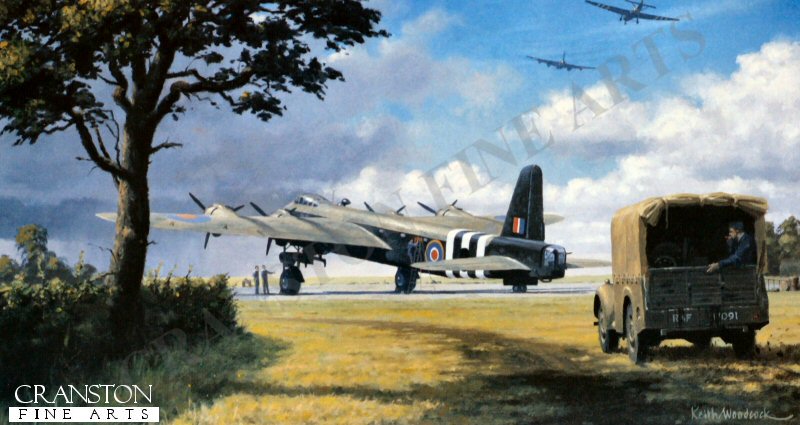 Stirlings by Keith Woodcock. (B) |   On Finals for Christmas by Keith Woodcock. (B) |
  Winter Departure by Keith Woodcock. (B) |
Photos Submitted Through Our Directory |
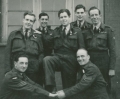 Crew of Lancaster NF958. F/O Norman Overend RNZAF Sgt Barry J Howarth (survived) Sgt George B Thomson (survived) Flt Sgt John D Jones (survived) Flt Sgt Robert P E Kendall (survived) Flt Sgt Harry A Beverton Sgt I Spagatner (survived). |
Known Individual Aircraft : | ||||||||
Type | Serial | Codes | First Flew | Squadron History | Aircrew History | History Notes | Engine | Factory |
LS-M | - | |||||||
| Aircraft for : George B Thomson | ||
| A list of all aircraft associated with George B Thomson. A profile page including a list of all art prints for the aircraft is available by clicking the aircraft name. | ||
| Aircraft | Info | |
Lancaster 
Manufacturer : Avro Production Began : 1942 Retired : 1963 Number Built : 7377 | Lancaster The Avro Lancaster arose from the avro Manchester and the first prototype Lancaster was a converted Manchester with four engines. The Lancaster was first flown in January 1941, and started operations in March 1942. By March 1945 The Royal Air Force had 56 squadrons of Lancasters with the first squadron equipped being No.44 Squadron. During World War Two the Avro Lancaster flew 156,000 sorties and dropped 618,378 tonnes of bombs between 1942 and 1945. Lancaster Bomberss took part in the devastating round-the-clock raids on Hamburg during Air Marshall Harris' Operation Gomorrah in July 1943. Just 35 Lancasters completed more than 100 successful operations each, and 3,249 were lost in action. The most successful survivor completed 139 operations, and the Lancaster was scrapped after the war in 1947. A few Lancasters were converted into tankers and the two tanker aircraft were joined by another converted Lancaster and were used in the Berlin Airlift, achieving 757 tanker sorties. A famous Lancaster bombing raid was the 1943 mission, codenamed Operation Chastise, to destroy the dams of the Ruhr Valley. The operation was carried out by 617 Squadron in modified Mk IIIs carrying special drum shaped bouncing bombs designed by Barnes Wallis. Also famous was a series of Lancaster attacks using Tallboy bombs against the German battleship Tirpitz, which first disabled and later sank the ship. The Lancaster bomber was the basis of the new Avro Lincoln bomber, initially known as the Lancaster IV and Lancaster V. (Becoming Lincoln B1 and B2 respectively.) Their Lancastrian airliner was also based on the Lancaster but was not very successful. Other developments were the Avro York and the successful Shackleton which continued in airborne early warning service up to 1992. | |
Stirling 
Manufacturer : Short Production Began : 1939 Number Built : 2381 | Stirling The Royal Air Force's first four engined monoplane Bomber, the Short Stirling first flew in May 1939 and entered front line service in August 1940 with no. 7 squadron. Due to its poor operational ceiling the aircraft sustained heavy losses and by mid 1942 the Stirling was beginning to be replaced by the Lancaster. Improved versions of the Short Stirling were built for Glider towing, paratroopers and heavy transport. also from 1943 many of the Stirling's were used for mine laying. A total of 2381 Stirling's were built for the Royal air Force and from this total 641 Stirling bombers were lost to enemy action. Crew 7 or 8: Speed: 260 mph (MK1) 275mph (MKIII) and 280mph (MKV)Service ceiling 17,000 feet Range: 2330 miles. (MK1) 2010 miles (MKIII) and 3,000 miles (MKV) Armament: two .303 Vickers machine guns. in nose turret, two .303 in browning machine guns in dorsal turret , Four .303 Browning machine guns in tail turret. Bomb Load 14,000 Lbs Engines: four 1150 Hp Bristol Hercules II (MK1) four 1650 hp Bristol Hercules XVI (MK111 and MKV) | |
Wellington 
Manufacturer : Vickers Production Began : 1938 Retired : 1953 | Wellington The Vickers Wellington was a Bomber aircraft and also used for maritime reconnaissance. and had a normal crew of six except in the MKV and VI where a crew of three was used. Maximum speed was 235 mph (MK1c) 255 mph (MK III, X) and 299 mph (MK IIII), normal operating range of 1805 miles (except MK III which was 1470miles) The Wellington or Wimpy as it was known, was the major bomber of the Royal Air Force between 1939 and 1943. The Royal Air Force received its first Wellingtons in October 1938 to 99 squadron. and by the outbreak of World war two there were 6 squadrons equipped with the Vickers Wellington. Due to heavy losses on daylight raids, the Wellington became a night bomber and from 1940 was also used as a long range bomber in North Africa. and in 1942 also became a long range bomber for the royal Air Force in India. It was well used by Coastal Command as a U-Boat Hunter. The Wellington remained in service with the Royal Air Force until 1953. Probably due to its versatile use, The aircraft was also used for experimental work including the fitting of a pressure cabin for High altitude tests. The Vickers Wellington could sustain major damage and still fly, probably due to its construction of its geodesic structure and practical application of geodesic lines. Designed by Sir Barnes Wallis | |
| Squadrons for : George B Thomson | ||
| A list of all squadrons known to have been served with by George B Thomson. A profile page is available by clicking the squadron name. | ||
| Squadron | Info | |
No.15 Sqn RAF Country : UK Founded : 1st March 1915 Aim sure | No.15 Sqn RAF On 1st March 1915, the officers and men who made up No.1 Reserve Squadron and the Recruits Depot, all of whom were based at South Farnborough, Hampshire, were brought together to form No.15 Squadron, Royal Flying Corps. Initially, the new squadron was equipped with a diverse range of flying machines, including Henri and Maurice Farmans, Avros, Bleriots, Moranes and BE2c aircraft. Having relocated to an airfield at Hounslow, west of London, where the squadron was allowed time to work up to operational status, it was, on 11th May, relocated to another airfield at Swingate Down, to the east of Dover, on the Kent coast. On 23rd December 1915, No.15 Squadron, RFC, deployed to France for operational duties. Throughout its time on the Western Front, during the First World War, the squadron was engaged in observation and reconnaissance duties, initially using BE2c aircraft but later, during June 1916, upgrading to R.E.8s. The work undertaken by the squadron, in its reconnaissance role, was recognised by higher authority, on a number of occasions, in the form of telegrams or communiqués. On 1st April 1918, No.15 Squadron became part of the newly formed Royal Air Force, which came into being with the amalgamation of the Royal Flying Corps and Royal Naval Air Service. With the end of hostilities in November 1918, came a reduction in the fighting strength of the RAF and, although not disbanded as a number of squadrons were, No.15 was reduced to a cadre. The axe finally fell on the final day of December 1919, when No.15 Squadron was disbanded. It was to be approximately five years before No.15s number plate was to be resurrected when, on 20th March 1924, No.15 Squadron was reformed as part of the Aeroplane and Armament Experimental Establishment (A&AEE), at Martlesham Heath, Suffolk. Over a period of ten years, No.15 Squadron completed 12,100 flying hours on over seventy-five different types of airframe. Over that same period, it also saw five changes of commanding officer. On 1st June 1934, No.15 was re-designated as a new unit, equipped with Hawker Hart Mk.I aircraft, undertaking daylight operations flying as part of Bomber Command. The new C.O. was Squadron Leader Thomas Elmhirst, who secured permission for his squadron to change the number plate to Roman numerals and have the XV applied to the fuselage on all the squadrons aircraft. This decision was to have a lasting effect and was only interrupted by the Second World War. Thomas Elmhirst also gave thought to the fact the squadron should have its own badge and motto, both of which were approved, during 1935. In early 1936, the squadron re-equipped with Hawker Hind bomber aircraft. These machines remained in service with No.XV until 13th July 1938, when the unit converted to Fairey Battle bomber aircraft. It was with the latter aircraft that the squadron prepared for war when, on 27th August 1939, a state of emergency was declared. History repeated itself when the Squadron returned to France on a war footing, but it was forced to return to England in order to re-equip with the Bristol Blenheim bomber. The new aircraft was initially seen as a wonder aircraft, but No.XV Squadron was virtually decimated in strength following the German invasion of the Netherlands in May 1940. With the Blenheim being designated unsuitable for the task, the squadron began converting to the Vickers Wellington bomber, designed by Barnes Wallace, on 7th November 1940. This was really a stop-gap measure as on 30th April 1941 No.XV began converting to the Short Stirling, four-engine, heavy bomber. During the next couple of years, night after night, the squadron carried the fight back to the enemy, enduring many losses and exploits of valour in the process. It participated in all the 1,000 bomber raids against Germany. As 1943 drew to a close, No.XV prepared to continue the fight with new equipment. Having converted to the Avro Lancaster bomber in late December 1943, the squadron went operational in mid-January 1944 with its new aircraft. By the time the war came to an end, No.XV was flying Lancaster B.1 Specials, which were specially adapted to carry 22,000lb Grand Slam bombs. February 1947 saw another change of equipment when the squadron converted to the Avro Lincoln bomber, whilst based at RAF Wyton in Huntingdonshire. However, by the end of that same year, No.XV found itself deploying aircraft to Shallufa, Egypt, as part of Operation Sunrise. Another change of occurred at the end of November 1950, when No.XV Squadron was disbanded but immediately reformed with Boeing B29 Washington bomber aircraft. It was during the Washington period, in March 1951, that the squadrons code letters ‘LS’, which it had been adopted during late 1939, were removed from the aircraft fuselages. The new scheme called for a natural metal finish, adorned with only the RAF roundel, fin flash and aircraft serial. With technology advancing all the time, No.XV entered a new phase in its history in June 1953, when it was declared fully operational flying English Electric Canberra bombers. During the next couple of years, the squadron continued to train and undertook many navigational and bombing exercises, which proved fruitful in 1956 when the Suez crises erupted. No.XV was deployed to Nicosia, as part of Operation Accumulate, on 23rd October. During the short period of fighting that followed, No.XV dropped a higher concentration of bombs than any other squadron. Following a cease-fire, the squadron returned to England where, on 15th April 1957, it was disbanded. The 1st of September 1958 saw the re-formation of No.XV as a V-Bomber squadron, equipped with Handley Page Victor B.I bombers. These aircraft were not only adorned with the official RAF insignia described above, but were also permitted to carry the squadron badge, together with the Roman XV numerals. The squadron retained these aircraft until 1964 when it was again disbanded. For a period of five years No.XV Squadron ceased to exist. However, this changed on 1st October 1970, when the squadron number plate and badge were resurrected and No.XV was reformed at RAF Honnington, in Suffolk. Equipped with Blackburn S.2B Buccaneer aircraft, the squadron departed for RAF Laarbruch, where, during January 1971, it officially became part of Royal Air Force Germany. After thirteen years service with the squadron, the Buccaneers were replaced with Panavia Tornado, swing-wing, bombers. On 1st September 1983, No.XV became the first RAF Squadron in Germany to be equipped with this type of aircraft. During the latter quarter of 1990, No.XV had deployed two flights, totalling twelve crews, to Muharraq Air Base, on Bahrain Island, in readiness for operations against the Iraqi dictator Saddam Hussein. During the following conflict, two aircraft crewed by XV Squadron personnel were shot down, resulting in the loss of Flt Lt Stephen Hicks and the capture of Flt Lts John Peters, John Nichol and Rupert Clark. The squadron returned to RAF Laarbruch at the end of March 1991, where a number of awards, for service in the Gulf War were announced. Wing Commander John Broardbent was awarded a Distinguished Service Order, whilst Sqn Ldr Gordon Buckley and Sqn Ldr Nigel Risdale were both awarded Distinguished Flying Crosses. Senior Engineering Officer S/L Rob Torrence was awarded the Member of the British Empire. Following disbandment in January 1992, No.XV was reformed a few months later on 1st April, at RAF Honnington, where it took on the role of the Tornado Weapons Conversion Unit. It was also granted the status of a Reserve Squadron. No.XV (R) Squadron remained at Honnington until 1st November 1993, when it re-located to RAF Lossiemouth, Moray, Scotland. During January 1998, it was re-designated as the Tornado GR1 Operational Conversion Unit and equipped with the up-graded Tornado GR4 variant. In 2011, just four years away from its 100th anniversary, No.XV (R) Squadron still operates from RAF Lossiemouth, providing refresher crews and new crews to the front line squadrons. Text by kind permission of Martyn Ford Jones | |
Return to Aviation Directory Search Home
|
Contact Details |
Sign Up To Our Newsletter!
This website is owned by Cranston Fine Arts. Torwood House, Torwoodhill Road, Rhu, Helensburgh, Scotland, G848LE Contact: Tel: (+44) (0) 1436 820269. Email: cranstonorders -at- outlook.com |