Cranston Military Prints .com Home Page
Customer Helpline (UK) : 01436 820269
Subscribe to our Newsletter!

You currently have no items in your basket

Payment Options Display
Buy with confidence and security!
Publishing historical art since 1985


Navigation Menus
Military
Art Index
Aviation
Art Index
Naval
Art Index
Artists
Index
Product Search         
Aviation
History Archive
Naval
History Archive
HALF PRICE AND FREE PRINT SPECIAL OFFERS
ALWAYS GREAT OFFERS :
20% FURTHER PRICE REDUCTIONS ON HUNDREDS OF LIMITED EDITION ART PRINTS
BUY ONE GET ONE HALF PRICE ON THOUSANDS OF PAINTINGS AND PRINTS
FOR MORE OFFERS SIGN UP TO OUR FREE NEWSLETTER
Raging Tempest by Ivan Berryman. - Cranston Military Prints

Raging Tempest by Ivan Berryman.


Raging Tempest by Ivan Berryman.

Developed from the hawker Typhoon, the first hawker Tempest MkV took to the air during September 1942 and immediately showed great promise as a most versatile aircraft. During the build up to Overlord in 1944, Tempests raged across northern France softening up the enemy defences and blocking or destroying arterial supply routes. This Hawker Tempest V is engaged in knocking out a German train as part of Roland Beamont's No.3 Squadron operations prior to D - Day.
Item Code : B0007PCRaging Tempest by Ivan Berryman. - Editions AvailableExtra....

Detail Images :


DESCRIPTIONSIZESIGNATURESOFFERSPRICEPURCHASINGPACKS
Signed limited edition of 250 prints. Image size 17 inches x 10 inches (43cm x 25cm)Artist : Ivan BerrymanSOLD
OUT
NOT
AVAILABLE
Limited edition of 50 artist proofs, printed on high quality German etching stock. Image size 17 inches x 10 inches (43cm x 25cm)Artist : Ivan Berryman£50 Off!
Add any two items on this offer to your basket, and the lower priced item will be half price in the checkout!
Now : £90.00

Quantity:
In 1 Pair
View
Lincoln, Kneen signature edition of 45 prints from the limited edition of 50 artist proofs. Image size 17 inches x 10 inches (43cm x 25cm)
Lincoln, John Abe
NO
PHOTO
AVAILABLE
Warrant Officer John Abe Lincoln
Born in 1923, Abe Lincoln joined the RAF in August 1942, spending two years training in India and Rhodesia. After training he was posted back to the UK, flying first Spitfires and then on Typhoons with 175 Squadron. The squadron was by then heavily involved with softening up targets with rockets ahead of the armies advance and close support duties at the front as the allies advanced through France into Germany. He remained with the squadron until the end of the war.
Signature Value : £45
CLICK HERE FOR FULL PROFILE

Kneen, Kenneth
NO
PHOTO
AVAILABLE

Flying Officer Kenneth Junior Kneen
Training overseas, on arriving back in the UK Ken was posted to Holland joining 175 Squadron flying Typhoons. The squadron at the time being heavily engaged in low level bombing strikes against rail and armoured targets along the Dutch German border region. He remained with the squadron until the end of the war, then joined the RAFVR.
Signature Value : £45
CLICK HERE FOR FULL PROFILE

+ Artist : Ivan Berryman


Signature(s) value alone : £90
£110 Off!Now : £90.00
Better Than
Half Price!

Quantity:
In 1 Pair
View
Collector's Postcard - Restricted Initial Print Run of 40 cards.Postcard size 6 inches x 4 inches (15cm x 10cm)none£2.90

Quantity:


Some other related items available from this site.

Aircraft History:  JN751 was built at Hawkers Langley factory and delivered to No. 20 MU at Aston Down 20th February 1944. Delivered to No.486 (NZ) Squadron initially, and subsequently received by No.3 Squadron, it became the personal aircraft of Wing Commander R P Beamont. On 8th June 1944, it became the first Tempest to shoot down and enemy aircraft (Bf109G-6, JN751 was hit in the starboard wing by a cannon shell in this combat) and during June/August it shot down over 30 V-1 flying bombs. On 1st September, following an engine failure on take-off, JN751 made a forced landing at Langley. Repaired 2nd September, Wing Commander Beamont collected the aircraft from Langley on 5th September and returned to Newchurch - this was his last flight in JN751. Returned to No.20 MU on 3rd October 1944, it was delivered to No.287 Squadron at Hornchurch on anti aircraft co-operation duties. On 18th May 1945, whilst trying to avoid a fog bank JN751 crashed on the Isle of Sheppey, killing the pilot, Flight Sergeant P.C.A. Redstone. <br><br>Wing Commander Roland P Beamont, CBE, DSO and bar, DFC and bar, DFC (USA), DL:    Born on 10th August 1920, Roland Beamont joined No87. Squadron in France during November 1939. Returning to England 20th May 1940 (having destroyed a Do17 and an Me109) he went on to destroy a further three enemy aircraft during the Battle of Britain. In June 1941 he was posted to No79 Squadron as a Flight Commander. In December 1941, he went to Hawker Aircraft Limited as a Service test pilot flying Hurricanes. On 29th June 1942, he was posted as Flight Commander to Hawker Typhoon equipped No.609 (WR) squadron at Duxford, and took command of the squadron in October. He returned to Hawker Aircraft during May 1943, to test fly the Tempest. In February 1944, he was tasked with forming the first Tempest Wing, No.150 at Castle Camps and later Newchurch. When leader of the five squadron Tempest Wing No.122 over Germany on 12th October 1944, Roland Beamont was shot down by ground fire, and became a POW. During his time with Nos 150 and 122 Wings he destroyed one Bf109, one Fw190, one Ju88 on the ground and thirty two V1 flying bombs. After the war Roland Beamont became Chief Test Pilot for English Electric, test flying the Canberra, P1, Lightning and TSR2 aircraft. He was the first British pilot to fly a British aircraft at Mach 1 in level flight, and later at Mach 2. After serving as Director of Flight operations for the Tornado test programme he retired and became a respected author.

Hawker Tempest Mk V JN751 R-B. by M A Kinnear.
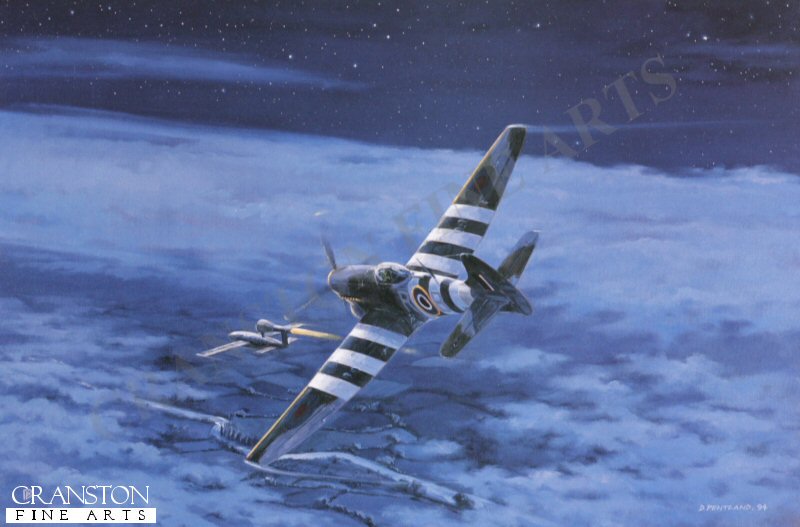
 Wing Commander Roland Beaumont in his personal Tempest V, intercepted and downed his first V1 Buzzbomb on the night of June 22nd, 1944, over south east England. As Commander of 150 wing and others he went on to shoot down a total of 30 V1 flying bombs, 8 enemy aircraft and 35 locomotives destroyed plus one minesweeper sunk.

A Buzz for Beamont by David Pentland
Wing Commander Roland Beamont in his personal Tempest V, intercepted and downed his first V1 Buzzbomb on the night of June 22nd, 1944, over south east England. As Commander of 150 wing and others he went on to shoot down a total of 30 V1 flying bombs, 8 enemy aircraft and 35 locomotives destroyed plus one minesweeper sunk.

A Buzz for Beamont by David Pentland.
 By mid-1941 it was clear that Hitlers plans to invade Britain were in disarray. The RAF had fought the Luftwaffe to a standoff, and many of Germanys top pilots had been killed or captured. Not willing to admit defeat in his campaign against Britain, Hitler approved the development of a pilotless terror weapon, the VF-1 Vergeltungswaffe (retaliation weapon). Designed by the Feiseler Company, the small pilotless Fi-103 was at times referred to in Britain as the doodlebug, buzz bomb, or farting fury. These flying bombs were inexpensive to build and were capable of carrying an 1870-pound warhead. The Fi-103  was powered by a ram-jet engine, and utilized three air driven gyroscopes to orient the aircraft. A rudimentary pre-set propeller device was utilized to determine when the VF-1 would land. Lacking the accuracy necessary to make it an effective weapon against military targets these doodlebugs were primarily targeted at large population centers. Therefore, they were primarily used as civilian terror weapons, and the RAF was given the assignment of providing the defense against these terror weapons. Early testing revealed many problems with the VF-1, and it was not until March 1944 that most of these problems had been worked out. The final VF-1 production models were capable of speeds in excess of 400 MPH . The high speed of the VF-1, coupled with its small size and large warhead, made it difficult for the RAF to shoot down these doodlebugs. The doodlebug had strong sheet steel skin which deflected machine gunfire, making it necessary to utilize cannon fire. Cannons had more than twice the range of machine guns, but the attacking fighters had to get in close to hit these small, fast targets. If the pilot got in too close the explosion of the VF-1s heavy warhead often disabled the attacking fighter. An alternative was to deflect the doodlebug by maneuvering alongside it, and then by executing a gentle banking maneuver, flip the VF-1, and disrupt its gyros. Generally, this caused the doodlebug to crash in an unpopulated area with little damage. Less than 10% of the buzz bombs were destroyed in this manner, and this technique was only utilized when the pilot had depleted his ammunition. One of the top buzz-bomb exterminators was Wing Commander Roland Beamont who destroyed 32 doodlebugs during his tour of duty. He flew the Tempest V with 150 Wing, which he commanded. The three squadrons of 150 Wing were credited with destroying 630 buzz bombs between June and August of 1944. The Hawker Tempest was the fastest interceptor available, and provided its pilots a highly stable platform for its four 20mm cannon. The Meteor, the RAFs first jet, was utilized briefly as a buzz bomb interceptor, but with only nine kills, it was withdrawn as being unsuitable for this purpose. As depicted in Stan Stokes painting appropriately entitled The Exterminator, Wing Commander Beamont is depicted flying his Tempest V through the debris created by a successful hit on a buzz bomb in July, 1944. The action takes place southeast of London over the tranquil English countryside.

The Exterminator by Stan Stokes.
Signatures on these products
*The value given for each signature has been calculated by us based on the historical significance and rarity of the signature and is for the unmatted version where available. Values of many pilot signatures have risen in recent years and will likely continue to rise as they become more and more rare.
NameInfo
Warrant Officer John Abe Lincoln
*Signature Value : £45

Editions signed :

Lincoln, Kneen signature edition of 45 prints from the limited edition of 50 artist proofs.


Lincoln, John Abe
(Warrant Officer John Abe Lincoln)

Born in 1923, Abe Lincoln joined the RAF in August 1942, spending two years training in India and Rhodesia. After training he was posted back to the UK, flying first Spitfires and then on Typhoons with 175 Squadron. The squadron was by then heavily involved with softening up targets with rockets ahead of the armies advance and close support duties at the front as the allies advanced through France into Germany. He remained with the squadron until the end of the war.


Flying Officer Kenneth Junior Kneen
*Signature Value : £45

Editions signed :

Lincoln, Kneen signature edition of 45 prints from the limited edition of 50 artist proofs.


Kneen, Kenneth
(Flying Officer Kenneth Junior Kneen)

Training overseas, on arriving back in the UK Ken was posted to Holland joining 175 Squadron flying Typhoons. The squadron at the time being heavily engaged in low level bombing strikes against rail and armoured targets along the Dutch German border region. He remained with the squadron until the end of the war, then joined the RAFVR.
Squadrons Related to This Print
No.3 Sqn
Aircraft Related to This Print
Tempest

Contact Details
Shipping Info
Terms and Conditions
Cookie Policy
Privacy Policy

Sign Up To Our Newsletter!

Stay up to date with all our latest offers, deals and events as well as new releases and exclusive subscriber content!

This website is owned by Cranston Fine Arts.  Torwood House, Torwoodhill Road, Rhu, Helensburgh, Scotland, G848LE

Contact: Tel: (+44) (0) 1436 820269.  Email: cranstonorders -at- outlook.com

Return to Home Page