|
|
|
|
||
|
|
|
|
||
| Navigation Menus |
|
Military Art Index |
Aviation Art Index |
Naval Art Index |
Artists Index |
Aviation History Archive |
Naval History Archive |
|
| HALF PRICE AND FREE PRINT SPECIAL OFFERS | ||||||
|
| ||||||||||||||||||||||||||||||||||||||||||||||||||||||||||||||||||||||||||||||||||||||||||||
Some other related items available from this site. | ||||
 Winter Combat by Nicolas Trudgian |   Dora-Nine by Ivan Berryman. |  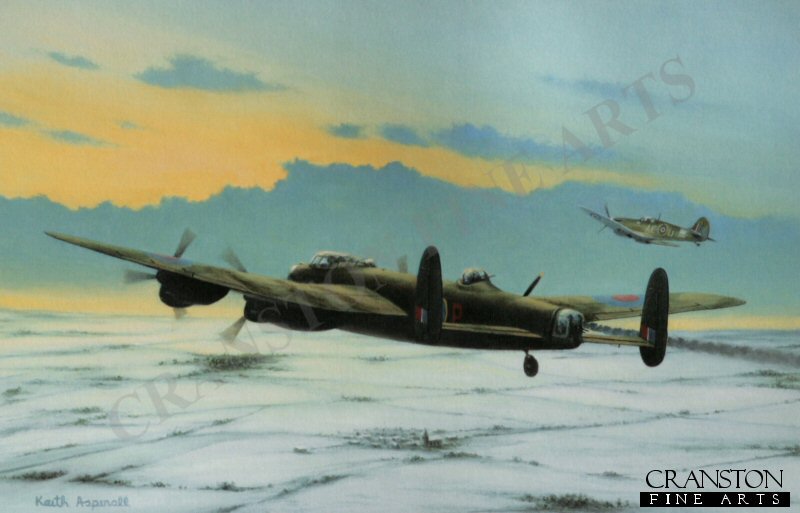 Last One Home by Keith Aspinall. |   The Shining Sword by Simon Smith | |
| Signatures on these products | |
| *The value given for each signature has been calculated by us based on the historical significance and rarity of the signature and is for the unmatted version where available. Values of many pilot signatures have risen in recent years and will likely continue to rise as they become more and more rare. | |
| Name | Info |
  Flight Lieutenant Bill Reid VC (deceased) Died : 2001 *Signature Value : £80 Editions signed : Original pencil drawing by Graeme Lothian. | Reid, Bill (Flight Lieutenant Bill Reid VC (deceased)) Volunteering for RAF aircrew in 1940, Bill Reid learned to fly in California, training on the Stearman, Vultee and Harvard. After gaining his pilots wings back in England he flew Wellingtons before moving on to Lancasters in 1943. On the night of Nov 3rd 1943, his Lancaster suffered two severe attacks from Luftwaffe night fighters, badly wounding Reid, killing his navigator and radio operator, and severely damaging the aircraft. Bill flew on 200 miles to accurately bomb the target and get his aircraft home. For this act of outstanding courage and determination he was awarded the Victoria Cross. Died 28th November 2001. |
  Flt Lt George Harris DFC (deceased) Died : 2018 *Signature Value : £50 Editions signed : Original pencil drawing by Graeme Lothian. | Harris, George (Flt Lt George Harris DFC (deceased)) George Harris went to an Operational Training Unit flying old Wellingtons and, on his last flight of the course, a night practice bombing and fighter affiliation trip, suffered an engine fire just after take-off. He came down in darkness in Sherwood Forest and came to in hospital. A wooden propeller had shattered on impact, sheared through the airframe and his seat, taking a slice out of his back and leaving him with several broken ribs, a punctured lung and lacerated kidney. His parents were warned he may not survive but within six weeks he was flying again, back in Wellingtons, then on Halifaxes, before finally moving on to Lancasters and a posting, along with three other crews, to No 1 Group 101 Squadron in Ludford Magna, Lincolnshire. It had taken three years of training and frustration and now he and his crew were replacements for those recently killed in action. The squadron's Lancasters were equipped with the radio jamming system known as the Airborne Cigar, or ABC. It covered the frequencies used by the Luftwaffe but its presence also deprived them of a vital navigational aid which heightened their vulnerability. On average only one in four crews survived and that was the case with those Harris had been posted with: all were lost, the first on its first operation. His missions ranged from major night attacks on Germany and tactical support attacks on German troop strongholds, communication centres, V-1 flying bomb sites and airfields in France and the Low Countries. He was subsequently invited to take his crew to the Pathfinder Force but turned down the opportunity as it would have meant leaving behind his German-speaking Special Operator, which he felt was wrong. Anyway, he regarded 101 as a very special squadron with huge spirit and said the Lancaster was 'a simply splendid' aircraft to fly. Among his hair-raising exploits were coping with another engine fire – resulting in an emergency landing on three engines with a full bomb load – braving electric storms which could throw the Lancasters around like corks and dodging the searchlights above enemy territory. On one occasion, returning from a night raid on Brunswick on 12th August 1944, the searchlights locked on him and he desperately performed a violent corkscrew manoeuvre to escape the beams. Failing to shake them off, he dived at full bore with a full bomb load, descending so rapidly the navigator said he had exceeded the plane's reported break-up speed. The slipstream and engine noise was like a banshee, he recalled. Miraculously they remained in one piece to tell the tale and, after debrief, took an idyllic stroll back to their quarters as the sun rose and the dawn chorus began. That night 24 of their men did not return and 101 maintained its reputation as a 'chop' squadron. Reflecting on the end of his operational tour with his Lancaster Z-Zebra, he said he felt strangely flat, rather old and empty but had gained much, including the sheer freedom and joy of flying, the magic of cloud hopping and, as a flight commander, the responsibility for life and death decisions over other men. His award of the DFC, for valour in the face of the enemy, was announced in February 1945. Seventy years later he received the Legion D'honneur for his part in the operations to liberate Caen. After the war he completed a BA in modern languages and economics at St John's College, Cambridge and took posts at Liverpool and Glasgow universities before moving to the Mobil Oil Company in 1954. Four years later he joined PA Management Consultants and in 1967 established executive search company Canny Bowen and Associates, the UK arm of the US firm Canny Bowen, undertaking searches at chairman, managing director and director level for major British and international companies. George died on 17th January 2018 in Tunbridge Wells, aged 95. |
 Air Commodore Wilf Burnett DSO OBE DFC AFC (deceased) Died : 2006 *Signature Value : £50 Editions signed : Original pencil drawing by Graeme Lothian. | Burnett, Wilf (Air Commodore Wilf Burnett DSO OBE DFC AFC (deceased)) Canadian Wilf Burnett joined the RAF before the war and at the outbreak of hostilities was flying Hampdens. He completed his first tour of 30 operations in September 1940, flying with 49 Sqn at Scampton. His crew had bombed invasion barges in the Channel ports, mined enemy waters, operated against the Ruhr, and taken part in the first raids against Berlin. In July 1941 he was posted to 408 (Goose) Sqn RCAF, at Syerston, where one night in January 1942, returning from Hamburg, their Hampden crashed in extreme weather. Wilf was the sole survivor, and he was hospitalised. Recovering he was accepted to command 138 (Special Duties) Sqn at Tempsford who were engaged in dropping agents and supplies to the Resistance in occupied countries flying Halifaxes, later Stirlings. He died 26th November 2006. |
  Flight Lieutenant John Petrie-Andrews DFC DFM *Signature Value : £50 Editions signed : Original pencil drawing by Graeme Lothian. | Petrie-Andrews, John (Flight Lieutenant John Petrie-Andrews DFC DFM) John Petrie-Andrews joined the RAF in 1940. After training as a pilot, in January 1943 he was posted to join 102 (Ceylon) Squadron at Pocklington for his first tour, flying Halifaxes. In February 1943 he transferred to 158 Squadron, still on Halifaxes. John the joined 35 Squadron, one of the original squadrons forming the Pathfinder Force. Here he flew first Halifaxes before converting to Lancasters. John Petrie-Andrews completed a total of 70 operations on heavy bombers, including 60 with the Pathfinders. |
  Squadron Leader Norman Scrivener DSO DFC (deceased) Died : 2007 *Signature Value : £60 Editions signed : Original pencil drawing by Graeme Lothian. | Scrivener, Norman (Squadron Leader Norman Scrivener DSO DFC (deceased)) One of the top RAF navigators of the war who went on more than 100 sorties in Bomber Command. Squadron Leader Norman Scrivener was born in Birmingham in November 1915 and joined the Royal Air Force in early 1939. Norman Scrivener trained at Staverton Aerodrome, in Gloucestershire, where he discovered he suffered from air sickness. He joined 97 (New Zealand ) Squadron, became a pilot officer and was one of the first navigators to use the developing radar systems and later flew with Wing Commander Guy Gibson (before Gibson moved to the Dambusters.) with 106 Squadron and in 1943 joined the Pathfinders of 83 Squadron as navigator to the Squadron Commander John Searby and took part in the raid on the German radar facilities in Peenemunde where the German V2 and V1 rockets were produced and tested. Squadron Leader Norman Scrivener was awarded the Distinguished Flying Cross and the Distinguished Flying Order. Sadly Squadron Leader Norman Scrivener died in Worcester aged 91 in May 2007. |
  Squadron Leader B A Jimmy James MC (deceased) Died : 2008 *Signature Value : £50 Editions signed : Original pencil drawing by Graeme Lothian. | James, B A Jimmy (Squadron Leader B A Jimmy James MC (deceased)) Squadron Leader B. A. Jimmy James, MC, survivor of the Great Escape from Stalag Luft III. Bertram Arthur James was born in India on April 17th, 1915 where his father was a tea-planter. He was educated at Kings School, Canterbury, and worked in British Columbia from 1934 until volunteering for flying training with the RAF in 1939. He was commissioned and posted to 9 Sqn flying Wellingtons from Honington in Suffolk. In June 1940 his aircraft was badly hit by flak over Holland while on a bombing raid to Germany and he was forced to bail out. He was captured and taken prisoner but then embarked on what was to become a prolific period of escaping including the Great Escape from Stalag Luft III. Jimmy James was one of 76 officers who escaped from Stalag Luft III on the night of March 24, 1944, and was fortunate not to be among the 50 executed on Hitlers order on recapture. He was sent instead to Sachsenhausen concentration camp from where he tunnelled his way out, only to be caught again after 14 days on the run. He was awarded the MC and mentioned in dispatches for his escape attempts. Squadron Leader B. A. Jimmy James retired from the RAF in 1958 and held a number of posts in the Diplomatic Service. He was the general-secretary of the Foreign and Commonwealth Office-sponsored Great Britain-USSR Association, until joining the Diplomatic Service in 1964. He held posts in Africa, Western and Eastern Europe and London. He retired in 1975, when he visited Sachsenhausen with Jack Churchill and other survivors. He served as the British representative on the International Sachsenhausen Committee until shortly before his death. He died on January 18th, 2008, aged 92 |
 Air Commodore D M Strong CB, AFC (deceased) Died : 2011 *Signature Value : £45 Editions signed : Original pencil drawing by Graeme Lothian. | Strong, David M (Air Commodore D M Strong CB, AFC (deceased)) Undergoing pilot training in 1936 David Strong joined Bomber Squadron in 1937. When war broke out he was flying Whitleys with 166 Sqn then went to 104 Sqn flying Wellingtons. In 1941 whilst returning from a bombing raid over Italy his aircraft was struck by lightning and he pulled out at 200 feet over the North Sea. Unable to continue he was forced to ditch and all the crew survived but were captured and sent to Stalag Luft III. After the war he remained in the RAF and after a distinguished career including Senior ASO, RAF Germany and Officer Commanding RAF Halton he retired in 1966. Sadly, David Strong passed away on 21st August 2011. |
  Flight Lieutenant Douglas Newham LVO DFC (deceased) Died : 2022 *Signature Value : £40 Editions signed : Original pencil drawing by Graeme Lothian. | Newham, Douglas (Flight Lieutenant Douglas Newham LVO DFC (deceased)) Douglas Newham was a navigator with 156 and 150 Squadrons, completing a tour in the middle east on Wellingtons. On his return to Britain he would spend a year instructing at navigation school before transferring to the Lancasters of 10 Squadron. Unfortunately, Douglas passed away on March 14th, 2022. |
| Squadrons Related to This Print |
| No.61 Sqn |
| Aircraft Related to This Print |
| Fw190 |
| Lancaster |
|
Contact Details |
Sign Up To Our Newsletter!
This website is owned by Cranston Fine Arts. Torwood House, Torwoodhill Road, Rhu, Helensburgh, Scotland, G848LE Contact: Tel: (+44) (0) 1436 820269. Email: cranstonorders -at- outlook.com |


 Signature(s) value alone : £425