Cranston Military Prints .com Home Page
Customer Helpline (UK) : 01436 820269
Subscribe to our Newsletter!

You currently have no items in your basket

Payment Options Display
Buy with confidence and security!
Publishing historical art since 1985


Navigation Menus
Military
Art Index
Aviation
Art Index
Naval
Art Index
Artists
Index
Product Search         
Aviation
History Archive
Naval
History Archive
HALF PRICE AND FREE PRINT SPECIAL OFFERS
ALWAYS GREAT OFFERS :
20% FURTHER PRICE REDUCTIONS ON HUNDREDS OF LIMITED EDITION ART PRINTS
BUY ONE GET ONE HALF PRICE ON THOUSANDS OF PAINTINGS AND PRINTS
FOR MORE OFFERS SIGN UP TO OUR FREE NEWSLETTER
Clipped Signature - James Kelly. - Cranston Military Prints

Clipped Signature - James Kelly.


Clipped Signature - James Kelly.

Served as a radio operator on Lancasters with No.419 (Canadian) Sqn of the Royal Air Force. He escaped the burning Lancaster famous for the Victoria Cross of Andrew Mynarski and hidden by the French, evaded capture and returned to England.
Item Code : CLP0888Clipped Signature - James Kelly. - Editions Available
DESCRIPTIONSIZESIGNATURESOFFERSPRICEPURCHASINGPACKS
Clipped Signature.
Great value : Value of signatures exceeds price of item!

Kelly, James

Warrant Officer James Kelly
Radio Operator Jim Kelly served RAF 419 Moose Squadron. James Kelly was the wireless operator on the fateful Mynarksi Lancaster bomber. They were flying a mission over Cambrai on the night of June 12th and 13th when the aircraft was hit. Four of the crew members: Brophy, navigator Robert Bodie, radio operator James Kelly and pilot de Breyne were hidden by the French and, except for Brophy, returned to England shortly after the crash.
Signature Value : £50
CLICK HERE FOR FULL PROFILE


Signature(s) value alone : £50
£10 Off!
Add any two items on this offer to your basket, and the lower priced item will be half price in the checkout!
Now : £45.00

Quantity:


Some other related items available from this site.

 With the threat from Hitler's increasingly belligerent regime growing, minds within Britain's Air Ministry had already identified potential targets should the unthinkable happen and war with Germany become a reality. The list included the great dams of western Germany, some of the largest in the world.  On 9 September 1939 Hitler's armies invaded Poland and, as Britain once again found herself at war with Germany, plans to attack the dams became a reality. Three were chosen as primary targets; the Möhne, Eder and Sorpe dams which between them controlled the vast supplies of water to the factories and manufacturing industries of the Ruhr. If these dams could be destroyed, the beating heart of industrial Germany would be dealt a heavy blow.  But there were problems; the range and dam defences were too great for a low-level attack by existing aircraft and commando raids were thought suicidal, with little chance of success. Barnes Wallis, however, had an idea - a cylindrical 'bouncing bomb' codenamed Upkeep - a mine designed to skip across the surface of the water clearing the torpedo nets, and explode against a dam wall at a depth that would cause maximum destruction.  To deliver his weapon, however, would require men of extraordinary flying skills, and an aircraft big enough for the job. By March 1943 all the criteria had been met; Upkeep was ready and tested, a new special squadron numbered 617 had been formed under Wing Commander Guy Gibson, and Avro's mighty Lancaster bomber was up to the task. On the evening of 16 May 1943, after weeks of intensive training, Gibson led the first wave of bombers away from RAF Scampton and set course for the Möhne dam. The Dambuster raid had begun.  Following three attempts and the tragic loss of one aircraft the dam still held; it is now the turn of Flight Lieutenant David Maltby at the controls of Lancaster AJ-J to press home his attack. With Mick Martin drawing the enemy's fire to port and Guy Gibson to starboard, Maltby holds his aircraft steady and true as bomb aimer John Fort releases their Upkeep mine.  The time was 00.49hrs on the morning of 17 May 1943 and the mine bounced to perfection, hit the target, sank, and detonated against the already damaged stone wall. Immeasurable pressure forced water through the groaning, already cracking blocks of granite until the dam could stand no more. The wall shuddered and then surrendered. 'There was a breach 100yds across,' Gibson wrote later, 'and the water, looking like stirred porridge in the moonlight, was gushing out and rolling into the Ruhr valley....'

Approach to the Möhne Dam by Anthony Saunders.
 The image shows Lancaster AJ-P attacking the Mohne dam.  Alongside is the portrait of AJ-P pilot Flt Lt H B Martin.  This aircraft was the third to attack the Mohne dam, and although the bomb was dropped successfully, it veered to the side of the dam and exploded off target.  The aircraft returned safely.<br><br><b>Crew of <i>P for Popsie</i> :</b><br><br>Pilot : Flt Lt H B Martin<br>Flight Engineer : Plt Off I Whittaker<br>Navigator : Flt Lt J F Leggo<br>Wireless Operator : Flg Off L Chambers<br>Bomb Aimer : Flt Lt R C Hay<br>Front Gunner : Plt Off B T Foxlee<br>Rear Gunner : Flt Sgt T D Simpson.

Tribute to the 617 Sqn Dambusters Crew of Lancaster AJ-P by David Pentland.
 Lancasters of 617 Sqn <i>Dambusters</i> get airborne from their Scampton base at the start of their journey to the Ruhr Valley on the night of 16th May 1943 under the codename <i>Operation Chastise</i>.  These are aircraft of the First Wave, led by Wing Commander Guy Gibson, the Second Wave having already departed some ten minutes earlier to negotiate a more northerly route to their targets.  On this momentous night, both the Möhne and Eder dams were successfully breached, whilst the Sorpe was also hit, but without serious damage.  Of the nineteen aircraft that took part in the mission, eleven returned safely.

The Dambusters by Ivan Berryman.
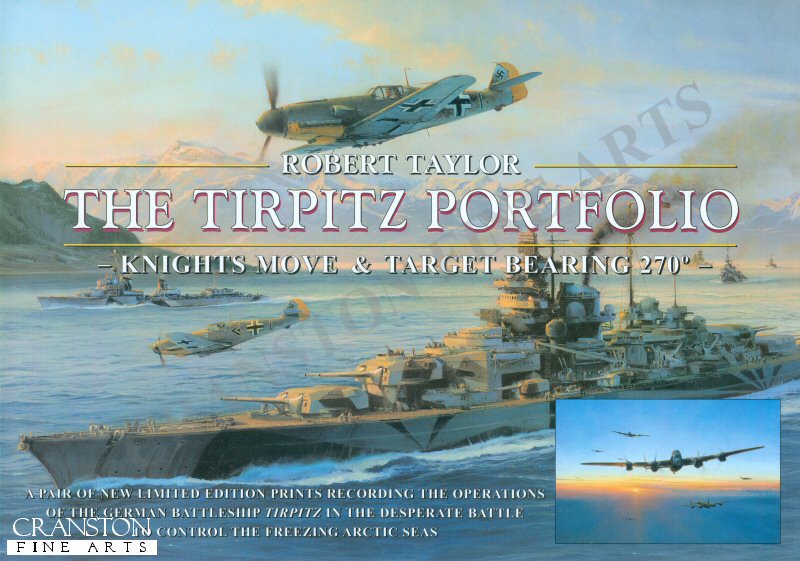
 At sunrise on 12 November, 1944, led by Wing Commander James Tait, Lancasters of 617 Squadron RAF prepare to make their bombing run on the German battleship Tirpitz, lying in the Norwegian fjord at Tromso.

Target Bearing 270 by Robert Taylor.
Signatures on these products
*The value given for each signature has been calculated by us based on the historical significance and rarity of the signature and is for the unmatted version where available. Values of many pilot signatures have risen in recent years and will likely continue to rise as they become more and more rare.
NameInfo


Warrant Officer James Kelly
*Signature Value : £50

Editions signed :

Clipped Signature.


Kelly, James
(Warrant Officer James Kelly)

Radio Operator Jim Kelly served RAF 419 Moose Squadron. James Kelly was the wireless operator on the fateful Mynarksi Lancaster bomber. They were flying a mission over Cambrai on the night of June 12th and 13th when the aircraft was hit. Four of the crew members: Brophy, navigator Robert Bodie, radio operator James Kelly and pilot de Breyne were hidden by the French and, except for Brophy, returned to England shortly after the crash.
Squadrons Related to This Print
Aircraft Related to This Print
Lancaster

Contact Details
Shipping Info
Terms and Conditions
Cookie Policy
Privacy Policy

Sign Up To Our Newsletter!

Stay up to date with all our latest offers, deals and events as well as new releases and exclusive subscriber content!

This website is owned by Cranston Fine Arts.  Torwood House, Torwoodhill Road, Rhu, Helensburgh, Scotland, G848LE

Contact: Tel: (+44) (0) 1436 820269.  Email: cranstonorders -at- outlook.com

Return to Home Page