Cranston Military Prints .com Home Page
Customer Helpline (UK) : 01436 820269
Subscribe to our Newsletter!

You currently have no items in your basket

Payment Options Display
Buy with confidence and security!
Publishing historical art since 1985


Navigation Menus
Military
Art Index
Aviation
Art Index
Naval
Art Index
Artists
Index
Product Search         
Aviation
History Archive
Naval
History Archive
HALF PRICE AND FREE PRINT SPECIAL OFFERS
ALWAYS GREAT OFFERS :
20% FURTHER PRICE REDUCTIONS ON HUNDREDS OF LIMITED EDITION ART PRINTS
BUY ONE GET ONE HALF PRICE ON THOUSANDS OF PAINTINGS AND PRINTS
FOR MORE OFFERS SIGN UP TO OUR FREE NEWSLETTER
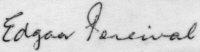
Clipped Signature - Edgar Percival. - Cranston Military Prints

Clipped Signature - Edgar Percival.


Clipped Signature - Edgar Percival.

An aviation engineer from Australia, he served with the Royal Flying Corps during World War One before designing and testing many aircraft and forming his own company - Percival Aircraft Ltd, best known for the Percival Proctor military plane. He died in 1984.

Please note that this particular signature has been written in pen - not in pencil like most of our signatures.
Item Code : CLP2858Clipped Signature - Edgar Percival. - Editions Available
DESCRIPTIONSIZESIGNATURESOFFERSPRICEPURCHASINGPACKS
Clipped Signature.
Great value : Value of signatures exceeds price of item!

Percival, Edgar W

Died : 1984
Edgar W Percival (deceased)
Mr Edgar Percival, Ceng, FRAeS, FIMechE, FIMarE, MSAE, MIAcE, FRSA. Edgar Percival was already in his basic engineering training in Australia when Louis Bleriot made his epoch making flight across the Channel in July 1909. He was severely handicapped by the time it took for news and information to reach Australia. Nevertheless he read every piece of information published.

Towards the end of 1909 and whilst studying at the Sydney Technical College, he decided to construct a man-carryi
Signature Value : £60
CLICK HERE FOR FULL PROFILE
 

Signature(s) value alone : £60
£20 Off!
Add any two items on this offer to your basket, and the lower priced item will be half price in the checkout!
Now : £40.00

Quantity:


Some other related items available from this site.

  From 1915 to 1917, there existed a very real threat of a bombing campaign on mainland Britain as the giant German airships drifted silently and menacingly across the English Channel and the North Sea to deliver their deadly cargo on the towns and cities of the east coast. Countermeasures were soon put into action as powerful searchlights picked out the Zeppelins for the anti-aircraft batteries and RFC pilots to pour their unrelenting fire into the raiders, sometimes with little effect, sometimes with catastrophic results. Here, 2nd Lieutenant Brandons BE.2 climbs for position, its exhaust pipes aglow in the dark, whilst flak bursts all around the massive bulk of the L.33 as she passes over the east end of London on the night of 23 / 24th September 1916.

A Zeppelin over London by Ivan Berryman.
This aircraft entered service with the RFC in February 1915. Nicknamed the gunbus, it was the first British aircraft to be designed as a fighting machine from the start. The plane was armed with a single .303 inch Lewis machine gun, fired by the observer. It was only a short period of time before it was outclassed by German aircraft carrying synchronised forward firing machine guns.

Vickers Gunbus FB5 by Tim Fisher
 Joined the Royal Flying Corps in 1912 and was a founder member of No.5 Sqn sent to France in WW1.  He survived the entire war, ending it with No.25 Sqn RAF.  He flew three tours in the Middle East with No.8 Sqn and No.55 Sqn, and served in non-combat roles in WW2. <br><br><b>Please note that this particular signature has been written in pen - not in pencil like most of our signatures.</b><br>

Clipped Signature - T E Guttery.
 Swamped by mud amidst a desolate, shattered landscape, men and horses of the Royal Field Artillery drag their 18 pounder field-gun towards a new position on 15 November 1917, during the final days of the Battle of Passchendaele.  Whilst the army continues its grim fight on the ground, overhead Sopwith Camels from 45 Squadron Royal Flying Corps tangle in an equally deadly duel with German Albatros fighters of Jasta 6.  Flying the lead Sopwith Camel is the RFC Ace, 2nd Lt Kenneth Montgomery who scored the last of his 12 victories in this dogfight when he shot down the German Ace Leutnant Hans Ritter von Adam, the Commanding Officer of Jasta 6 with an impressive 21 victories to his name.  To commemorate one of the most significant anniversaries in history, Anthony Saunders has created a powerful painting portraying the bleak sacrifice made by so many heroic young men.  The names of the bitter battles they endured, however, still live on a hundred years later - Ypres, the Somme, Vimy Ridge, Arras, Loos - and one of the most savage - Passchendaele.
The Big Push - Passchendaele 1917 by Anthony Saunders.
Signatures on these products
*The value given for each signature has been calculated by us based on the historical significance and rarity of the signature and is for the unmatted version where available. Values of many pilot signatures have risen in recent years and will likely continue to rise as they become more and more rare.
NameInfo


Edgar W Percival (deceased)
Died : 1984
*Signature Value : £60

Editions signed :

Clipped Signature.


Percival, Edgar W
(Edgar W Percival (deceased))

Mr Edgar Percival, Ceng, FRAeS, FIMechE, FIMarE, MSAE, MIAcE, FRSA. Edgar Percival was already in his basic engineering training in Australia when Louis Bleriot made his epoch making flight across the Channel in July 1909. He was severely handicapped by the time it took for news and information to reach Australia. Nevertheless he read every piece of information published.

Towards the end of 1909 and whilst studying at the Sydney Technical College, he decided to construct a man-carrying glider. Engines were then not available in Australia for powered aircraft. Design work on his glider began in earnest in January 1910 with first flight in early December 1910. Many flights were made during the ensuing year from a most suitable hill on his father's property, Clarendon Park, Richmond, New South Wales. He then accepted an engineering apprenticeship with a well-known firm of engineers and ship-builders in Sydney. He dismantled the glider and stored it in a loft above the stables.

In 1916 Edgar Percival was commissioned in the Royal Flying Corps (Special Reserve) and served with No.60 (Fighter) Squadron in France and No.111 (Fighter) Squadron in Palestine. In 1918 when stationed at RAF Aboukir in Egypt he designed a special purpose aircraft developed from the Bristol F2B with the Rolls-Royce Eagle engine. He personally carried out all the test and development flying on this aircraft.

In 1926 the Australian Federal Government organised a competition for locally desgned light aircraft using indigenous materials wherever possible. For this he co-designed, built and tested an aircraft in which he 94% of the total prize money. This was against considerable opposition as specifically for the competition three of the proven DH53 Humming Bird aircraft were imported from the United Kingdom. There were 15 entries in all, 10 finally took part. The extent of Percival's lead was never clearer than in the high altitude section where he reached 10,700ft, the next competitor, the only one remaining achieved 5,200ft.

In 1919 Percival became involved in operating ex-World War I aircraft in Australia on a commercial basis, many of which he specifically modified and redesigned until 1929 when he moved to the UK and devoted his attention to test flying. From the until 1931 he tested the following aircraft : Hendy Hobo, Hendy 302, Parnall Elf, Parnall Prawn (for the Schneider Trophy Race), Parnall Experimental aircraft for Farnborough test (2), Sikorsky 28 amphibian, Saunders Roe Cutty Sark, Saro-Percival Mail Carrier, Saro Windhover amphibian.

In 1931 he formed his own company, Percival Aircraft Ltd to which he then devoted his total attention and designed, built and flew the following aircraft : Percival Gull D1, D2 and D3, Percival Mew Gull E 1, Percival Vega Gull later to become the Percival Proctor for the Armed Forces, Percival Mew Gull E 2, Percival Mew Gull E 3 H - the fastest of any racing aircraft in the British Commonwealth, Percival Q 6 - a 7-seater twin-engine commercial aircraft., Percival E P 9 - a special purpose aircraft.

He died on 21st January 1984 at the age of 86.
Squadrons Related to This Print
Royal Flying Corps

Contact Details
Shipping Info
Terms and Conditions
Cookie Policy
Privacy Policy

Sign Up To Our Newsletter!

Stay up to date with all our latest offers, deals and events as well as new releases and exclusive subscriber content!

This website is owned by Cranston Fine Arts.  Torwood House, Torwoodhill Road, Rhu, Helensburgh, Scotland, G848LE

Contact: Tel: (+44) (0) 1436 820269.  Email: cranstonorders -at- outlook.com

Return to Home Page