|
|
|
|
||
|
|
|
|
||
| Navigation Menus |
|
Military Art Index |
Aviation Art Index |
Naval Art Index |
Artists Index |
Aviation History Archive |
Naval History Archive |
|
| HALF PRICE AND FREE PRINT SPECIAL OFFERS | ||||||
|
| |||||||||||||||||||||||||||||||||||||||||||||||||||||||||||||||||||||||||||||||||||||||||||||||||||||||||||||
Some other related items available from this site. | ||||
  Alfred Rubbel at Kursk by David Pentland. |   Operation Zitadelle by David Pentland. |   Arnhem Drop 17th September 1944 by Simon Smith. |  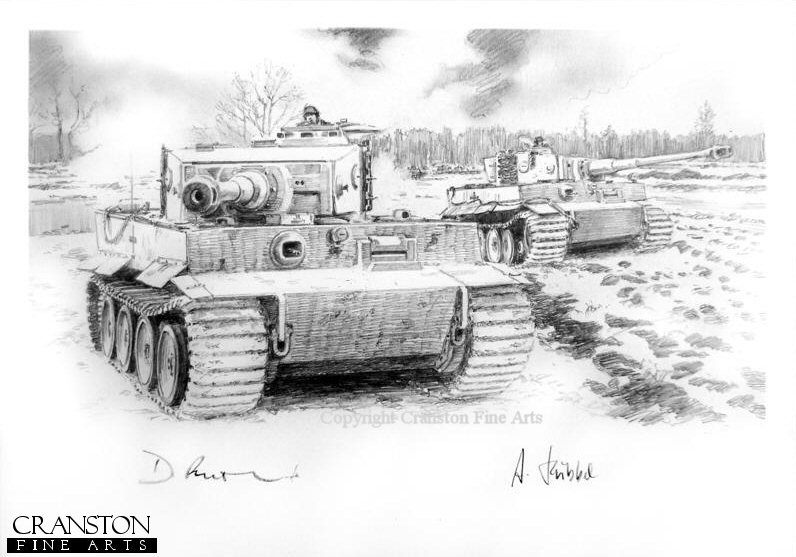 Guard Duty by David Pentland. | |
| Signatures on these products | |
| *The value given for each signature has been calculated by us based on the historical significance and rarity of the signature and is for the unmatted version where available. Values of many pilot signatures have risen in recent years and will likely continue to rise as they become more and more rare. | |
| Name | Info |
  Oberstleutnant Alfred Rubbel (deceased) Died : 2013 *Signature Value : £60 Editions signed : Alfred Rubbel Knights Cross signature edition of 25 prints, from the signed limited edition of 1150 prints. | Rubbel, Alfred (Oberstleutnant Alfred Rubbel (deceased)) Alfred Rubbel was born in Tilsit on June 28, 1921, and volunteered for the Wehrmacht at the age of eighteen. After his basic training in the infantry replacement regiment 21 and his transfer to the armoured weapon, Alfred Rubbel began the Russian campaign on 22nd June 1942 in the 9th Panzer Regiment 29 of the 12th Panzer Division. First as a charge guard in the chief battalion, then as a guardsman, he experienced the rapid advance of the Army Group to the east. In the fighting around Leningrad on September 3rd, 1941, wounded by grenade splinters, he was transferred to the homeland. In January 1942 he returned to his unit, he took part in the fighting at the Volkhov. After refreshing and rebuilding his company in Silesia, he returned to Panzer Regiment 4 with the long-handled cannon to the Eastern Front. As an unofficial and tank commander, his path led him on a long Panzer raid to the West Caucasus, where the battles in Eastern Caucasus were connected between September and December 1942. In December 1942, he and his comrades in Putlos and Paderborn began the conversion to Panzer VI Tiger. Went to 503th Panzer Division 503, and set in the railway transport in the direction of Rostov, he took part in the retreat to the Dnieper and the battle for the Kessel of Cherkassy as a Panzer commander at Operation Zitadelle, the largest tank battle of the Second World War. After officers' training courses in Ohrdruf and Krampnitz in December 1944, he moved to the 3rd Panzer Division 503, he fought in the King (Tiger II) in Hungary and Austria. At the end of the war, lieutenant of the reserve Alfred Rubbel can look back on a total balance of 57 tank victories in 79 Panzer battles on 81 deployments in the tank and 41 months on the front. He was awarded the Iron Cross I and II. Rubbel was a close friend of Kurt Knispel, a fellow tank commander of Pz Abt 503 and top-scoring Panzer Ace. |
 Hans Hossfelder *Signature Value : £70 Editions signed : Knights Cross Presentation Edition of 5 prints from the signed limited edition of 1150 prints, supplied double mounted. | Hossfelder, Hans (Hans Hossfelder) 2nd Waffen SS Division. Was part of the small group of less than ten troops who captured Belgrade along with 1300 troops in April 1941. Awarded the Iron Cross 1st Class. Hans Hossfelder was born on 29 April 1920 in Tarnowitz, a small town north of Breslau in Silesia.He had two Brothers, Hannes, Hugo, and one sister, Klara. His father was a leather tanner and merchant by trade, and had worked for the Imperial stables of the Kaiser during the First World War. The Capture of Belgrade was a interesting event in the war. As partof a Motor Cycle unit Hans Hossfelder had been sent forward to look for any method of crossing the Danube. If any bridges were intact they were to report this back and try to hold it, keeping it from being blown. But all bridges ha dbeen destriyed Aftrer managing to ferry men across the Danube in a motor boat. But the boat sank onm the third crossing whihc left Hossfelder and 6 others on the other bank of the Danube completly cut of from the rest of the unit . We had a radio, four rifles, two MP-38s, one pistol, and about twenty rounds of ammunition each. The Officer in charge Klingenberg ordered the remainder of the unit to split in two; one group would continue up river looking for a place to cross and the other would establish a security line to prevent any Yugoslav forces from attacking the units rear. Hossfleders small group was to move forward and report back on any enemy movements to our battalion commander, Obersturmbannfuehrer (SS Lieutenant Colonel) Hannes Eckhold. The small unit captures some civilians and used them as a shield as they neared Belgrade. In various captures vehicles they had passed a numbe rof Yougaslavian check points without difficulty, Just outside the city the unit were fired upon when one of the prisoners yelled out and warned his comrades. He was shot, and a 2 hour fire fight begane using up most of the units ammunition Hossfelder and his comrades managed to drive through the soldiers and entered the city where we drove to the city plaza. This was where Klingenberg showed his brilliance. He ordered Hossfelder to raise the German ensign up the flagpole. Soon the mayor arrived and began discussing the terms of surrender, thinking that they were a much larger group. Klingenberg told him that if they did not check in by radio regularly there would be a massive retaliatory bombing. Then, at that moment, German Fiesler 'Storch' flew overhead, and thinking quickly, Klingenberg told the mayor that the clock was ticking. What the mayor did not know was that the radio had taken a bullet; it could receive but not transmit. I faked radio traffic for hours, keeping up the illusion. The city agreed that that 1,300 soldiers and militia would surrender their weapons, and Klingenberg ordered the prisoners to quarter themselves in the various hotels and placed a curfew on the city. . The small unit fo 7 men collected every map and document at the mayor's office and police stations. They also had every doctor and nurse report to them, and also had the chief of police disclose all criminal records for future intelligence work. They also inventoried and stockpiled all the gasoline, oil, and vehicles, and waited. The They used POWs to repair the runway and we had the locations of all the anti-aircraft positions and mine fields. They had arrived in Belgrade on 12 April, secured the city, and the rest of our division and the headquarters of XLV Corps entered on the evening of the 13th. When the first group entered the city Hossfelder quickly explained the situation to them and had them play along. They had written them off as missing in action when the rest of the unit had not heard from us due to the radio being broken. There was a rumour that we had been captured and tortured for information. . They also found out that the High Command did not believe that Belgrade had been taken, since the force projection was for a siege, not a rapid capture, and Hausser was ordered to inspect for himself. Hossfelder and the entire unit were all decorated with the Iron Cross, and Klingenberg was presented with the Knight's Cross. Hossfelder was offered a commission and attended the academy at Bad Toelz and was able to attend the following year. The invasion of Russia interrupted the training. Hossfelder fought at Kharkov in 1942 serving under Otto Kumm, then went to the academy, where He finishedhis Offcier trainign in August 1942. and became a platoon leader, and was wounded during an artillery barrage. Hans Hossfelder spent several months recuperating and received the Iron Cross First Class, Wound Badge, and he already had the Infantry Assault and General Assault Badges. He later was assigned to the anti-tank company of 'Der Fuehrer' Regiment, and stayed all through the battle of Kursk. After the war he became a schoolteacher and retired in Munich. |
  Paul Egger (deceased) Died : 2007 *Signature Value : £70 Editions signed : Knights Cross Presentation Edition of 5 prints from the signed limited edition of 1150 prints, supplied double mounted. | Egger, Paul (Paul Egger (deceased)) Knights Cross winning tank commander, SS Panzer Abteilung 502. Received Knights Cross 28th April 1945. 7th highest scoring Panzer Ace with a score of 113. Paul Egger was born in Mautern , Austria on the 23rd November 1916 and after finnishing high school in June 1935 he worked as a clerk until joining the Luftwaffe in late 1938. paul Egger was already a Glider Pilot and was trained as a bomber Pilot joining Kampfgeschader 51., Flying the Diver Bomber Junkers JU 87 Stuka. Paul Egger took part in the Invassion of Poland. he was then transferred tp Jagdeschwader 27 becoming a fighter Pilot flying the Messerschmitt BF 109 taking part in the Battle of france and the Battle of Britain, flying a total of 112 misions and was shot down three times. He had 2 kills. In his last mission he was shot down over the English Channel and had severe head wounds which stopped him flying and he was eventually transferred to staff duties. Paul Egger voluntered for the Waffen SS in May 1941 and was trained as aanti tank gunner. After traingin ghe moved to the Motorcycle Battalion of the Das reich division and transferred later to the 8th Compnay SS Panzer Regiment 2. As a tank commander he soon hsowed skill as a commander during the battle of Kieve he destroyed 28 tanks, 14 anti tank guns, 8 artillery batteries and 40 various Russian vehicles. In February 1943 durign the Thrid battle of Kharkov he recorded his 65th tank victory but his company was all but wiped out apart form his tank and one other. Paul Egger transferred to the 102 SS Heavy Panzer battalion commanding a Tiger tank in October 1943. After the D - Day landings. Paul Egger battalion was deployed to Normandy where he fought at point 122 destroying 14 allied tanks and 4 anti tank guns. His commander reccomended him for a knights cross for this action but received a German cross in Gold instead. Egger's battalion was almost completely destroyed during the fighting and in September 1944, and reformed in Sennelager Germany and renamed the 502 SS Heavy Panzer Battalion. In 1945 Egger was promoted to Untersturmfuhrer. 502 SS Heavy Panzer Battalion was sent to the Eatsern Front and fought around Stettin. paul Egger destroyed another 19 tanks during the fighting. In April 1945 Egger was promoted to Obersturmfuhrer took over command of the 1st Company. Egger recieved the Knight's Cross by Felix Steiner the commander of the XI SS Panzer Army Commander On the 3 May 1945, Paul Egger became the seventh top panzer ace recording his 113th tank destroyed. Paul Egger escaped from berlin and the Russian but surrendered to the American forces at the River Elbe after being shoot in the arm. he became a prisoner of war for 30 months and released in November 1947. Egger became a sports reporter. In civilian life he became a sports reporter. He died on 12 July 2007. |
 Hugo Eichorn (deceased) Died : 1992 *Signature Value : £70 Editions signed : Knights Cross Presentation Edition of 5 prints from the signed limited edition of 1150 prints, supplied double mounted. | Eichorn, Hugo (Hugo Eichorn (deceased)) Panzer Ace who won the Knights Cross. Waffen SS, 5th SS Viking Division. 8 single-handed tank kills. Died 27th May 1992. |
|
Contact Details |
Sign Up To Our Newsletter!
This website is owned by Cranston Fine Arts. Torwood House, Torwoodhill Road, Rhu, Helensburgh, Scotland, G848LE Contact: Tel: (+44) (0) 1436 820269. Email: cranstonorders -at- outlook.com |


 Signature(s) value alone : £60


 Signature(s) value alone : £180