Cranston Military Prints .com Home Page
Customer Helpline (UK) : 01436 820269
Subscribe to our Newsletter!

You currently have no items in your basket

Payment Options Display
Buy with confidence and security!
Publishing historical art since 1985


Navigation Menus
Military
Art Index
Aviation
Art Index
Naval
Art Index
Artists
Index
Product Search         
Aviation
History Archive
Naval
History Archive
HALF PRICE AND FREE PRINT SPECIAL OFFERS
ALWAYS GREAT OFFERS :
20% FURTHER PRICE REDUCTIONS ON HUNDREDS OF LIMITED EDITION ART PRINTS
BUY ONE GET ONE HALF PRICE ON THOUSANDS OF PAINTINGS AND PRINTS
FOR MORE OFFERS SIGN UP TO OUR FREE NEWSLETTER
Lancaster - The Heavy Brigade by Keith Woodcock. - Cranston Military Prints

Lancaster - The Heavy Brigade by Keith Woodcock.


Lancaster - The Heavy Brigade by Keith Woodcock.

Avro Lancaster of the Royal Air Force bomber command. The classic RAF bomber of World War Two.
Item Code : DHM2418BLancaster - The Heavy Brigade by Keith Woodcock. - Editions AvailableExtra....

A photograph of the print :

DESCRIPTIONSIZESIGNATURESOFFERSPRICEPURCHASINGPACKS
Signed limited edition of 500 prints. Image size 12 inches x 6 inches (31cm x 15cm)Artist : Keith WoodcockAdd any two items on this offer to your basket, and the lower priced item will be half price in the checkout!£32.00

Quantity:
Signed limited edition, with extra aircrew signature. Image size 12 inches x 6 inches (31cm x 15cm)
White, Tony
NO
PHOTO
AVAILABLE

Warrant Officer Tony White
Served with the RAF from 1941 - 1946.
Signature Value : £15
CLICK HERE FOR FULL PROFILE

+ Artist : Keith Woodcock


Signature(s) value alone : £15
Add any two items on this offer to your basket, and the lower priced item will be half price in the checkout!£42.00

Quantity:


Some other related items available from this site.

 The crews of 617 Squadron that took part in the epic Dambusters raid on the night of 16/17 May 1943 were among the finest in the RAF. They were the elite of Bomber Command, and when they left RAF Scampton that night, the skills of their pilots - some of the finest of the Second World War, would be tested to the limit.  First, they must guide their aircraft across heavily defended enemy territory at altitudes often as low as fifty feet, dodging flak, trees, buildings and power lines.  And then they must attack their targets with a precision unmatched in the annals of the RAF.  Of all the pilots who took to the skies that night, no-one was more accomplished at low-level flying than Flight Lieutenant Mick Martin, and it is his aircraft, Lancaster AJ-P that is the subject of this artwork.  In company with Flight Lieutenant John Hopgood in the distance, they follow one of the many canals of Holland, wingtips barely missing the sails of the windmills, en-route to the Mohne Dam.

Inbound to Target - The Dambusters by Robert Taylor.
 Piloted by RAAF skipper T.N.Scholefield, No. 467 Squadrons Lancaster S For Sugar, one of RAF Bomber Commands most famous Lancs, heads out on her 100th mission on May 11, 1944. Embellished with a bomb symbol painted on the fuselage signifying each raid completed, and the infamous Hermann Goering quotation No enemy plane will fly over the Reich Territory, the mighty bomber leads a formation bound for Germany. In total she completed 137 bombing raids. Today, beautifully restored, S For Sugar proudly rests in the RAF Bomber Command Museum at Hendon, London. <br><br><i>This print has some light handling damage to outer edge of border.  If we sold framed prints, we would frame these up and sell them as new, the damage is so light.  Instead we have reduced the price online to reflect the minor damage. <br><a href=https://www.military-art.com/mall/border-damage.php>Please click here for a list of all our stock in this category.</a></b><br><br>

One Hundred Up! by Simon Atack.
Up to 1942 Bomber Command operations were beset by many problems. The means they had to accurately pinpoint the target and assault it were totally lacking, in fact their Commander in Chief, Air Marshall Arthur Harris later wrote : It was glaringly obvious that the average crew in average weather could not find their way to the target.  Between February and August 1942 an effort was made to rectify this through the development of a specialised target finding and target marking force, which became known as the Pathfinders. Activated on August 15 this new group was formed under the leadership of their AOC Air Commodore Don Bennett, himself a very experienced pre war pilot with exceptional navigational skills. The aircrews of No. 8 (PFF) Group were tasked with marking out the designated targets but the formation of this group was initially opposed by Harris. He felt that the ranks of his Main Force could be weakened if a high number of experienced and highly skilled crews were taken by this specialist unit, leading to a lessening of skills within the other bomber groups. He agreed however for an alternative scheme whereby complete units were assigned to the Pathfinder Force and the stage was then set for what was to become the Main Offensive of Bomber Command.  The first four Squadrons - Nos. 7 (Stirlings) 35 (Halifax) 83 (Lancaster) and 156 (Wellingtons) - were based at a clutch of airfields between Cambridge and Huntingdon. In the absence of any specialist Target Markers the crews were initially forced to operate using standard flares and the early raids produced variable results, with cloud cover often proving the main obstacle in accurate marking. However during the winter of 1942 the introduction of the ground guided marking system, OBOE, marked a quantum leap in accurate target marking and by mid 1943 Pathfinder techniques had been developed for all forms of weather conditions, including nights when complete overcast existed.Pathfinder crews used a combination of personal skill and technical equipment such as H2S to locate their targets. Often flying against overwhelming odds and in appalling conditions they transformed the performance of a bomber force that in 1941 was dropping almost half its bombs on open countryside. This third and final painting in Gerald Coulsons Tribute to Bomber Command depicts Lancaster Bombers of No.8 (PFF) Group returning late after a gruelling operation over Berlin. It is Christmas 1943 and the winter landscape reflects the early morning sunrise as the weary crews approach the safety of their Cambridgeshire base.

Winter Ops by Gerald Coulson.
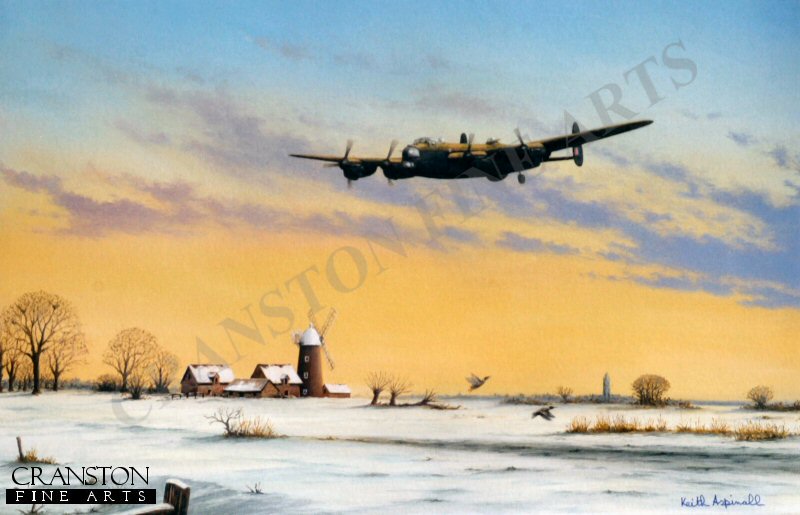
Returning from a night mission, a sole Lancaster returns over the snow covered fields of England. A fitting tribute to the air crews of the Lancaster squadrons of World War Two.

Breaking the Silence by Keith Aspinall.
Signatures on these products
*The value given for each signature has been calculated by us based on the historical significance and rarity of the signature and is for the unmatted version where available. Values of many pilot signatures have risen in recent years and will likely continue to rise as they become more and more rare.
NameInfo


Warrant Officer Tony White
*Signature Value : £15

Editions signed :

Signed limited edition, with extra aircrew signature.


White, Tony
(Warrant Officer Tony White)

Served with the RAF from 1941 - 1946.
Aircraft Related to This Print
Lancaster

Contact Details
Shipping Info
Terms and Conditions
Cookie Policy
Privacy Policy

Sign Up To Our Newsletter!

Stay up to date with all our latest offers, deals and events as well as new releases and exclusive subscriber content!

This website is owned by Cranston Fine Arts.  Torwood House, Torwoodhill Road, Rhu, Helensburgh, Scotland, G848LE

Contact: Tel: (+44) (0) 1436 820269.  Email: cranstonorders -at- outlook.com

Return to Home Page