Cranston Military Prints .com Home Page
Customer Helpline (UK) : 01436 820269
Subscribe to our Newsletter!

You currently have no items in your basket

Payment Options Display
Buy with confidence and security!
Publishing historical art since 1985


Navigation Menus
Military
Art Index
Aviation
Art Index
Naval
Art Index
Artists
Index
Product Search         
Aviation
History Archive
Naval
History Archive
HALF PRICE AND FREE PRINT SPECIAL OFFERS
ALWAYS GREAT OFFERS :
20% FURTHER PRICE REDUCTIONS ON HUNDREDS OF LIMITED EDITION ART PRINTS
BUY ONE GET ONE HALF PRICE ON THOUSANDS OF PAINTINGS AND PRINTS
FOR MORE OFFERS SIGN UP TO OUR FREE NEWSLETTER
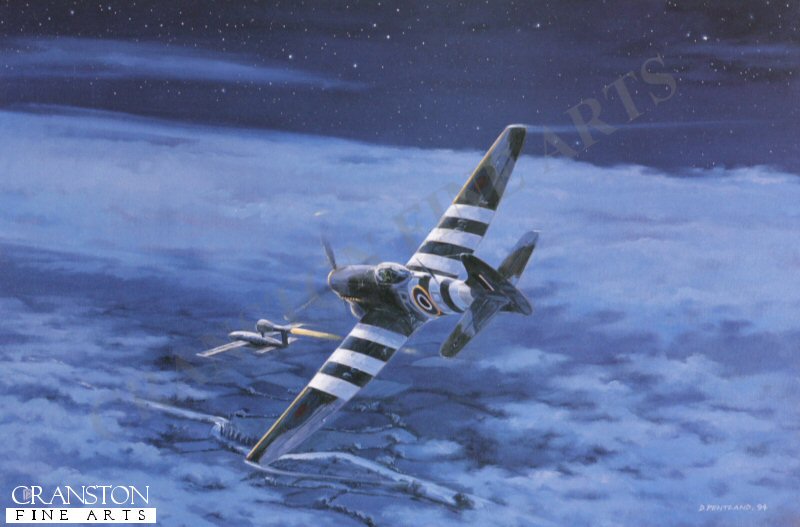
Overturning the Odds by Keith Woodcock - Cranston Military Prints

Overturning the Odds by Keith Woodcock


Overturning the Odds by Keith Woodcock

With all his ammunition spent on other interceptions, Wing Commander Beamont in his Hawker Tempest MKV tips a German flying VI bomb to its destruction with his wingtip during the summer of 1944.
Item Code : DHM2419Overturning the Odds by Keith Woodcock - Editions AvailableExtra....


A photo of the print.

DESCRIPTIONSIZESIGNATURESOFFERSPRICEPURCHASINGPACKS
Signed limited edition of 500 prints. Image size 22 inches x 14.5 inches (56cm x 37cm)
Beamont, Roland

Died : 2001
Wing Commander Roland Bee Beamont CBE DSO DFC DL (deceased)
One of World War IIs great characters, Bee flew Hurricanes with 87 Squadron, later leading a Tempest Wing. He had 8 victories plus a further 32 VIs destroyed. After the war he became a highly respected Chief Test Pilot.Wing Commander Roland Beamont, one of the RAFs top buzz bomb interceptors, was born in Enfield England on August 10, 1920. Educated at Eastborne College, Beamont accepted a short service commission with the Royal Air Force in 1938. He commenced flying in 1939 at the the No. 13 R
Signature Value : £65
CLICK HERE FOR FULL PROFILE
 
+ Artist : Keith Woodcock


Signature(s) value alone : £65
£15 Off!Now : £80.00

Quantity:
In 1 Pair
View


Some other related items available from this site.

Aircraft History:  JN751 was built at Hawkers Langley factory and delivered to No. 20 MU at Aston Down 20th February 1944. Delivered to No.486 (NZ) Squadron initially, and subsequently received by No.3 Squadron, it became the personal aircraft of Wing Commander R P Beamont. On 8th June 1944, it became the first Tempest to shoot down and enemy aircraft (Bf109G-6, JN751 was hit in the starboard wing by a cannon shell in this combat) and during June/August it shot down over 30 V-1 flying bombs. On 1st September, following an engine failure on take-off, JN751 made a forced landing at Langley. Repaired 2nd September, Wing Commander Beamont collected the aircraft from Langley on 5th September and returned to Newchurch - this was his last flight in JN751. Returned to No.20 MU on 3rd October 1944, it was delivered to No.287 Squadron at Hornchurch on anti aircraft co-operation duties. On 18th May 1945, whilst trying to avoid a fog bank JN751 crashed on the Isle of Sheppey, killing the pilot, Flight Sergeant P.C.A. Redstone. <br><br>Wing Commander Roland P Beamont, CBE, DSO and bar, DFC and bar, DFC (USA), DL:    Born on 10th August 1920, Roland Beamont joined No87. Squadron in France during November 1939. Returning to England 20th May 1940 (having destroyed a Do17 and an Me109) he went on to destroy a further three enemy aircraft during the Battle of Britain. In June 1941 he was posted to No79 Squadron as a Flight Commander. In December 1941, he went to Hawker Aircraft Limited as a Service test pilot flying Hurricanes. On 29th June 1942, he was posted as Flight Commander to Hawker Typhoon equipped No.609 (WR) squadron at Duxford, and took command of the squadron in October. He returned to Hawker Aircraft during May 1943, to test fly the Tempest. In February 1944, he was tasked with forming the first Tempest Wing, No.150 at Castle Camps and later Newchurch. When leader of the five squadron Tempest Wing No.122 over Germany on 12th October 1944, Roland Beamont was shot down by ground fire, and became a POW. During his time with Nos 150 and 122 Wings he destroyed one Bf109, one Fw190, one Ju88 on the ground and thirty two V1 flying bombs. After the war Roland Beamont became Chief Test Pilot for English Electric, test flying the Canberra, P1, Lightning and TSR2 aircraft. He was the first British pilot to fly a British aircraft at Mach 1 in level flight, and later at Mach 2. After serving as Director of Flight operations for the Tornado test programme he retired and became a respected author.

Hawker Tempest Mk V JN751 R-B. by M A Kinnear.
 Wing Commander Roland Beamont in his personal Tempest V, intercepted and downed his first V1 Buzzbomb on the night of June 22nd, 1944, over south east England. As Commander of 150 wing and others he went on to shoot down a total of 30 V1 flying bombs, 8 enemy aircraft and 35 locomotives destroyed plus one minesweeper sunk.

A Buzz for Beamont by David Pentland.
 Equipped with the experimental <i>Monica IIIE</i> detection device, Hawker Tempest EJ535 was deployed to the Fighter Interception Unit at Newchurch for evaluation in July 1944.  Originally developed as the AN/APS 13, <i>Monica</i> had been intended as a rear-looking device to warn crews of attacks from behind.  Now modified to face forward, it became a valuable aid in the battle against Hitler's terror weapons, notably the V-1 Flying Bomb.  In the hands of the Fighter Interception Unit's then Commanding Officer Joseph Berry, this became a winning combination with no fewer than 52 <i>Doodlebugs</i> falling to Berry's guns - on one occasion, seven V1s being shot down by Berry in a single night.

Bug Killer by Ivan Berryman.
 MK1 Hurricanes of No. 601 Squadron refueled and rearmed, climb to rejoin the battle during the summer of 1940. As the great air battle rages high above, life goes in the countryside as a Southern Railway train pulls out of a local village station, capturing the resilient mood of the people.

Tangmere Hurricanes by Nicolas Trudgian.
Signatures on these products
*The value given for each signature has been calculated by us based on the historical significance and rarity of the signature and is for the unmatted version where available. Values of many pilot signatures have risen in recent years and will likely continue to rise as they become more and more rare.
NameInfo


Wing Commander Roland Bee Beamont CBE DSO DFC DL (deceased)
Died : 2001
*Signature Value : £65

Editions signed :

Signed limited edition of 500 prints.


Beamont, Roland
(Wing Commander Roland Bee Beamont CBE DSO DFC DL (deceased))

One of World War IIs great characters, Bee flew Hurricanes with 87 Squadron, later leading a Tempest Wing. He had 8 victories plus a further 32 VIs destroyed. After the war he became a highly respected Chief Test Pilot.Wing Commander Roland Beamont, one of the RAFs top buzz bomb interceptors, was born in Enfield England on August 10, 1920. Educated at Eastborne College, Beamont accepted a short service commission with the Royal Air Force in 1938. He commenced flying in 1939 at the the No. 13 Reserve Flying School at White Waltham. His initial duty was with the Group Fighter Pool at St. Athan where he learned to fly the Hurricane. Beamont was soon posted with the No. 87 Squadron which was part of the Advanced Air Striking Force in France. Seeing action in both France and Belgium prior to the Allied withdrawl, Beamont rejoined 87 Squadron in England during the Battle of Britain. In the spring of 1941 Beamont was awarded the Distinguished Flying Cross after destroying five enemy aircraft. As Commanding Officer of 609 Squadron, Beamont pioneered both day and night ground attack missions utilizing the Typhoon. Beamont was credited with destroying 25 trains in a three month period. He was then made responsible for organizing and commanding the first Tempest Wing at Newchurch. Three days after D-Day Bearnont shot down an Me-109, marking the first aerial combat victory for the Hawker Tempest. In the summer of 1944 Beamont destroyed 32 buzz bombs prior to leading his wing to a Dutch Airfield at Volkel on the Continent. In October of 1944 Beamont was shot down during a ground attack mission over Germany, and he remained a prisoner of war until wars end. Following repatriation Beamont became an experimental test pilot with the Gloster Aircraft Company, which had developed the RAFs first jet aircraft. Turning down a permanent commission with the RAF, Beamont then joined English Electric Company in Wharton as the Chief Test Pilot for the B3/45 (Canberra) jet bomber program. He managed all prototype testing on the Canberra, and in the process set two Atlantic speed records. Later Beamont was involved with the supersonic P1/Lightning program, and became the first British pilot to fly at twice the speed of sound. From 1965 until 1970 he was a founding member of Britains highly succesful Saudi Arabian export program. For several years prior to his retirement in 1979, Beamont was Director of Operations for British Aerospace and Panavia where he was in charge of flight testing for the Tornado. Since his retirement Beamont has authored nine books, and published numerous magazine articles. He is a Fellow of the Royal Aeronautical Scociety and an Honorary Fellow of the Society of Experimental Test Pilots in America. He died 19th November 2001.
Aircraft Related to This Print
Tempest

Contact Details
Shipping Info
Terms and Conditions
Cookie Policy
Privacy Policy

Sign Up To Our Newsletter!

Stay up to date with all our latest offers, deals and events as well as new releases and exclusive subscriber content!

This website is owned by Cranston Fine Arts.  Torwood House, Torwoodhill Road, Rhu, Helensburgh, Scotland, G848LE

Contact: Tel: (+44) (0) 1436 820269.  Email: cranstonorders -at- outlook.com

Return to Home Page