|
|
|
|
||
|
|
|
|
||
| Navigation Menus |
|
Military Art Index |
Aviation Art Index |
Naval Art Index |
Artists Index |
Aviation History Archive |
Naval History Archive |
|
| HALF PRICE AND FREE PRINT SPECIAL OFFERS | ||||||
|
| ||||||||||||||||||||||||||||||||||||||||||||
Some other related items available from this site. | ||||
  Spitfire Country by Ivan Berryman. |   Depart in Peace by Geoff Lea. |   Fighter Legend - Johnnie Johnson by Nicolas Trudgian. |  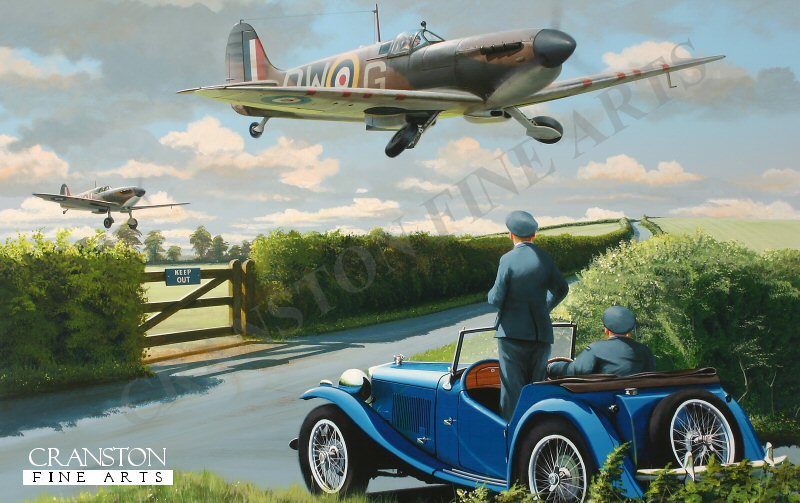 Tribute to No.610 Sqn by Ivan Berryman | |
| Signatures on these products | |
| *The value given for each signature has been calculated by us based on the historical significance and rarity of the signature and is for the unmatted version where available. Values of many pilot signatures have risen in recent years and will likely continue to rise as they become more and more rare. | |
| Name | Info |
  Squadron Leader Tony Iveson DFC (deceased) Died : 2013 *Signature Value : £45 Editions signed : Original drawing by David Pentland. | Iveson, Tony (Squadron Leader Tony Iveson DFC (deceased)) Tony Iveson fought in the Battle of Britain with RAF Fighter Command, as a Sergeant pilot, joining 616 Squadron at Kenley flying Spitfires on 2 September 1940. On the 16th of September, he was forced to ditch into the sea after running out of fuel following a pursuit of a Ju88 bomber. His Spitfire L1036 ditched 20 miles off Cromer in Norfolk, and he was picked up by an MTB. He joined No.92 Sqn the following month. Commissioned in 1942, Tony undertook his second tour transferring to RAF Bomber Command, where he was selected to join the famous 617 Squadron, flying Lancasters. He took part in most of 617 Squadrons high precision operations, including all three sorties against the German battleship Tirpitz, and went on to become one of the most respected pilots in the squadron. He died on 5th November 2013. |
  Wing Commander Terence Kane (deceased) Died : 2016 *Signature Value : £40 Editions signed : Original drawing by David Pentland. | Kane, Terence (Wing Commander Terence Kane (deceased)) Terence Michael Kane was born in London on September 9th 1920 and educated at Varndean School in Brighton. He joined the RAF on a short service commission on July 25th 1938, During his flying training he was injured in an Audax crash and admitted to hospital, however he was able to complete his training and was posted to CFS, Upavon, for an instructor's course, after which he joined the staff at 14 FTS, Kinloss and later Cranfield. He went to 7 OTU, Hawarden in July 1940, converted to Spitfires and joined No.234 Squadron on September 14th. On September 22nd 1940 he had shared in the destruction of a Junkers Ju88 bomber. The following day, only nine days after joining No.234 Squadron, Kane took off on a routine patrol when Messerschmitt Bf109s attacked his section. Kane shot one of them down but, during the combat, the engine of his Spitfire was damaged and he was forced to bale out at 6,000 feet. He had difficulty escaping from the fighter's cockpit but eventually managed to roll the aircraft over and fall clear. His parachute opened at 500 feet and seconds later he landed in the sea off the French coast. Floating in his life jacket, he was fortunate to be plucked from the sea within two hours by the German Navy. After being rescued, Kane was well treated before being taken to his first PoW camp. After initial interrogation he was sent to Oflag IXA/H, a converted medieval castle at Spangenberg, 15 miles south of Kassel. With his fellow RAF PoWs, Kane was moved between camps a number of times and on October 2nd 1941 he was in a large party that arrived at Oflag VIB near Warburg. A week later another group of RAF prisoners arrived, among whom Kane recognised his elder brother, Squadron Leader Mike Kane MBE, whose Whitley bomber had been shot down two months earlier. The younger Kane was unaware that his brother had been posted as missing, or that he had already made a daring escape bid – only to be recaptured when he was discovered in the hold of a Swedish ship in the docks at Lübeck. The two brothers were moved in May 1942 to the new Luftwaffe camp, Stalag Luft III at Sagan. They were sent to the East Compound, next to the one where the Great Escape took place in March 1944. On the night of January 27th 1945 the prisoners were given a few hours' notice to gather their belongings and prepare to leave. The Soviet Army was approaching from the east and the Germans had decided to evacuate the camp and march the prisoners westwards. During one of the coldest winters of the century, the men suffered great privation and numerous casualties on what became known as 'The Long March'. Eventually, Kane and his colleagues reached Lübeck where they were liberated by a scout car of the British 11th Armoured Division. Kane was flown back to England on May 8th after four-and-a half years as a PoW. Kane remained in the RAF, mainly on intelligence duties including two years in the Middle East. He left the service in 1950 but could not settle to civilian life and re-joined in February 1954. He specialised as a fighter controller, serving in Germany and in the United Kingdom. After a period as the defence adviser in Libya he became the project officer in the MoD for the 'Linesman' system, a network of radars and a centralised control system for the air defence of the UK. He finally he retired in 1974. He died on 5th August 2016. |
| Squadrons Related to This Print |
| No.616 Sqn |
| Aircraft Related to This Print |
| Spitfire |
|
Contact Details |
Sign Up To Our Newsletter!
This website is owned by Cranston Fine Arts. Torwood House, Torwoodhill Road, Rhu, Helensburgh, Scotland, G848LE Contact: Tel: (+44) (0) 1436 820269. Email: cranstonorders -at- outlook.com |


 Signature(s) value alone : £85