Cranston Military Prints .com Home Page
Customer Helpline (UK) : 01436 820269
Subscribe to our Newsletter!

You currently have no items in your basket

Payment Options Display
Buy with confidence and security!
Publishing historical art since 1985


Navigation Menus
Military
Art Index
Aviation
Art Index
Naval
Art Index
Artists
Index
Product Search         
Aviation
History Archive
Naval
History Archive
HALF PRICE AND FREE PRINT SPECIAL OFFERS
ALWAYS GREAT OFFERS :
20% FURTHER PRICE REDUCTIONS ON HUNDREDS OF LIMITED EDITION ART PRINTS
BUY ONE GET ONE HALF PRICE ON THOUSANDS OF PAINTINGS AND PRINTS
FOR MORE OFFERS SIGN UP TO OUR FREE NEWSLETTER
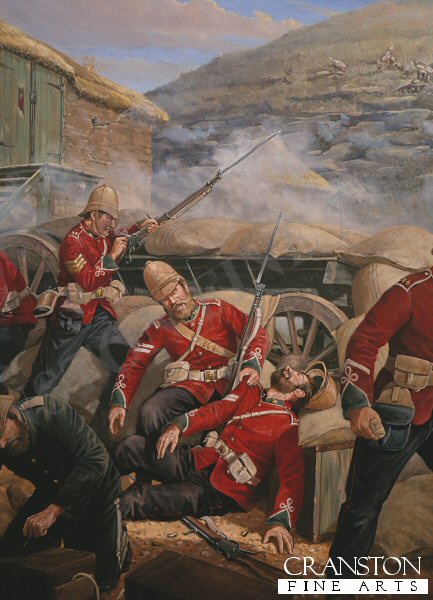
Defence of Rokes Drift, 1879 by Henry Dupray. - Cranston Military Prints

Defence of Rokes Drift, 1879 by Henry Dupray.


Defence of Rokes Drift, 1879 by Henry Dupray.

Item Code : HD0021Defence of Rokes Drift, 1879 by Henry Dupray. - Editions Available
DESCRIPTIONSIZESIGNATURESOFFERSPRICEPURCHASINGPACKS
Antique print c.1898 mounted on thick card at the time. Image size 12 inches x 8 inches (31cm x 20cm) some marks around edges of border and images.none£75.00

Quantity:


Some other related items available from this site.

The Battle of Ulundi took place at the Zulu capital of Ulundi on 4th July 1879.  Ulundi became the last battle to be fought during the Zulu war and the British victory finally broke the military power of the Zulu Nation.  The battle began at 6 a.m. when Buller led out an advance guard of mounted troops and South African irregulars.  The British force comprised of five companies of the 80th regiment in square in four ranks, with two Gatling Guns in the centres, two 9-pounders on the left flank and two 7-pounders on the right. The 90th Light Infantry with four companies of the 94th regiment made up the left face with two more 7-pounders.  On the right face were the 1st Battalion of the 13th Light Infantry, four companies of the 58th Regiment, two 7-pounders and two 9-pounders. The rear face was composed of two companies of the 94th Regiment and two companies of the 2nd Battalion of the 21st Regiment.  In the middle of the square were headquarters staff, No. 5 company of the Royal Engineers whhich was led by Lt John Chard who had commanded the troops at Rorkes Drift, the 2nd Native Natal Contingent, fifty wagons and carts with reserve ammunition and hospital wagons. Bullers horsemen protected the front and both flanks of the square. A rearguard of two squadrons of the 17th Lancers and a troop of Natal Native Horse followed.  In total the British force stood at just over 5300 against the Zulu warrior regiments in total over 15000.  The Zulu warriors charged again and again at the square but with the strong British firepower of tifle and gatling gun, they could not get close.  As the Zulu warriors strength weakened, Lord Chelmsford ordered the cavalry to mount, and the 17th Lancers and the 1st Kings Dragoon Guards along with colonial cavalry were ordered to charge the now fleeing Zulus.  The Zulus fled towards the high ground with the cavalry in pursuit.  The Lancers were checked at the Mbilane stream by the fire of a concealed party of Zulus, causing a number casualties before the 17th Lancers overcame the Zulu resistance.  The pursuit continued until not one living Zulu remained on the Mahlabatini plain, with members of the Natal Native Horse, Natal Native Contingent and Woods Irregulars slaughtering the Zulu wounded, done in revenge for the massacre at Isandlwana.

The Death or Glory Boys by Bud Bradshaw.
Battle of Isandhlwana.   Zulu victory over the British forces on 22nd January 1879 about 100km north of Durban. Lord Chelmsford led a column of forces to seek out the Zulu army camped at Isandhlwana, while patrols searched the district. After receiving a report, Chelmsford set forth at half strength, leaving six companies of the 24th Regiment, two guns, some Colonial Volunteers and a native contingent (in all about 1,800 troops) at the camp. Later that morning an advanced post warned of an approaching Zulu army. Shortly after this, thousands of Zulus were found hidden in a ravine by a mounted patrol but as the patrol set off to warn the camp, the Zulus followed. At the orders of the Camp Commander, troops spread out around the perimeter of the camp, but the Zulu army broke through their defences. The native contingent who fled during the attack were hunted down and killed. The remaining troops of the 24th Regiment, 534 soldiers and 21 officers, were killed where they fought. The Zulus left no one alive, taking no prisoners and leaving no wounded or missing. About 300 Africans and 50 Europeans escaped the attack. Consequently, the invasion of Zulu country was delayed while reinforcements arrived from Britain.

Last Stand of the 24th Regiment at the Battle of Isandhlwana by Simon Smith
Corporal Allen and Corporal Lyons, B. Company 2nd Battalion 24th Foot Rorkes Drift Back Wall, 6pm January 22nd 1879.  After the initial Zulu assault on the back wall of the post failed at about 4.30pm, a fire-fight broke out between Zulu snipers posted on the terraces of the Shiyane (Oskarsberg) Hill and the defenders posted behind the barricade of wagons and mealie-bags. This section of the wall as commanded by Sergeant Henry Gallagher, of B Company. At about 6 pm, Corporal Lyons was leaning over the barricade to aim when he was hit in the neck by a bullet which paralysed him; as his friend, Corporal Allen, bent to help him, Allen too was shot through the arm. In the foreground Corporal Attwood of the Army Service Corps distributes ammunition. The wall was abandoned shortly after and the British retired to the small are in front of the storehouse. Allen was later awarded the VC, and Attwood the DCM.  He was born at Churcham, Gloucestershire, and served for five years in the Monmouthshire Militia before joining the 24th Regiment. He served through the Kaffir War 1877-8 before his bravery at Rorkes Drift for which he was presented with the Victoria Cross by Lord Wolseley on August 3rd 1879. He later served in the 1st Volunteers Battalion Royal Fusiliers.

Wounded by Mark Churms
Defending the barracades, men of the 24th of Foot, or 2nd Warwickshire regiment (later in 1881 to become the South Wales Borderers) repel the massed Zulus attempting to smash through the mealie bag entrenchment. At the end of the battle, hundreds of the  Zulu warriors of the uThulwans, iNdlondo and uDloko regiments lay dead.  According to official figures the British lost 25 men, 11 Victoria crosses were awarded for the defence of Rorkes Drift.

Rorkes Drift January 22nd, 1879 by Stuart Liptrot

Contact Details
Shipping Info
Terms and Conditions
Cookie Policy
Privacy Policy

Sign Up To Our Newsletter!

Stay up to date with all our latest offers, deals and events as well as new releases and exclusive subscriber content!

This website is owned by Cranston Fine Arts.  Torwood House, Torwoodhill Road, Rhu, Helensburgh, Scotland, G848LE

Contact: Tel: (+44) (0) 1436 820269.  Email: cranstonorders -at- outlook.com

Return to Home Page