Cranston Military Prints .com Home Page
Customer Helpline (UK) : 01436 820269
Subscribe to our Newsletter!

You currently have no items in your basket

Payment Options Display
Buy with confidence and security!
Publishing historical art since 1985


Navigation Menus
Military
Art Index
Aviation
Art Index
Naval
Art Index
Artists
Index
Product Search         
Aviation
History Archive
Naval
History Archive
HALF PRICE AND FREE PRINT SPECIAL OFFERS
ALWAYS GREAT OFFERS :
20% FURTHER PRICE REDUCTIONS ON HUNDREDS OF LIMITED EDITION ART PRINTS
BUY ONE GET ONE HALF PRICE ON THOUSANDS OF PAINTINGS AND PRINTS
FOR MORE OFFERS SIGN UP TO OUR FREE NEWSLETTER
Doolittles D-Day, 6th June 1944 by Robert Taylor. - Cranston Military Prints

Doolittles D-Day, 6th June 1944 by Robert Taylor.


Doolittles D-Day, 6th June 1944 by Robert Taylor.

By any military standards, it is difficult to imagine the Supreme Commander of the largest air force of the day, piloting himself over the battlefront during the early moments of one of historys greatest military operations. But General Jimmy Doollittle was no ordinary commander. Already awarded Americas highest decoration for valour, General Doolittle was, by the summer of 1944, in command of the American 8th Air Force. On the morning of 6 June, D-Day, he dispatched 1350 bombers together with his entire fighter force to attack enemy ground installations near the beachheads. Sitting around waiting for intelligence reports was not Jimmy Doolittles style. He was going to see for himself what was happening! With Pat Partridge as wingman, they took off flying P-38 Lightnings - chosen for their distinctive profile in the hopes they would deter friendly fire - and climbed above the overcast. Having observed the 8th Air Forces operations at first hand, as they turned for home, Doolittle spotted a hole in the clouds, flick-rolled through it and disappeared beneath the cloud layer. Pat Partridge had his head in the cockpit, probably changing his gas tanks, and when he looked up there was no sign of his Supreme Commander, he circled around for a while, then headed for home. Beneath the clouds Doolittle saw - the most impressive and unforgettable sight I could have possibly imagined - . As some 5000 ships of all shapes and sizes landed 176,000 troops on the enemy held beaches of Northern France, Doolittle flew up and down the battlefront assessing how the invasion was progressing, and after a two and a half hour sortie, headed back to base. After landing, Doolittle hurried over to General Eisenhowers headquarters to provide the first report Eisenhower received, beating his own intelligence information by several hours.
Item Code : RT0313GSDoolittles D-Day, 6th June 1944 by Robert Taylor. - Editions Available
DESCRIPTIONSIZESIGNATURESOFFERSPRICEPURCHASINGPACKS
Limited edition of 500 prints. Image szie 32 inches x 16 inches 81cm x 41cm)
Hurlbut, Frank D

Lt Colonel Frank D Hurlbut (deceased)
Frank Hurlbut joined the National Guard in early 1940 before being activated following the Japanese Attack at Pearl Harbor. He was posted to the 82nd Fighter Group, 96th FS flying P38s in Europe. He became a P38 Ace on 10th July 1943 during a notable fighter sweep in which his Group was credited with 10 kills. Frank Hurlbut flew over 50 combat missions and scored nine confirmed victories, all in Europe, making him the second highest Ace in the 12th Air Force. In Italy, in the summer of 1944,
Signature Value : £35
CLICK HERE FOR FULL PROFILE
 
Willsie, Dick

Died : 2013
Colonel Richard Willsie (deceased)
Joining up in 1942, Dick Willsie was posted to North Africa with the 414th Night Fighter Squadron, where he flew 31 missions on the Beaufighter. He transferred to the 96th Fighter Squadron, 82nd Fighter Group, flying the P38 Lightning on 82 day missions through to the end of hostilities in Europe. Willsie would go on to serve in both Korea and Vietnam, and Willsie became the commanding officer of the 602nd Air Commando Squadron and retired in 1974. Dick Willsie was born on the 6th of September
Signature Value : £45
CLICK HERE FOR FULL PROFILE
 
Childress, Hubert M
Colonel Hubert M. Childress
Hubert Childress was posted to England, joining the 27th Photo Recon Squadron, 7th Photographic Group flying the F5 - a specially adapted photo-recon version of the P38 with cameras and no guns. Hubert flew his first combat mission on New Year's Eve 1943, and was heavily involved in many reconnaissance missions prior to D-Day. He also flew the Spitfire MkIXs on several operations. He flew 58 combat missions and later commanded the 7th Photographic Group (R)
Signature Value : £45
CLICK HERE FOR FULL PROFILE

Ostronik, Richard
First Lieutenant Richard Ostronik
Joining the service at the end of 1942, Dick Ostronik was posted to the 82nd Fighter Group in Italy, in the summer of 1944, where he flew P38s with the 96th FS. Attacking targets of opportunity and strafing trains, the squadron escorted the heavy bombers that attacked aircraft factories and industrial targets, and flew defending photo reconnaissance missions - once against a pair of Me262s. Dick flew over 30 combat missions, finishing his stint in Europe in May 1945.
Signature Value : £35
CLICK HERE FOR FULL PROFILE

Roasvig, Mel
First Lieutenant Mel Roasvig
Already in the Reserves, Mel Roasvig was activated for full service in August 1941, and was posted overseas to join the 97th Fighter Squadron, 82nd Fighter Group, by then operating in Italy. Flying the P38 Lightning in its main role of bomber escort, he also took part in dive bombing operations in Czechoslovakia, and hitting targets of opportunity, including strafing an ammunition train which exploded, the debris seriously damaging his aircraft.
Signature Value : £40
CLICK HERE FOR FULL PROFILE

+ Artist : Robert Taylor


Signature(s) value alone : £200
SOLD
OUT
NOT
AVAILABLE
Studio Proof Edition of 75 giclee canvas prints. Size 38 inches x 20 inches (96cm x 51cm)Artist : Robert Taylor£495.00

Quantity:


Some other related items available from this site.

 Nobody, least of all Allied aircrew, ever doubted the tenacity of the Luftwaffe, more particularly that of the German fighter pilots. From the early encounters during the Battle of Britain to the greeat air battles in defence of their homeland late in the war, at all times they were held in high regard, even if resented as a foe. At no time was their dedication, determination, and courage better demonstrated than during the final stages of World War Two. By the summer of 1944 the Allies had gained a foothold in Normandy, and total air superiority above northern France. German installations and ground positions were being pounded daily from the air, and the Ruhr, the heartland of industrial Germany, was under constant siege. Even the factories in southern Germany were not safe from the attentions of the USAAF bombers by day, and the RAF by night. But in spite of the pressures of mounting losses and diminished supplies, the Luftwaffe fought doggedly on in best traditions of the fighter pilot. The morning of 19th July 1944 saw the USAAFs 8th and 15th Air Forces mount an attack of awesome proportion against the aircraft factories in the region of Munich. To combat a seemingly overwhelming force of 1400 bombers and almost as many fighter escorts, the Luftwaffe were able to put up just three Gruppen from JG300 and one from JG302, flying a mix of Me109Gs and Fw190s - barely 50 serviceable fighters between them. They were joined by a dozen Me109s of II./JG27, these fighters desperately trying to defend the very factories in which they were made.

Messerschmitt Country by Nicolas Trudgian
 Best known as leader of the legendary Zemke's Wolfpack, his famous 56th Fighter Group was the top scoring Fighter Group in the European Theater.  He pioneered the use of the P-38 Droop Snoot as a bomb aiming aircraft which led the bomb-loaded P-47s on to the target with great success.  One of the outstanding fighter leaders of the war, his personal tally was 17.5 victories.  He died in 1994.

Clipped Signature - Hub Zemke.
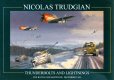
  The relief of Bastogne turned the tide in the Battle of the Bulge and Hitlers final great offensive of World War II lay in ruins. P47 Thunderbolts of the 406th Fighter Group, in company with P38 Lightnings, support the advancing armor of General George Pattons US Third Army as they prepare to relieve the battered 101st Airborne Division from their heroic defence of Bastogne during the final climax to the Battle of the Bulge, 24 December 1944. The Battle of the Bulge was one of the largest land battles of WWII with more than a million American, British and German troops involved, incurring huge casualties on all sides and this release pays tribute to the sacrifice of Allied Forces, during this important milestone in World War II.

Thunderbolts and Lightnings by Nicolas Trudgian.
 The highest scoring US pilot of the Second World War, Richard Bong, is depicted in his personal P.38J <i>Marge</i>, claiming just one of his 40 confirmed victories. Insisting that he was not the greatest of marksmen, it was Bongs habit to manoeuvre to impossibly close distances before opening fire on his opponents. His eventual total may well have been greater than 40, as a further 8 probables could be attributed to him, together with 7 damaged. He was killed whilst testing a P.80 jet for the USAF in August 1945.

Richard Bong by Ivan Berryman.
Signatures on these products
*The value given for each signature has been calculated by us based on the historical significance and rarity of the signature and is for the unmatted version where available. Values of many pilot signatures have risen in recent years and will likely continue to rise as they become more and more rare.
NameInfo


Lt Colonel Frank D Hurlbut (deceased)
*Signature Value : £35

Editions signed :

Limited edition of 500 prints.


Hurlbut, Frank D
(Lt Colonel Frank D Hurlbut (deceased))

Frank Hurlbut joined the National Guard in early 1940 before being activated following the Japanese Attack at Pearl Harbor. He was posted to the 82nd Fighter Group, 96th FS flying P38s in Europe. He became a P38 Ace on 10th July 1943 during a notable fighter sweep in which his Group was credited with 10 kills. Frank Hurlbut flew over 50 combat missions and scored nine confirmed victories, all in Europe, making him the second highest Ace in the 12th Air Force. In Italy, in the summer of 1944, where he flew P38s with the 96th FS. Attacking targets of opportunity and strafing trains, the squadron escorted the heavy bombers that attacked aircraft. We have learned (2017) that Frank Hurlbut has died.


Colonel Richard Willsie (deceased)
Died : 2013
*Signature Value : £45

Editions signed :

Limited edition of 500 prints.


Willsie, Dick
(Colonel Richard Willsie (deceased))

Joining up in 1942, Dick Willsie was posted to North Africa with the 414th Night Fighter Squadron, where he flew 31 missions on the Beaufighter. He transferred to the 96th Fighter Squadron, 82nd Fighter Group, flying the P38 Lightning on 82 day missions through to the end of hostilities in Europe. Willsie would go on to serve in both Korea and Vietnam, and Willsie became the commanding officer of the 602nd Air Commando Squadron and retired in 1974. Dick Willsie was born on the 6th of September 1920 in Michigan USA and joined the US Air force in 1942. Dick Willsie was posted to North Africa with the 414th Night-fighter Squadron, where he flew 31 missions on the Beaufighter. He transferred to the 96th FS, 82nd Fighter Group, flying the P38 Lightning on 82 day missions through to the end of hostilities in Europe. He notched up a large number of ground attack victories as well as three aerial victories in his P38 'Snake Eyes'. On one mission Captain Richard 'Dick' Willsie's P-38 was damaged by flak near Ploesti, Romania. Lieutenant Willsie felt the bullets tearing into his aircraft, the force of the hits actually making his feet bounce on the rudder pedals. He noticed oil leaking from the left engine, and then the engine lost oil pressure. Willsie immediately feathered the propeller, turning the blades edge on to present the least resistance to the wind, and headed for home, his right engine at full power. Then he noticed coolant streaming from his remaining good engine. Within minutes he would be without power. He immediately reported over the radio that he was going down. One of the many to hear his broadcast announcement was 19-year-old Richard T. 'Dick' Andrews, who flew with the same 82nd Fighter Group as Willsie. But unlike the more experienced Willsie, Andrews had less than 100 flying hours in the P-38. Pick a good field, radioed the youngster, and I will come in after you.It was a strange message; it made no sense. But Willsie had no time to wonder about it. His remaining engine was popping loudly, a fresh hit shattered his windscreen and bloodied his forehead, and a plowed field appeared ahead. As his wounded fighter barely made it over the final obstacle he planted his forehead firmly against the padded gun sight. That did not prevent his nose taking a beating as his plane skidded to a stop with its wheels retracted. Scrambling from the cockpit as quickly as possible, he - as per instructions - destroyed his P-38 with a small phosphorous bomb. With truckloads of enemy troops approaching from beyond some trees six Me-109 German fighters appeared overhead. And a second P-38 was coming toward him with its landing gear down! Other Lightnings engaged the Me-109s and Andrews set his P-38 down, landing in line with the plowed furrows. Willsie raced to the plane, praying it might be his salvation, praying they would both be able to fit into the one small seat. Andrews threw his parachute - and everything else that was handy and not nailed down - out of the cockpit. With no time to think of how it might be done both men climbed hurriedly into the plane 'with miraculous precision,' as the older pilot would later joke. At Andrews' suggestion the more experienced Willsie took the controls. With Andrews in back, one leg slung over Willsie's shoulder, the two somehow managed to close and securely lock the canopy. They barely cleared the trees at the end of their improvised 'runway' and quickly ran into inclement weather and became separated from the other P-38s. With no map and fully expecting to be greeted by friendly fire because of their aircraft type, with which the Russians might not be familiar, they headed for an air base at nearby Poltava. Word of the rescue spread and others tried to emulate it. But so many were injured in these attempts that the USAAF had to issue orders forbidding the use of such tactics. Richard T. Andrews was awarded the Silver Star for his unique rescue. Willsie would go on to serve in both Korea and Vietnam, and Willsie became the commanding officer of the 602nd Air Commando Squadron and retired in 1974. Colonel Richard Willsie died on Febuary 16th, 2013 in Dana Point, Orange County, California.


Colonel Hubert M. Childress
*Signature Value : £45

Editions signed :

Limited edition of 500 prints.


Childress, Hubert M
(Colonel Hubert M. Childress)

Hubert Childress was posted to England, joining the 27th Photo Recon Squadron, 7th Photographic Group flying the F5 - a specially adapted photo-recon version of the P38 with cameras and no guns. Hubert flew his first combat mission on New Year's Eve 1943, and was heavily involved in many reconnaissance missions prior to D-Day. He also flew the Spitfire MkIXs on several operations. He flew 58 combat missions and later commanded the 7th Photographic Group (R)


First Lieutenant Richard Ostronik
*Signature Value : £35

Editions signed :

Limited edition of 500 prints.


Ostronik, Richard
(First Lieutenant Richard Ostronik)

Joining the service at the end of 1942, Dick Ostronik was posted to the 82nd Fighter Group in Italy, in the summer of 1944, where he flew P38s with the 96th FS. Attacking targets of opportunity and strafing trains, the squadron escorted the heavy bombers that attacked aircraft factories and industrial targets, and flew defending photo reconnaissance missions - once against a pair of Me262s. Dick flew over 30 combat missions, finishing his stint in Europe in May 1945.


First Lieutenant Mel Roasvig
*Signature Value : £40

Editions signed :

Limited edition of 500 prints.


Roasvig, Mel
(First Lieutenant Mel Roasvig)

Already in the Reserves, Mel Roasvig was activated for full service in August 1941, and was posted overseas to join the 97th Fighter Squadron, 82nd Fighter Group, by then operating in Italy. Flying the P38 Lightning in its main role of bomber escort, he also took part in dive bombing operations in Czechoslovakia, and hitting targets of opportunity, including strafing an ammunition train which exploded, the debris seriously damaging his aircraft.
Aircraft Related to This Print
Lightning (US)

Contact Details
Shipping Info
Terms and Conditions
Cookie Policy
Privacy Policy

Sign Up To Our Newsletter!

Stay up to date with all our latest offers, deals and events as well as new releases and exclusive subscriber content!

This website is owned by Cranston Fine Arts.  Torwood House, Torwoodhill Road, Rhu, Helensburgh, Scotland, G848LE

Contact: Tel: (+44) (0) 1436 820269.  Email: cranstonorders -at- outlook.com

Return to Home Page