Cranston Military Prints .com Home Page
Customer Helpline (UK) : 01436 820269
Subscribe to our Newsletter!

You currently have no items in your basket

Payment Options Display
Buy with confidence and security!
Publishing historical art since 1985


Navigation Menus
Military
Art Index
Aviation
Art Index
Naval
Art Index
Artists
Index
Product Search         
Aviation
History Archive
Naval
History Archive
HALF PRICE AND FREE PRINT SPECIAL OFFERS
ALWAYS GREAT OFFERS :
20% FURTHER PRICE REDUCTIONS ON HUNDREDS OF LIMITED EDITION ART PRINTS
BUY ONE GET ONE HALF PRICE ON THOUSANDS OF PAINTINGS AND PRINTS
FOR MORE OFFERS SIGN UP TO OUR FREE NEWSLETTER
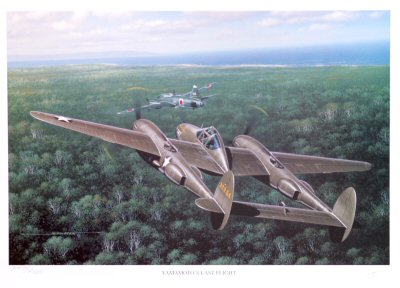
Yamamoto's Last Flight by Stan Stokes. - Cranston Military Prints

Yamamoto's Last Flight by Stan Stokes.


Yamamoto's Last Flight by Stan Stokes.

On April 18, 1943, in one of the more interesting, daring, and ultimately controversial missions of WW II, a flight of P-38s under the command of Major John Mitchell, intercepted and destroyed the aircraft carrying Admiral Isoroku Yamamoto, Commander in Chief of the Japanese Combined Fleet, and the mastermind of the attack on Pearl Harbor. American code breakers had intercepted and translated a message indicating that Adm. Yamamoto would fly from Rabaul to an airfield on the southern tip of Bouganville on the morning of April 18, 1943. Because of the great distances to be covered during this intercept mission the P-38s would have very limited time over the rendezvous area. Fortunately for the Army Air Force pilots, Yamamoto was noted for his punctuality, and if he departed Rabaul on time the mission might just work. Major Mitchell led his flight of 16 P-38s to the rendezvous, with twelve of his fighters acting as high cover to fend off escorting fighters, while four pilots were designated as the killer flight by Mitchell and were to destroy the Mitsubishi Betty which would be carrying the Admiral. Two betty bombers and six Zero fighters were encountered. Both Bettys were downed by the killer flight and one of the four P-38s in the killer flight was lost. Unfortunately, this marvelous mission has also been surrounded by more than its share of controversy. One of the three surviving pilots of the killer flight was Thomas Lamphier. Lamphier claimed that only he fired the fatal shots into Yamamotos Betty. In 1972 the Air Force reviewed all relevant information surrounding the flight, including testimony from a surviving Japanese fighter pilot on the mission and a surviving passenger on the second Betty. The official Air Force decision in 1972 was that both Lamphier and his wingman Rex Barber should share equal credit. In March of 1985 another Victory Credit Board of Review was convened, and it too concluded that the victory should be shared. Later that year new evidence was put forward in the form of a taped interview with one of the surviving Zero pilots, Kenji Yanagiya. Yanagiyas testimony clearly supported the Rex Barber account of the mission and not that of Lamphier. Lamphier, who died in 1987, continued to be outspoken until his death in his claims. In 1993, The noted aviation historian, Carroll Glines published an excellent book entitled Attack on Yamamoto. The bulk of the evidence presented in Glines book supported the conclusion that only Rex Barber probably deserves credit for the victory. More recently a board assembled by the American Fighter Aces Association met and reviewed all available facts. That Board decided that only Rex Barber deserves the official credit for downing Yamamoto. Despite all this unfortunate controversy one cannot deny that the mission to intercept Yamamoto was the longest successful mission of its type in WWII. Yamamotos death boosted morale in the United States, shocked the Japanese public, and was ultimately symbolic of the turn around in the War in the Pacific, which began at Midway in 1942, and gathered momentum in 1943.
Item Code : STK0038GSYamamoto's Last Flight by Stan Stokes. - Editions AvailableExtra....


A photo of an edition of the print.

DESCRIPTIONSIZESIGNATURESOFFERSPRICEPURCHASINGPACKS
Signed limited edition of 4750 prints. Print size 16 inches x 11.5 inches (41cm x 30cm) Artist : Stan Stokes£15 Off!
Add any two items on this offer to your basket, and the lower priced item will be half price in the checkout!
Now : £35.00

Quantity:
In 1 Pair
View
225 prints from the signed limited edition of 4750 prints, with signature of Stan Stokes and pilot, and a remarque.Image size 16 inches x 11.5 inches (41cm x 30cm)
Barber, Rex

Died : 2001
Colonel Rex Barber (deceased)
Rex Theodore Barber was born in Culver, Oregon on May 6, 1917. Barber was accepted at Oregon State University and graduated from that University in 1940. In September of that year Barber enlisted in the Army Air Corps, and served as a private first class, prior to being accepted for flight training in March of 1941. Following graduation with Class 41-H from Mather Field in California in October of 1941, now Lt. Rex Barber was assigned to the 70th Fighter Squadron of the 35th Fighter Group. He ar
Signature Value : £65
CLICK HERE FOR FULL PROFILE
 
+ Artist : Stan Stokes


Signature(s) value alone : £65
SOLD
OUT
NOT
AVAILABLE
Limited edition of 100 giclee art prints. Size 21 inches x 14 inches (53cm x 36cm)Artist : Stan Stokes£150.00

Quantity:
Prints from the 225 prints from the signed limited edition of 4750 prints, with signature of Stan Stokes and pilot. Image size 16 inches x 11.5 inches (41cm x 30cm)
Barber, Rex

Died : 2001
Colonel Rex Barber (deceased)
Rex Theodore Barber was born in Culver, Oregon on May 6, 1917. Barber was accepted at Oregon State University and graduated from that University in 1940. In September of that year Barber enlisted in the Army Air Corps, and served as a private first class, prior to being accepted for flight training in March of 1941. Following graduation with Class 41-H from Mather Field in California in October of 1941, now Lt. Rex Barber was assigned to the 70th Fighter Squadron of the 35th Fighter Group. He ar
Signature Value : £65
CLICK HERE FOR FULL PROFILE
 
+ Artist : Stan Stokes


Signature(s) value alone : £65
£25 Off!Now : £125.00

Quantity:
Limited edition of 100 giclee canvas prints. Size 27 inches x 18 inches (69cm x 46cm)none£400.00

Quantity:


Some other related items available from this site.

 With 12 victories to his credit, William Sloan was the highest scoring pilot of the 96th FS/82nd FG and is shown here in his P.38 Snooks IV ½, a reference to the fact that this aircraft was made up of so many cannibalised parts from other P.38s.

Lt William J Dixie Sloan by Ivan Berryman.
 With 12 victories to his credit, William Sloan was the highest scoring pilot of the 96th FS/82nd FG and is shown here in his P.38 Snooks IV ½, a reference to the fact that this aircraft was made up of so many cannibalised parts from other P.38s.

Lt William J Dixie Sloan by Ivan Berryman.
 By any military standards, it is difficult to imagine the Supreme Commander of the largest air force of the day, piloting himself over the battlefront during the early moments of one of historys greatest military operations. But General Jimmy Doollittle was no ordinary commander. Already awarded Americas highest decoration for valour, General Doolittle was, by the summer of 1944, in command of the American 8th Air Force. On the morning of 6 June, D-Day, he dispatched 1350 bombers together with his entire fighter force to attack enemy ground installations near the beachheads. Sitting around waiting for intelligence reports was not Jimmy Doolittles style. He was going to see for himself what was happening! With Pat Partridge as wingman, they took off flying P-38 Lightnings - chosen for their distinctive profile in the hopes they would deter friendly fire - and climbed above the overcast. Having observed the 8th Air Forces operations at first hand, as they turned for home, Doolittle spotted a hole in the clouds, flick-rolled through it and disappeared beneath the cloud layer. Pat Partridge had his head in the cockpit, probably changing his gas tanks, and when he looked up there was no sign of his Supreme Commander, he circled around for a while, then headed for home. Beneath the clouds Doolittle saw - the most impressive and unforgettable sight I could have possibly imagined - . As some 5000 ships of all shapes and sizes landed 176,000 troops on the enemy held beaches of Northern France, Doolittle flew up and down the battlefront assessing how the invasion was progressing, and after a two and a half hour sortie, headed back to base. After landing, Doolittle hurried over to General Eisenhowers headquarters to provide the first report Eisenhower received, beating his own intelligence information by several hours.

Doolittles D-Day, 6th June 1944 by Robert Taylor.
 The highest scoring US pilot of the Second World War, Richard Bong, is depicted in his personal P.38J <i>Marge</i>, claiming just one of his 40 confirmed victories. Insisting that he was not the greatest of marksmen, it was Bongs habit to manoeuvre to impossibly close distances before opening fire on his opponents. His eventual total may well have been greater than 40, as a further 8 probables could be attributed to him, together with 7 damaged. He was killed whilst testing a P.80 jet for the USAF in August 1945.

Richard Bong by Ivan Berryman.
Signatures on these products
*The value given for each signature has been calculated by us based on the historical significance and rarity of the signature and is for the unmatted version where available. Values of many pilot signatures have risen in recent years and will likely continue to rise as they become more and more rare.
NameInfo


Colonel Rex Barber (deceased)
Died : 2001
*Signature Value : £65

Editions signed :

225 prints from the signed limited edition of 4750 prints, with signature of Stan Stokes and pilot, and a remarque.
Prints from the 225 prints from the signed limited edition of 4750 prints, with signature of Stan Stokes and pilot.


Barber, Rex
(Colonel Rex Barber (deceased))

Rex Theodore Barber was born in Culver, Oregon on May 6, 1917. Barber was accepted at Oregon State University and graduated from that University in 1940. In September of that year Barber enlisted in the Army Air Corps, and served as a private first class, prior to being accepted for flight training in March of 1941. Following graduation with Class 41-H from Mather Field in California in October of 1941, now Lt. Rex Barber was assigned to the 70th Fighter Squadron of the 35th Fighter Group. He arrived in the Fiji Islands with his new unit in January of 1942. Barber's only victory in 1942 was on December 28, 1942 when he downed a twin-engine Japanese 'Nell.' Early in 1943 the 70th Fighter Squadron was integrated into the 339th Fighter Group, and converted to the Lockheed P-38 Lightning fighter. The P-38 was an ideal aircraft given the long distances involved in combat in the Pacific. In April Rex got credit for downing two Zekes near Cape Esperance. On April 18, 1943 Rex participated in one of the most interesting missions of the War, the interception and destruction of the Betty bomber carrying Admiral lsoruko Yamamoto, the Commander of the Japanese Combined Fleet, and mastermind of the attack on Pearl Harbor. The mission was commanded by Major John Mitchell. While a total of sixteen aircraft were involved, only four were to actually attack the Betty. With Yamamoto noted for his punctuality, and American code-breakers having deciphered his intinerary, Mitchell's flight had a fighting chance of pulling off the mission. Yamamoto's flight arrived on schedule. There were two Betty bombers and only four escorting fighters. Barber, Lt. Frank Holmes and Captain Tom Lamphier got in the heat of the action. Barber got hits on both the Bettys and also bagged a Zeke. The Army Air Force decided after the mission to give equal credit to both Lamphier and Barber for downing the Betty which Yamamoto was a passenger in. Years later Tom Lamphier lobbied hard for getting sole credit for the Yamamoto victory. The Air Force's official investigation concluded that a shared victory was still appropriate. More recent evidence, including testimony from one of the Japanese Zero pilots and a survivor from one of the Bettys which was downed, were supportive of the thesis that Rex Barber should get full credit. A book published by noted aviation historian and author Carroll Glines favors this conclusion, and a recent review panel of the American Fighter Aces Association concluded that Rex Barber deserves the sole credit for downing Yamamoto's Betty. This unfortunate controversy tarnishes the fact that this mission was the longest successful interception of its kind, and all those who participated in all aspects of it deserve credit. Barber served a second combat tour in the Pacific with the 449th Fighter Squadron in China. Following the War, Rex commanded the 29th Fighter Squadron of the 412th Fighter Group. Later he would command one of the Air Force's early jet squadrons flying the P-59A Airacomet and the P-80. Rex retired from the Air Force in 1961. His numerous decorations include the Navy Cross, the Silver Star with one Oak Leaf Cluster, the Purple Heart, the Air Medal, and the Air Force Commendation Medal. In January 1945, he returned to duty with 412th Fighter Group, 29th Fighter Squadron, testing the Lockheed P-80 Shooting Star. He flew jet fighters in the Korean War and retired as a Colonel after a full Air Force career. By the end of WWII, Barber had five confirmed aerial victories and three probables. Awarded the Navy Cross, Silver Star, Purple Heart, Air Medal and Veteran of foreign Wars Gold Medal of Merit, he died peacefully in his home on July 26, 2001.
Aircraft Related to This Print
Betty
Lightning (US)

Contact Details
Shipping Info
Terms and Conditions
Cookie Policy
Privacy Policy

Sign Up To Our Newsletter!

Stay up to date with all our latest offers, deals and events as well as new releases and exclusive subscriber content!

This website is owned by Cranston Fine Arts.  Torwood House, Torwoodhill Road, Rhu, Helensburgh, Scotland, G848LE

Contact: Tel: (+44) (0) 1436 820269.  Email: cranstonorders -at- outlook.com

Return to Home Page