Cranston Military Prints .com Home Page
Customer Helpline (UK) : 01436 820269
Subscribe to our Newsletter!

You currently have no items in your basket

Payment Options Display
Buy with confidence and security!
Publishing historical art since 1985


Navigation Menus
Military
Art Index
Aviation
Art Index
Naval
Art Index
Artists
Index
Product Search         
Aviation
History Archive
Naval
History Archive
HALF PRICE AND FREE PRINT SPECIAL OFFERS
ALWAYS GREAT OFFERS :
20% FURTHER PRICE REDUCTIONS ON HUNDREDS OF LIMITED EDITION ART PRINTS
BUY ONE GET ONE HALF PRICE ON THOUSANDS OF PAINTINGS AND PRINTS
FOR MORE OFFERS SIGN UP TO OUR FREE NEWSLETTER
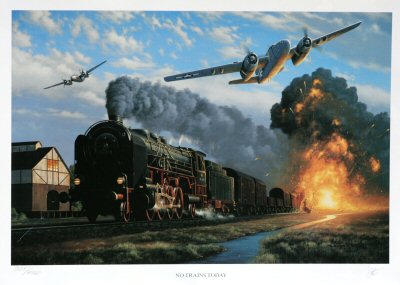
No Trains Today by Stan Stokes. - Cranston Military Prints

No Trains Today by Stan Stokes.


No Trains Today by Stan Stokes.

The A-26 Invader was one of the most effective attack bombers to see action late in the War, and the aircraft, when fitted with eight .5 caliber machine guns in its nose, was an incredibly effective ground or surface ship attack aircraft. Douglas Aircraft developed the aircraft. The team of Edward Heinemann and Jack Northrop worked on the initial design of what would become the A-20 Havoc. Northrop then left Douglas to form his own company. Heinemenn and project engineer Robert Donovan began work on the A-26 project in 1941. It would incorporate several of the A-20s features yet it would be as advanced as possible with many state-of-the-art concepts. A mid-mounted, laminar-flow airfoil wing was utilized with double slotted electrically controlled flaps. Defensive armament was limited to remotely controlled dorsal and ventral turrets both under the control of a gunner located in the rear of the fuselage. Approval to develop prototypes was received from the Army in June of 1941. Three were built at Douglas El Segundo, California plant and were designated the XA-26. Heinemanns design team had built in a lot of flexibility into the A-26s design. The aircraft could be easily modified to vary its role. A three-man attack bomber version with a Plexiglas nose could be modified into a two-man night fighter version with radar in the nose and four ventral-mounted 20mm cannons, or modified once again into a ground attack aircraft with a variety of nose-mounted armaments. Work on the three prototypes was slowed by the War, but the aircraft was ready to go into production by mid-1942. Screw-ups within the Army and a lack of manufacturing equipment delayed the start of production until 1943. The Army decided to cancel the night fighter version of the A-26 and proceed with production of both a bomber and ground attack versions of the aircraft that would be named the Invader. The A-26B with the nose-mounted armament generally was fitted with either six or eight machine guns. The B variant could carry a 6,000-pound bomb load powered by its twin 2000-HP Pratt and Whitney R-2800-27 engines. With a maximum speed of 322-MPH the aircraft had a service ceiling of 25,000 feet and a maximum range of approximately 3000 miles. The A-26C variant was the glass nosed bomber version. In total 1,355 B versions were built along with 1,336 C versions. After the War the A-26s designation changed to the B-26 - leading to some confusion with the Martin-built B-26. In Stan Stokes painting entitled No Trains Today, a pair of A-26Bs rip into an Axis freight train behind enemy lines in 1945. The A-26 would go on to serve in the Korean War and several of these splendid aircraft remain air-worthy to this day.
Item Code : STK0101GSNo Trains Today by Stan Stokes. - Editions AvailableExtra....

A photograph of an edition of the print :

DESCRIPTIONSIZESIGNATURESOFFERSPRICEPURCHASINGPACKS
Signed limited edition of 4750 prints. Print size 16 inches x 11.5 inches (41cm x 30cm) Artist : Stan Stokes£15 Off!
Add any two items on this offer to your basket, and the lower priced item will be half price in the checkout!
Now : £35.00

Quantity:
Limited edition of 100 giclee art prints. Size 21 inches x 14 inches (53cm x 36cm)Artist : Stan Stokes£145.00

Quantity:
Limited edition of 100 giclee canvas prints. Size 27 inches x 18 inches (69cm x 46cm)none£400.00

Quantity:


Some other related items available from this site.

 When the seasoned B-26 crews of the 386th Bomb Group took delivery of their Douglas A-26 Invader aircraft in September 1944, the arrival of their new fast attack bombers neatly coincided with a move to France. Now based at Beaumont-sur-Oise, they were able to penetrate deep into enemy territory. The three man crews took part in the Battle of the Bulge, their twin engined aircraft being well suited to their task of destroying strategic bridges and cutting vital supply lines. After the Ardennes Campaign, now fully equipped with the A-26, the 386th BG continued to strike hard against important targets in Germany, the nimble handling characteristics of the aircraft making low-level attacks a speciality. As the Allies advanced upon Germany the 386th moved to St. Trond in Belgium, their base at the time of Nicolas Trudgians dramatic painting. Arriving at high speed over the busy German rail yard in the heart of the Ruhr Valley, barely skimming the nearby factory chimney stacks on the way into the target, the A-26 crews on the 386th deliver a devastating blow, leaving a trail of destruction in their wake. With bombs away, the Invader crews strafe the area with their battery of ten forward-firing .50 cal. machine guns, the roar of their twin 2000hp engines heightening the tension and confusion on the ground.

Ruhr Valley Invaders by Nicolas Trudgian.
 The A-26 Invader was one of the most effective attack bombers to see action late in the War, and the aircraft, when fitted with eight .5 caliber machine guns in its nose, was an incredibly effective ground or surface ship attack aircraft. Douglas Aircraft developed the aircraft. The team of Edward Heinemann and Jack Northrop worked on the initial design of what would become the A-20 Havoc. Northrop then left Douglas to form his own company. Heinemenn and project engineer Robert Donovan began work on the A-26 project in 1941. It would incorporate several of the A-20s features yet it would be as advanced as possible with many state-of-the-art concepts. A mid-mounted, laminar-flow airfoil wing was utilized with double slotted electrically controlled flaps. Defensive armament was limited to remotely controlled dorsal and ventral turrets both under the control of a gunner located in the rear of the fuselage. Approval to develop prototypes was received from the Army in June of 1941. Three were built at Douglas El Segundo, California plant and were designated the XA-26. Heinemanns design team had built in a lot of flexibility into the A-26s design. The aircraft could be easily modified to vary its role. A three-man attack bomber version with a Plexiglas nose could be modified into a two-man night fighter version with radar in the nose and four ventral-mounted 20mm cannons, or modified once again into a ground attack aircraft with a variety of nose-mounted armaments. Work on the three prototypes was slowed by the War, but the aircraft was ready to go into production by mid-1942. Screw-ups within the Army and a lack of manufacturing equipment delayed the start of production until 1943. The Army decided to cancel the night fighter version of the A-26 and proceed with production of both a bomber and ground attack versions of the aircraft that would be named the Invader. The A-26B with the nose-mounted armament generally was fitted with either six or eight machine guns. The B variant could carry a 6,000-pound bomb load powered by its twin 2000-HP Pratt and Whitney R-2800-27 engines. With a maximum speed of 322-MPH the aircraft had a service ceiling of 25,000 feet and a maximum range of approximately 3000 miles. The A-26C variant was the glass nosed bomber version. In total 1,355 B versions were built along with 1,336 C versions. After the War the A-26s designation changed to the B-26 - leading to some confusion with the Martin-built B-26. In Stan Stokes painting entitled No Trains Today, a pair of A-26Bs rip into an Axis freight train behind enemy lines in 1945. The A-26 would go on to serve in the Korean War and several of these splendid aircraft remain air-worthy to this day.

No Trains Today by Stan Stokes.
 Arthur R Milow - Commanding Officer of the 643rd Bomb Squadron, 409th Bomb Group, he flew 66 combat missions in the A-20 Havoc and A-26 Invader, including on D-Day itself and in the Battle of the Bulge.  He died in 2012.<br><br>Wayne E Downing - A pilot on the A-20 Havoc with the 416th Bomb Group, he flew missions D-Day.  He later converted to the A-26 Invader, completing a total of 86 combat missons.  Post-war he stayed with the Air Force flying the B-47 and B-52 until 1962, becoming a maths teacher after leaving the service.  He died in 2018.<br><br>Ralph F Conte - A bombardier / navigator with the 416th Bomb Group, he flew his first mission on 4th March 1944.  Flying a total of 65 combat missions in the A-20 Havoc and A-26 Invader, he was awarded the Purple Heart after being wounded by flak on 18th July 1944.  He died in 2016.

Clipped Signature - Arthur R Milow.
When the seasoned B-26 crews of the 386th Bomb Group took delivery of their Douglas A-26 Invader aircraft in September 1944, the arrival of their new fast attack bombers neatly coincided with a move to France. Now based at Beaumont-sur-Oise, they were able to penetrate deep into enemy territory. The three man crews took part in the Battle of the Bulge, their twin engined aircraft being well suited to their task of destroying strategic bridges and cutting vital supply lines. After the Ardennes Campaign, now fully equipped with the A-26, the 386th BG continued to strike hard against important targets in Germany, the nimble handling characteristics of the aircraft making low-level attacks a speciality. As the Allies advanced upon Germany the 386th moved to St. Trond in Belgium, their base at the time of Nicolas Trudgians dramatic painting. Arriving at high speed over the busy German rail yard in the heart of the Ruhr Valley, barely skimming the nearby factory chimney stacks on the way into the target, the A-26 crews on the 386th deliver a devastating blow, leaving a trail of destruction in their wake. With bombs away, the Invader crews strafe the area with their battery of ten forward-firing .50 cal. machine guns, the roar of their twin 2000hp engines heightening the tension and confusion on the ground.  <br><br><b>Published 2000.<br>

Ruhr Valley Invaders by Nicolas Trudgian
Aircraft Related to This Print
Invader

Contact Details
Shipping Info
Terms and Conditions
Cookie Policy
Privacy Policy

Sign Up To Our Newsletter!

Stay up to date with all our latest offers, deals and events as well as new releases and exclusive subscriber content!

This website is owned by Cranston Fine Arts.  Torwood House, Torwoodhill Road, Rhu, Helensburgh, Scotland, G848LE

Contact: Tel: (+44) (0) 1436 820269.  Email: cranstonorders -at- outlook.com

Return to Home Page