Cranston Military Prints .com Home Page
Customer Helpline (UK) : 01436 820269
Subscribe to our Newsletter!

You currently have no items in your basket

Payment Options Display
Buy with confidence and security!
Publishing historical art since 1985


Navigation Menus
Military
Art Index
Aviation
Art Index
Naval
Art Index
Artists
Index
Product Search         
Aviation
History Archive
Naval
History Archive
HALF PRICE AND FREE PRINT SPECIAL OFFERS
ALWAYS GREAT OFFERS :
20% FURTHER PRICE REDUCTIONS ON HUNDREDS OF LIMITED EDITION ART PRINTS
BUY ONE GET ONE HALF PRICE ON THOUSANDS OF PAINTINGS AND PRINTS
FOR MORE OFFERS SIGN UP TO OUR FREE NEWSLETTER
The Brits Get Burned by Stan Stokes. - Cranston Military Prints

The Brits Get Burned by Stan Stokes.


The Brits Get Burned by Stan Stokes.

Twenty-four hours prior to the Japanese attack on Pearl Harbor Japanese fighters near the Gulf of Siam shot down a RAF Catalina flying boat. The RAF aircraft had stumbled across the Japanese Southern Expeditionary Fleet proceeding to Malaya with a powerful invasion force. With many of its carriers approaching Pearl Harbor, the Japanese invasion force was dependent on land-based air cover. The Japanese Navys 22nd Air Flotilla had relocated to bases in French Indochina. Also within range were Army aircraft flying out of the Saigon area. The Japanese had several hundred aircraft at their disposal. On the British side there was a collection of approximately 150 mostly obsolete and poorly maintained aircraft including Brewster Buffalos, Vildebeast torpedo bombers, Blenheim light bombers, and Hudson patrol aircraft. The British had reinforced their naval forces in the area in November with the arrival of Force Z. Force Z included the old battle cruiser Repulse and the new state-of-the-art battleship Prince of Wales. It had also included the aircraft carrier Indomitable, but that ship had unhappily run aground in the West Indies. Force Z was sent north, under radio silence, to seek out the Japanese invasion force. Guided by some reports from a submarine, a force of 53 Japanese aircraft from the 22nd Air Flotilla took off on a mission to intercept the British force. Flying twin-engine G3M Nell and G4M1 Betty bombers, mostly armed with torpedoes, the Japanese pilots flew southwards through darkness and heavy clouds. Finally spotting something, the aircraft proceeded to attack position, but realized at the last minute that they were preparing to attack Admiral Ozawas flagship. About the same time, Force Z made contact with two scout planes launched from Ozawas cruisers. Disappointed that they had lost any element of surprise, the British force turned back. The next day the force was spotted by Japanese reconnaissance aircraft and their position was established for another attack force of nearly 100 aircraft. The Repulse was attacked first by a low level bombing run by Nells. Two waves of torpedo bomber attacks then followed. Captain Tennant, the ships commander twisted and swerved his ship, managing to dodge all the torpedoes. A third wave resulted in a single torpedo hit; exposing the old ship to nine more torpedo bombers. Four more torpedoes struck home, and the Repulse rolled over and sunk. The Prince of Wales was attacked by an initial wave of nine torpedo bombers, and suffered two hits. Mortally wounded she was attacked by a second wave of torpedo bombers. This time 4 more torpedoes struck home. She capsized and sank a few hours after the Repulse had preceded her. The demise of the Repulse and the Prince of Wales marked the end of the Battleship Era. Never again could powerful ships feel any security as long as unopposed enemy airpower was in range.
Item Code : STK0126GSThe Brits Get Burned by Stan Stokes. - Editions AvailableExtra....

A photograph of an edition of the print :

DESCRIPTIONSIZESIGNATURESOFFERSPRICEPURCHASINGPACKS
Signed limited edition of 4750 prints. Print size 16 inches x 11.5 inches (41cm x 30cm) Artist : Stan Stokes£15 Off!
Add any two items on this offer to your basket, and the lower priced item will be half price in the checkout!
Now : £35.00

Quantity:
Limited edition of 100 giclee canvas prints. Size 36 inches x 24 inches (91cm x 61cm)none£550.00

Quantity:
Limited edition of 100 giclee canvas prints. Size 27 inches x 18 inches (69cm x 46cm)none£50 Off!Now : £370.00

Quantity:


Some other related items available from this site.

 Corsairs of VMF 121 provide close air support to the US landings on Rendova, June 30, 1943. Fiercely contested, the invasion force was heavily attacked by Zero fighters and Mitsubishi G4M1 Betty bombers, flying from their base at Rabaul. Dog-fighting at tree-top height, VMF 121 Corsairs rip into a bunch of Betty bombers as they try to make their escape following their attack on shipping. On fire, the Betty in the foreground is doomed, and will shortly become one of 19 Japanese aircraft accounted for by VMF 121. Other Marine fighter units brought the total this day to a staggering 58 enemy aircraft destroyed.

Battle for the Islands by Nicolas Trudgian.
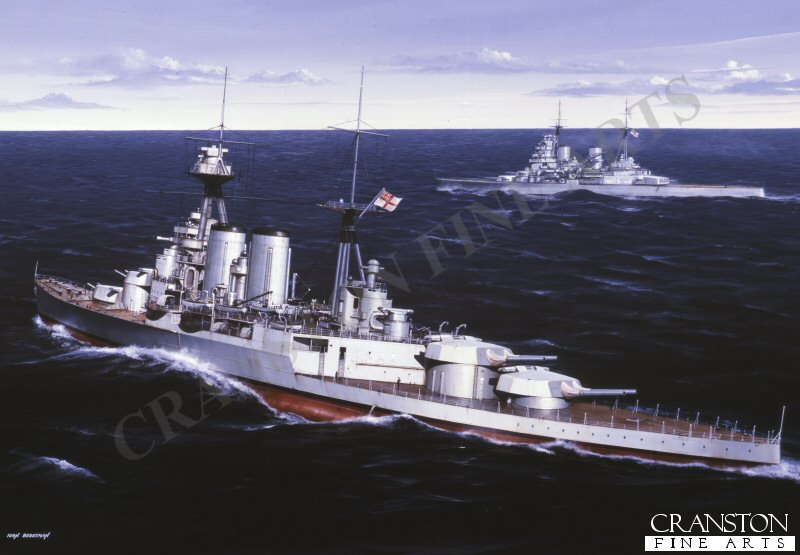
Pride of the Royal Navy, the mighty Hood rolls majestically in the north Atlantic swell as HMS Prince of Wales holds station off her starboard bow.

HMS Hood by Ivan Berryman
 On April 18, 1943, in one of the more interesting, daring, and ultimately controversial missions of WW II, a flight of P-38s under the command of Major John Mitchell, intercepted and destroyed the aircraft carrying Admiral Isoroku Yamamoto, Commander in Chief of the Japanese Combined Fleet, and the mastermind of the attack on Pearl Harbor. American code breakers had intercepted and translated a message indicating that Adm. Yamamoto would fly from Rabaul to an airfield on the southern tip of Bouganville on the morning of April 18, 1943. Because of the great distances to be covered during this intercept mission the P-38s would have very limited time over the rendezvous area. Fortunately for the Army Air Force pilots, Yamamoto was noted for his punctuality, and if he departed Rabaul on time the mission might just work. Major Mitchell led his flight of 16 P-38s to the rendezvous, with twelve of his fighters acting as high cover to fend off escorting fighters, while four pilots were designated as the killer flight by Mitchell and were to destroy the Mitsubishi Betty which would be carrying the Admiral. Two betty bombers and six Zero fighters were encountered. Both Bettys were downed by the killer flight and one of the four P-38s in the killer flight was lost. Unfortunately, this marvelous mission has also been surrounded by more than its share of controversy. One of the three surviving pilots of the killer flight was Thomas Lamphier. Lamphier claimed that only he fired the fatal shots into Yamamotos Betty. In 1972 the Air Force reviewed all relevant information surrounding the flight, including testimony from a surviving Japanese fighter pilot on the mission and a surviving passenger on the second Betty. The official Air Force decision in 1972 was that both Lamphier and his wingman Rex Barber should share equal credit. In March of 1985 another Victory Credit Board of Review was convened, and it too concluded that the victory should be shared. Later that year new evidence was put forward in the form of a taped interview with one of the surviving Zero pilots, Kenji Yanagiya. Yanagiyas testimony clearly supported the Rex Barber account of the mission and not that of Lamphier. Lamphier, who died in 1987, continued to be outspoken until his death in his claims. In 1993, The noted aviation historian, Carroll Glines published an excellent book entitled Attack on Yamamoto. The bulk of the evidence presented in Glines book supported the conclusion that only Rex Barber probably deserves credit for the victory. More recently a board assembled by the American Fighter Aces Association met and reviewed all available facts. That Board decided that only Rex Barber deserves the official credit for downing Yamamoto. Despite all this unfortunate controversy one cannot deny that the mission to intercept Yamamoto was the longest successful mission of its type in WWII. Yamamotos death boosted morale in the United States, shocked the Japanese public, and was ultimately symbolic of the turn around in the War in the Pacific, which began at Midway in 1942, and gathered momentum in 1943.

Yamamoto's Last Flight by Stan Stokes.
Pride of the Royal Navy, the mighty Hood rolls majestically in the north Atlantic swell as HMS Prince of Wales holds station off her starboard bow.

HMS Hood by Ivan Berryman
Aircraft Related to This Print
Betty
Ships Related to This Print
HMS Prince of Wales

Contact Details
Shipping Info
Terms and Conditions
Cookie Policy
Privacy Policy

Sign Up To Our Newsletter!

Stay up to date with all our latest offers, deals and events as well as new releases and exclusive subscriber content!

This website is owned by Cranston Fine Arts.  Torwood House, Torwoodhill Road, Rhu, Helensburgh, Scotland, G848LE

Contact: Tel: (+44) (0) 1436 820269.  Email: cranstonorders -at- outlook.com

Return to Home Page