Cranston Military Prints .com Home Page
Customer Helpline (UK) : 01436 820269
Subscribe to our Newsletter!

You currently have no items in your basket

Payment Options Display
Buy with confidence and security!
Publishing historical art since 1985


Navigation Menus
Military
Art Index
Aviation
Art Index
Naval
Art Index
Artists
Index
Product Search         
Aviation
History Archive
Naval
History Archive
HALF PRICE AND FREE PRINT SPECIAL OFFERS
ALWAYS GREAT OFFERS :
20% FURTHER PRICE REDUCTIONS ON HUNDREDS OF LIMITED EDITION ART PRINTS
BUY ONE GET ONE HALF PRICE ON THOUSANDS OF PAINTINGS AND PRINTS
FOR MORE OFFERS SIGN UP TO OUR FREE NEWSLETTER
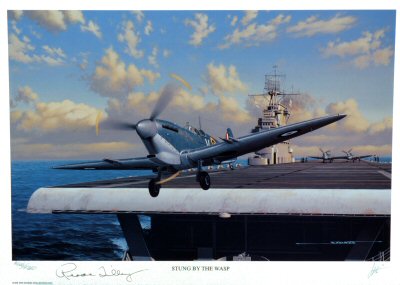
Stung by the Wasp by Stan Stokes. - Cranston Military Prints

Stung by the Wasp by Stan Stokes.


Stung by the Wasp by Stan Stokes.

The Axis attack on the British controlled island of Malta commenced in 1940 only one day after Mussolini committed Italy's forces on the side of the Germans during WW II. This strategically located island was a thorn in the side of Axis plans to dominate the Mediterranean and win control of North Africa. Malta would be attacked thousands of times by waves of both Italian and German bombers during the course of the War. On a per acre basis it may be one of the most bombed targets of WW II. In the early phases of the defense of the island a handful of Gloster Gladiators which were supplemented eventually by RAF Hurricanes carried on the brunt of the islands defense. Spitfires were sorely needed. The first Fifteen Spitfires arrived in Malta on March 7, 1942, and a second group of Spits arrived on March 29. In both cases they were launched from the HMS Eagle, and had to fly more than 600 miles over the Mediterranean to reach the island. In April of 1942, Churchill asked Roosevelt for assistance in supplying Spitfires to Malta. The besieged island was now in range of approximately 400 German fighters and bombers and about 200 Italian aircraft, and intelligence information pointed to the possibility of an invasion by airborne paratrooper forces out of Sicily. Due to combat losses, and the difficulty in getting spare parts, the islands defenders could generally muster only 20-30 defensive fighters on any particular day. This was woefully inadequate. With the Eagle was now laid up for repairs, and the Argus and Victorious not capable of handling the Spitfires. Churchill specifically requested American intervention, and asked FDR if the USS Wasp could shuttle fifty Spitfires to Malta. FDR agreed to the mission, and plans were immediately implemented. It was determined that two entire Spitfire squadrons No. 601 and 603 would make the journey. These units had a number of American pilots. On April 12 the Wasp docked on the Clyde of Glasgow and began taking on the Spitfires for her journey. With most of its regular aircraft removed, only nineteen F4F Wildcats were retained for fighter cover. On the 14th the Wasp set sale with a number of escorts. All the aircraft were Mk. Vc models equipped with four canon and four machine guns. Each had a Vokes air filter fitted beneath its nose and was equipped with a 90-gallon auxiliary fuel tank. The Spits were over-sprayed with a dark blue paint in hopes of making them less noticeable to the enemy during the 660 mile over water flight to Malta. Following breakfast on Monday April 20, 1942, the RAF pilots manned the 47 aircraft deemed suitable for the flight and the launch commenced. One immediate casualty was an RAF mechanic who walked into a turning prop and was immediately killed. One American pilot flew his Spitfire to Algeria, but the remaining 46 aircraft successfully landed in Malta. Within hours of their arrival the airfields were once again under attack by Axis bombers, and the newly arrived pilots were immediately pressed into service defending the island. The ability of the British to retain control of Malta as a base for torpedo planes and bombers which could harrass Rommels supply lines to North Africa, was critical in attaining eventual Allied victory in North Africa, the successful invasion of Italy, and ultimately, complete Allied victory in Europe.
Item Code : STK0135CStung by the Wasp by Stan Stokes. - Editions Available
DESCRIPTIONSIZESIGNATURESOFFERSPRICEPURCHASINGPACKS
Signed limited edition of 4750 prints. Print size 16 inches x 11.5 inches (41cm x 30cm) Artist : Stan Stokes£15 Off!
Add any two items on this offer to your basket, and the lower priced item will be half price in the checkout!
Now : £35.00

Quantity:
225 prints from the signed limited edition of 4750 prints, with signature of Stan Stokes and pilot, and a remarque.Image size 16 inches x 11.5 inches (41cm x 30cm)
Tilley, Reade F

Died : 2001
Col Reade F Tilley USAF (deceased)
A native of Clearwater, Florida, Reade Tilley grew up with a love for competition in the fast lane. This made Reade natural for driving race cars and the military equivalent; fighter pilot. After attending the St. Petersburg College in Florida and the University of Texas at Austin, Reade was faced with the difficult choice of deciding whether to continue to pursue his race car driving career or become a fighter pilot. With war raging in Europe, Reade opted for the latter, and joined the Royal Ca
Signature Value : £60
CLICK HERE FOR FULL PROFILE
 
+ Artist : Stan Stokes


Signature(s) value alone : £60
£30 Off!Now : £120.00

Quantity:
Prints from the 225 prints from the signed limited edition of 4750 prints, with signature of Stan Stokes and pilot. Image size 16 inches x 11.5 inches (41cm x 30cm)

Extras....


A photograph of this print, showing the pilot signature in the border.


Tilley, Reade F

Died : 2001
Col Reade F Tilley USAF (deceased)
A native of Clearwater, Florida, Reade Tilley grew up with a love for competition in the fast lane. This made Reade natural for driving race cars and the military equivalent; fighter pilot. After attending the St. Petersburg College in Florida and the University of Texas at Austin, Reade was faced with the difficult choice of deciding whether to continue to pursue his race car driving career or become a fighter pilot. With war raging in Europe, Reade opted for the latter, and joined the Royal Ca
Signature Value : £60
CLICK HERE FOR FULL PROFILE
 
+ Artist : Stan Stokes


Signature(s) value alone : £60
£40 Off!
Add any two items on this offer to your basket, and the lower priced item will be half price in the checkout!
Now : £90.00

Quantity:
In 3 Pairs
View


Some other related items available from this site.

  A trio of Spitfire Mk1s of 603 Sqn based at Biggin Hill are depicted on patrol in the Summer skies above Kent during the height of the Battle of Britain in August 1940. Lead aircraft is N3288 XT-H flown by Plt Off George Gilroy who finished the war with 14 confirmed victories, 10 shared and a further 14 aircraft destroyed in actions in which he was directly involved.

Biggin Trio by Ivan Berryman.
  MK1 Hurricanes of No. 601 Squadron refueled and rearmed, climb to rejoin the battle during the summer of 1940. As the great air battle rages high above, life goes in the countryside as a Southern Railway train pulls out of a local village station, capturing the resilient mood of the people.

Tangmere Hurricanes by Nicolas Trudgian.
 The Axis attack on the British controlled island of Malta commenced in 1940 only one day after Mussolini committed Italy's forces on the side of the Germans during WW II. This strategically located island was a thorn in the side of Axis plans to dominate the Mediterranean and win control of North Africa. Malta would be attacked thousands of times by waves of both Italian and German bombers during the course of the War. On a per acre basis it may be one of the most bombed targets of WW II. In the early phases of the defense of the island a handful of Gloster Gladiators which were supplemented eventually by RAF Hurricanes carried on the brunt of the islands defense. Spitfires were sorely needed. The first Fifteen Spitfires arrived in Malta on March 7, 1942, and a second group of Spits arrived on March 29. In both cases they were launched from the HMS Eagle, and had to fly more than 600 miles over the Mediterranean to reach the island. In April of 1942, Churchill asked Roosevelt for assistance in supplying Spitfires to Malta. The besieged island was now in range of approximately 400 German fighters and bombers and about 200 Italian aircraft, and intelligence information pointed to the possibility of an invasion by airborne paratrooper forces out of Sicily. Due to combat losses, and the difficulty in getting spare parts, the islands defenders could generally muster only 20-30 defensive fighters on any particular day. This was woefully inadequate. With the Eagle was now laid up for repairs, and the Argus and Victorious not capable of handling the Spitfires. Churchill specifically requested American intervention, and asked FDR if the USS Wasp could shuttle fifty Spitfires to Malta. FDR agreed to the mission, and plans were immediately implemented. It was determined that two entire Spitfire squadrons No. 601 and 603 would make the journey. These units had a number of American pilots. On April 12 the Wasp docked on the Clyde of Glasgow and began taking on the Spitfires for her journey. With most of its regular aircraft removed, only nineteen F4F Wildcats were retained for fighter cover. On the 14th the Wasp set sale with a number of escorts. All the aircraft were Mk. Vc models equipped with four canon and four machine guns. Each had a Vokes air filter fitted beneath its nose and was equipped with a 90-gallon auxiliary fuel tank. The Spits were over-sprayed with a dark blue paint in hopes of making them less noticeable to the enemy during the 660 mile over water flight to Malta. Following breakfast on Monday April 20, 1942, the RAF pilots manned the 47 aircraft deemed suitable for the flight and the launch commenced. One immediate casualty was an RAF mechanic who walked into a turning prop and was immediately killed. One American pilot flew his Spitfire to Algeria, but the remaining 46 aircraft successfully landed in Malta. Within hours of their arrival the airfields were once again under attack by Axis bombers, and the newly arrived pilots were immediately pressed into service defending the island. The ability of the British to retain control of Malta as a base for torpedo planes and bombers which could harrass Rommels supply lines to North Africa, was critical in attaining eventual Allied victory in North Africa, the successful invasion of Italy, and ultimately, complete Allied victory in Europe.

Stung by the Wasp by Stan Stokes.
 Spitfire Ace Basil Gerald <i>Stapme</i> Stapleton achieved Ace status with 6 victories during the Battle of Britain in 1940.  He is shown here in his Spitfire XT-L of No.603 Sqn during combat with German Ace Franz von Werra - the German ultimately survived being shot down over Kent in this encounter.  Stapleton went on to fly Typhoons before himself being forced down behind enemy lines and captured in 1944, and liberated six months later.  Basil Stapleton died in 2010.

Tribute to Basil Stapleton by Ivan Berryman.
Signatures on these products
*The value given for each signature has been calculated by us based on the historical significance and rarity of the signature and is for the unmatted version where available. Values of many pilot signatures have risen in recent years and will likely continue to rise as they become more and more rare.
NameInfo


Col Reade F Tilley USAF (deceased)
Died : 2001
*Signature Value : £60

Editions signed :

225 prints from the signed limited edition of 4750 prints, with signature of Stan Stokes and pilot, and a remarque.
Prints from the 225 prints from the signed limited edition of 4750 prints, with signature of Stan Stokes and pilot.


Tilley, Reade F
(Col Reade F Tilley USAF (deceased))

A native of Clearwater, Florida, Reade Tilley grew up with a love for competition in the fast lane. This made Reade natural for driving race cars and the military equivalent; fighter pilot. After attending the St. Petersburg College in Florida and the University of Texas at Austin, Reade was faced with the difficult choice of deciding whether to continue to pursue his race car driving career or become a fighter pilot. With war raging in Europe, Reade opted for the latter, and joined the Royal Canadian Air Force in 1940. In 1941 he was assigned to No. 121 Eagle Squadron of the RAF. This was one of the three American-manned squadrons in the RAF. Reading of the horrific air attacks being endured by the people of the besieged Island of Malta, Reade volunteered for a daring mission to launch landbased Spitfires from the USS Wasp to relieve the forces on the island. On the morning of April 20, 1942 forty-seven Spits, including one flown by Tilley, were launched from the Wasp. The arrival of these fighters was very important in saving the strategic island from annihilation by the Nazis. Arriving safely in Malta, Tilley would soon fly in combat, and on his second mission he would down a Bf-109. The Luftwaffe launched an all-out effort to destroy the recently arrived Spitfires, and within a matter of days all of the newly arrived aircraft were either destroyed or damaged. In June Tilley returned to Gibraltar and led another flight of Spitfires to Malta, this time from the deck of the HMS Eagle. During his combat tours at Malta, Tilley attained a total of seven confirmed aerial victories, two probables, and five damaged. He was one of the first two American pilots to be awarded the Distinguished Flying Cross during the defense of Malta. The citation reads in part: '... on three occasions by making feint attacks after having expended his ammunition he successfully drove off enemy fighters attempting to machine gun our aircraft as they landed ...' Reade was promoted to Flying Officer in August of 1942, and in October he transferred to the USAAC with the rank of Captain. In early 1944 he was promoted to the rank of Major. Tilley remained with the USAF following the War and served initially with the USAFE, the Air Forces in Europe, where he was involved with the Berlin Air Lift. Later Tilley would serve with the Strategic Air Command. Promoted to Colonel in 1955, he served as the Director of Public Information for General Curtis LeMay. During this period Tilley was able to hone his race car driving skills as a member of the SAC Racing Team. Driving an Allard, Tilley competed against some of the top professional drivers of the era in a series of road race competitions at Air Force bases throughout the country. Reade also served as Director of Information for Pacific Air Forces during the Vietnam War. After retiring from the Air Force, he became a consultant. Reade Tilley passed away in 2001.
Squadrons Related to This Print
No.601 Sqn
No.603 Sqn
Aircraft Related to This Print
Seafire
Ships Related to This Print
USS Wasp

Contact Details
Shipping Info
Terms and Conditions
Cookie Policy
Privacy Policy

Sign Up To Our Newsletter!

Stay up to date with all our latest offers, deals and events as well as new releases and exclusive subscriber content!

This website is owned by Cranston Fine Arts.  Torwood House, Torwoodhill Road, Rhu, Helensburgh, Scotland, G848LE

Contact: Tel: (+44) (0) 1436 820269.  Email: cranstonorders -at- outlook.com

Return to Home Page