Cranston Military Prints .com Home Page
Customer Helpline (UK) : 01436 820269
Subscribe to our Newsletter!

You currently have no items in your basket

Payment Options Display
Buy with confidence and security!
Publishing historical art since 1985


Navigation Menus
Military
Art Index
Aviation
Art Index
Naval
Art Index
Artists
Index
Product Search         
Aviation
History Archive
Naval
History Archive
HALF PRICE AND FREE PRINT SPECIAL OFFERS
ALWAYS GREAT OFFERS :
20% FURTHER PRICE REDUCTIONS ON HUNDREDS OF LIMITED EDITION ART PRINTS
BUY ONE GET ONE HALF PRICE ON THOUSANDS OF PAINTINGS AND PRINTS
FOR MORE OFFERS SIGN UP TO OUR FREE NEWSLETTER
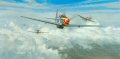
Vintage Mustangs by Stan Stokes. - Cranston Military Prints

Vintage Mustangs by Stan Stokes.


Vintage Mustangs by Stan Stokes.

When War broke out in Europe in 1939 the British Government decided to establish a second source for the Curtis P-40 fighter. The Brits approached North American Aviation of Inglewood, California. North Americans manufacturing division was headed by James Dutch Kindelberger, and the division already was involved with Britain in supplying its AT-6 trainers to the RAF. Kindelberger rejected the British proposal and instead offered a new aircraft to be built using the same engine as the P-40, but with an improved more aerodynamic design. In May of 1940 a contract was signed for 320 of the new aircraft, designated NA-73, and North American put Raymond Rice in charge of the design team. The chief designer was Edgar Schmued who had immigrated to America from Germany in 1930. Incorporating a laminar flow wing, and a streamlined design, the NA-73X took to the air in October of 1940 under the control of Vance Breese, the projects test pilot. As production commenced a pair of aircraft were provided the USAAC for evaluation at Wright-Patterson Field in Ohio. Designated the XP-51 by the USAAC, the Brits coined the name Mustang for this new aircraft. About 1,000 Mustangs were produced utilizing the Allison V- 1710-3 9 engine. The aircrafts performance was somewhat disappointing, and the RAF proposed testing this aircraft with the more powerful Rolls Royce Merlin engine. Testing showed dramatic performance improvements, and the P-51 was some reborn with a Packard-built version of the Merlin. More than 3,700 P-5 1 Bs utilizing the Merlin engine were produced. Equipped with underwing drop tanks these Mustangs were now capable of accompanying US bombers deep into enemy airspace. They also were now the equals of anything the Germans could produce when involved in high altitude dog fighting. A number of Americas top fighter aces of the War flew the Mustang, including Col. Henry W. Brown. Brown, a native of Dallas Texas, flew a P-51B nicknamed the Hun Hunter from Texas. Brown had been assigned to the 355th Fighter Group of the Eighth Air Force in 1943. His first combat tour, flying the P-47 Jug, yielded 4.5 enemy aircraft destroyed on the ground. On his second combat tour Brown began flying the Mustang. He attained 14.2 confirmed aerial victories, and a total of 28.7, prior to being shot down and captured in October of 1944. Following the War, and his release from prisoner of war camp, Brown remained in the Air Force. He commanded a number of fighter units prior to his retirement in 1974. The Ford Mustang was introduced in April 1964 at the New York Worlds Fair. It was the most successful new car of the 1960s with nearly 700,000 sold between mid-1964 and December 1965. Spearheading this incredible success was Lee A. lacocca, a straight-talking former car salesman, who had risen rapidly in the Ford organization. In many ways the Mustang was similar to the first Ford Thunderbirds of 1955-57, yet this automobile had its own unique identity. Powered by either a 101 HP 170 cu. inch six, or a 164 HP V-8, a long list of options allowed consumers to tailor their Mustang to their own tastes. The original Mustang was a brilliant design and much of the credit goes to Joe Oros, Gale Halderman, and L. David Ash of the Ford Division Styling Studio.
Item Code : STK0195GSVintage Mustangs by Stan Stokes. - Editions Available
DESCRIPTIONSIZESIGNATURESOFFERSPRICEPURCHASINGPACKS
Signed limited edition of 950 prints. Print size 26 inches x 22 inches (66cm x 56cm)
Brown, Henry W
Died : 2008
Henry W Brown
Col. Henry William Brown. Brown, born in 1923 and a native of Dallas Texas, flew a P-51B nicknamed the Hun Hunter from Texas. Brown had been assigned to the 355th Fighter Group of the Eighth Air Force in 1943. His first combat tour, flying the P-47 Jug, yielded 4.5 enemy aircraft destroyed on the ground. On his second combat tour Brown began flying the Mustang. Brown became the first Eighth Air Force pilot to destroy more than three aircraft in a day when on 8th March 1944 he strafed Hosepe airf
Signature Value : £40
CLICK HERE FOR FULL PROFILE

+ Artist : Stan Stokes


Signature(s) value alone : £40
£10 Off!Now : £120.00

Quantity:
Limited edition of 100 giclee canvas prints. Size 45 inches x 30 inches (114cm x 76cm)noneSOLD
OUT
NOT
AVAILABLE
Limited edition of 100 giclee canvas prints. Size 36 inches x 24 inches (91cm x 61cm)noneSOLD
OUT
NOT
AVAILABLE
Limited edition of 100 giclee canvas prints. Size 27 inches x 18 inches (69cm x 46cm)none£400.00

Quantity:


Some other related items available from this site.

The 357th Fighter Group was an air combat unit of the US army Air Force during the Second World War. The 357th operated  P-51 Mustang fighter aircraft as part of the U.S. 8th Air Force and its members were known unofficially as the <i>Yoxford Boys</i> after the village of Yoxford near their base in the UK.  Group tradition holds that the name was the invention of Lord Haw Haw in a broadcast greeting the night of its arrival at RAF Leiston.  Its victory totals in air-to-air combat are the most of any P-51 group in the Eighth Air Force and third among all groups fighting in Europe.

The Yoxford Boys by Gerald Coulson.
 P-51s of the 328th Fighter Squadron high above towering cumulus clouds over East Anglia in November 1944.  Led by Major George Preddy, the P-51 pilots prepare to escort a large formation of B-17s on yet another arduous long range mission to Germany.

Blue Nose by Richard Taylor.
 Depicting Mustang aircraft escorting Flying Fortresses on a bombing raid over Germany.

Guardian Angel by Anthony Saunders.
 They were an extraordinary group of men who flew their distinctive blue-nosed P-51 Mustangs fearlessly in the savage skies over war-torn Europe.  They were the pilots of the 352nd Fighter Group - Masters of the Sky.  The three squadrons of P-51 Mustangs that made up the 352nd Fighter Group contained a remarkable collection of fearless young aviators who, amongst other things, provided more Aces in a Day than any other P-51 Group in any theatre.  These were pilots such as George Preddy - the highest scoring P-51 Mustang Ace in the Eighth Air Force - who downed 6 Me109s in a single day, and Don Bryan with 5 victories in a day.  No less than twenty nine of the USAAF's top aerial Aces in Europe were also from the 352nd, and twelve 352nd pilots scored aerial victories over the revolutionary German jet fighters.  To commemorate the men who flew with the 352nd Fighter Group during World War II, Richard Taylor has created his magnificent painting, Masters of the Sky.  Led by their Commanding Officer Major George Preddy, the P-51 Mustang pilots of the 328th Fighter Squadron engage in a bitter struggle with Luftwaffe fighters in the cold winter air high over eastern Germany.  They have been escorting B-17 Fortresses attacking the heavily defended synthetic oil plant at Merseberg, November 1944.  As the B-17s turn safely towards home above them, Preddy skilfully manages to down one of the attacking Fw190s in the ensuing melee.
Masters of the Sky by Richard Taylor.
Signatures on these products
*The value given for each signature has been calculated by us based on the historical significance and rarity of the signature and is for the unmatted version where available. Values of many pilot signatures have risen in recent years and will likely continue to rise as they become more and more rare.
NameInfo


Henry W Brown
Died : 2008
*Signature Value : £40

Editions signed :

Signed limited edition of 950 prints.


Brown, Henry W
(Henry W Brown)

Col. Henry William Brown. Brown, born in 1923 and a native of Dallas Texas, flew a P-51B nicknamed the Hun Hunter from Texas. Brown had been assigned to the 355th Fighter Group of the Eighth Air Force in 1943. His first combat tour, flying the P-47 Jug, yielded 4.5 enemy aircraft destroyed on the ground. On his second combat tour Brown began flying the Mustang. Brown became the first Eighth Air Force pilot to destroy more than three aircraft in a day when on 8th March 1944 he strafed Hosepe airfield, destroting three Ju88s and sharing an Me110. He attained 14.2 confirmed aerial victories, and a total of 28.7, prior to being shot down by German flak at Nordlingen Aerodrome on 3rd October 1944. The CO of 354th Fighter Group, Major Charles Lenfest, attempted a rescue by landing to collect him, but became stuck in wet ground and both were captured. Following the war, and his release from prisoner of war camp, Brown remained in the Air Force. He commanded a number of fighter units prior to his retirement in 1974. Col. Henry W. Brown died on February 19th 2008 in Sumter, South Carolina.
Aircraft Related to This Print

Contact Details
Shipping Info
Terms and Conditions
Cookie Policy
Privacy Policy

Sign Up To Our Newsletter!

Stay up to date with all our latest offers, deals and events as well as new releases and exclusive subscriber content!

This website is owned by Cranston Fine Arts.  Torwood House, Torwoodhill Road, Rhu, Helensburgh, Scotland, G848LE

Contact: Tel: (+44) (0) 1436 820269.  Email: cranstonorders -at- outlook.com

Return to Home Page