Cranston Military Prints .com Home Page
Customer Helpline (UK) : 01436 820269
Subscribe to our Newsletter!

You currently have no items in your basket

Payment Options Display
Buy with confidence and security!
Publishing historical art since 1985


Navigation Menus
Military
Art Index
Aviation
Art Index
Naval
Art Index
Artists
Index
Product Search         
Aviation
History Archive
Naval
History Archive
HALF PRICE AND FREE PRINT SPECIAL OFFERS
ALWAYS GREAT OFFERS :
20% FURTHER PRICE REDUCTIONS ON HUNDREDS OF LIMITED EDITION ART PRINTS
BUY ONE GET ONE HALF PRICE ON THOUSANDS OF PAINTINGS AND PRINTS
FOR MORE OFFERS SIGN UP TO OUR FREE NEWSLETTER
The Sleeping Giant Awakes by Richard Taylor. - Cranston Military Prints

The Sleeping Giant Awakes by Richard Taylor.


The Sleeping Giant Awakes by Richard Taylor.

Pearl Harbor - Monday December 8th, 1941. On Sunday December 7th, 1941, the free world had been stunned into disbelief by the treacherous Japanese attack on Pearl Harbor. Giving no formal declaration of war, the devastating Japanese assault on the headquarters of the US Pacific Fleet had left over two thousand American servicemen dead, most of her battleships destroyed or damaged, and the remains of nearly 200 American aircraft lay in tatters. America reeled from the shock and sheer incredulity. But for Admiral Yamamoto, Commander-in-Chief of the Imperial Japanese Navy, and architect of the attack on Pearl Harbor, the success of victory left a bitter taste. The main targets of his carefully orchestrated plan had been the US carriers but, as fate would have it, they were all at sea. Yamamoto knew in his heart that he would have to face those carriers one day, and when he did they would be the platform upon which America would unleash the brunt of her power against him. At 12.30 the following day President Roosevelt began his address to Congress, calling for the declaration of war on Japan. By 4.10pm America was formally at war, and five thousand miles away the first of the carriers, USS Enterprise, was returning to Pearl Harbor. Richard Taylor's painting depicts the Enterprise as she approaches Ford Island and the smoldering ruins that had been the Pacific Fleet. As ships still burn and the thick smoke hangs in the air, ever alert F4F-3A Wildcats of VF-6 fly an overhead patrol. Throughout the night the carrier will refuel and re-arm, and at dawn she will return to sea with a steel resolve and a new mission, to avenge Pearl Harbor. The Japanese failure to destroy the US carriers was a fateful mistake and, six months later, the Enterprise finally got her chance at the Battle of Midway, as the US carriers delivered one of the most decisive victories in the history of naval warfare, paving the way for victory in the Pacific.
Item Code : DHM6126RMThe Sleeping Giant Awakes by Richard Taylor. - Editions AvailableExtra....


Companion print Day of the Rising Sun

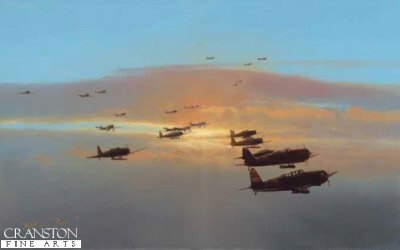
Admiral Nagumo had called his crews to readiness in the early hours. He was pleased, because for the past 11 days his fleet had steamed 4000 miles across the Pacific without detection. Now they were just a couple of hundred miles off the northern shores of Oahu. Anticipation was high and at 0610 hrs, he ordered the launch of the first wave of aircraft from the carriers.

With the rising sun glinting on their fuselages, Nakajima B5N Kate torpedo and high-altitude bombers, and Aichi D3A Val dive-bombers, head for the unsuspecting US Pacific Fleet at anchor in Pearl Harbor. In less than two hours time the fate of the world will have been changed forever.

Companion print size 18.5 inches x 13.5 inches (47cm x 35cm)

DESCRIPTIONSIZESIGNATURESOFFERSPRICEPURCHASINGPACKS
Signed limited edition of 350 prints. Image size 27 inches x 16 inches (69cm x 41cm) Paper size 33.5 inches x 24 inches (84cm x 61cm)
Donis, James
Staff Sgt James Anthony Donis
Enlisting in the Army Air Corps in 1940, he was posted to Oahu in January 1941 and as an Air Mechanic he was with Base Engineering at Wheeler Field when the attack took place.
Signature Value : £15
CLICK HERE FOR FULL PROFILE

Rubien, Bernard
Lt Col Bernard Rubien
After enlisting in the Army Air Corps in September 1940, he arrived at Pearl Harbor on December 10th, 1940.
Signature Value : £20
CLICK HERE FOR FULL PROFILE

Priest, Leo
Sgt Leo Priest
Initially in the National Guard he joined the regular US Army in September 1940 and was at the command post at Hickham Field on the morning of the Pearl Harbor attack.
Signature Value : £10
CLICK HERE FOR FULL PROFILE

+ Artist : Richard Taylor


Signature(s) value alone : £45
£40 Off!Now : £110.00

Quantity:
Limited edition of 25 artist proofs. Image size 27 inches x 16 inches (69cm x 41cm) Paper size 33.5 inches x 24 inches (84cm x 61cm)
Donis, James
Staff Sgt James Anthony Donis
Enlisting in the Army Air Corps in 1940, he was posted to Oahu in January 1941 and as an Air Mechanic he was with Base Engineering at Wheeler Field when the attack took place.
Signature Value : £15
CLICK HERE FOR FULL PROFILE

Rubien, Bernard
Lt Col Bernard Rubien
After enlisting in the Army Air Corps in September 1940, he arrived at Pearl Harbor on December 10th, 1940.
Signature Value : £20
CLICK HERE FOR FULL PROFILE

Priest, Leo
Sgt Leo Priest
Initially in the National Guard he joined the regular US Army in September 1940 and was at the command post at Hickham Field on the morning of the Pearl Harbor attack.
Signature Value : £10
CLICK HERE FOR FULL PROFILE

+ Artist : Richard Taylor


Signature(s) value alone : £45
£145.00

Quantity:
Limited edition of 25 remarques. Image size 27 inches x 16 inches (69cm x 41cm) Paper size 33.5 inches x 24 inches (84cm x 61cm)
Donis, James
Staff Sgt James Anthony Donis
Enlisting in the Army Air Corps in 1940, he was posted to Oahu in January 1941 and as an Air Mechanic he was with Base Engineering at Wheeler Field when the attack took place.
Signature Value : £15
CLICK HERE FOR FULL PROFILE

Rubien, Bernard
Lt Col Bernard Rubien
After enlisting in the Army Air Corps in September 1940, he arrived at Pearl Harbor on December 10th, 1940.
Signature Value : £20
CLICK HERE FOR FULL PROFILE

Priest, Leo
Sgt Leo Priest
Initially in the National Guard he joined the regular US Army in September 1940 and was at the command post at Hickham Field on the morning of the Pearl Harbor attack.
Signature Value : £10
CLICK HERE FOR FULL PROFILE

+ Artist : Richard Taylor


Signature(s) value alone : £45
£40 Off!Now : £395.00

Quantity:


Some other related items available from this site.

 The Grumman Aircraft Engineering Corp. was organized in late 1929. The US Navy ordered 27 production Grumman FF-1 biplane fighters in 1932, the beginning of a relationship that has endured for more than seventy years. The FF-1 was a diminutive staggerwing fighter capable of a top speed of 207-MPH. A large number of aircraft were produced for export by Grumman in the early 1930s, but the company wanted to win a contract for a new and improved USN fighter. In May of 1934 the company succeeded with a contract for 54 F2F-1s. In 1934 the company also won a contract for a new and improved F3F-1. The latter was aerodynamically improved design which overcame some of the design inadequacies of the earlier aircraft. The F3F-2 was delivered in 1937. Three units were equipped with the aircraft, VF-6 operating off the USS Enterprise, VMF-2 based in San Diego, California, and VMF-1 based in Quantico, Virginia. Grumman was working on another variant, but they became concerned about the monoplane design proposed by Brewster Aircraft, so they modified their proposal from the XF4F-1 biplane to the XF4F-2 monoplane which would become the Grumman Wildcat fighter. The F3F was a stretched version of the earlier F2F produced by Grumman and also had larger wings and more modern aerodynamic features. Initial production models were fitted with a 650-HP Pratt & Whitney radial and an 8-foot 6-inch Hamilton Standard prop. The F3F-2 was the primary variant. It utilized a 950-HP engine and was armed with one .30 caliber and one 0.50 caliber machine guns. The F3F-2 was capable of a top speed slightly in excess of 240-MPH, had  a service ceiling of 30,000 feet, and an effective range of 825-miles.   The F3F-2s were delivered to VF-6 aboard the USS Enterprise, VMF-1 at Quantico Virginia and VMF-2 at San Diego, California. The F3F-3 was similar in design to the F3F-2. The two aircraft were almost indistinguishable, yet the 3 was 8-MPH faster due to a tighter fitting engine cowling, some aerodynamic refinements, and the deletion of the the fuselage vents. By the end of 1941 the last of these Grumman biplane fighters had disappeared from front line service. VMF 111 and VMF 211 were the last two units to relinquish their F3Fs in July and October of 1941, respectively. The1941 color movie Dive Bomber, starring Erroll Flynn, Ralph Bellamy, and Fred McMurray, featured the F3F, and many future naval aviators were motivated to sign-up after seeing this picture. As illustrated in Stan Stokes painting, an F3F aircraft piloted by a young Naval officer of Fighting Six, James E. Howard, lifts off from the USS Enterprise during fleet maneuvers before the War. Howard flew with VF-6 from 1937 through 1941. In mid-41 he resigned his commission to join the AVG Flying Tigers in China, and upon his return to the States he accepted a commission with the USAAF as a Captain. He became commander of the 356th Fighter Squadron flying the P-51 Mustang. Howards most memorable day was on January 11, 1944 when he single handedly protected a bomber squadron from enemy fighter attack on their return from their bombing mission. Labeled a one man air force by one of the bomber pilots, Howard would be awarded the Congressional Medal of Honor for his heroic acts of January 11th. Howard was the only fighter ace in the European theater to be so honored.

The Last Navy Biplane Fighter by Stan Stokes.
  The view across Battleship Row, viewed from above Ford Island as the USS Nevada gallantly makes her break for the open sea, coming under heavy attack from Japanese A6M2s from the carrier Hiryu. The Nevada was eventually too badly damaged to continue and was beached to avoid blocking the harbour entrance. In the immediate foreground, the lightly damaged USS Tennessee is trapped inboard of USS West Virginia which has sunk at her moorings, leaking burning oil and hampering the daring operations to pluck trapped crew members from her decks, while just visible to the right is the stern of the USS Maryland and the capsized Oklahoma.

The Raid on Pearl Harbor, 7th December 1941 by Ivan Berryman
On 20th October 1943, Wildcat and Avenger aircraft from the Carrier US Core, on patrol north of the Azores, surprised U378, a type VIIC U-boat which had been active in that area. The element of surprise was so complete that the submarines guns remained unmanned throughout the action.

The Element of Surprise by Robert Barbour
 Admiral Isoroku Yamamoto attended Harvard University where he gained a good understanding of American culture and developed an avid interest in the game of poker. Yamamoto played his cards when he outlined a plan to attack Pearl Harbor in January 1941. In April the Japanese organized a First Air Fleet with Vice Admiral Nagumo as its Commander in Chief. Commander Minoru Genda was appointed air staff officer, and because Nagumo was unfamiliar with air tactics, Genda was given responsibility for planning the attack on Pearl Harbor. Cdr. Genda immediately began perfecting the Pearl Harbor plan, and few details were overlooked. The Imperial Navys First Air Fleet consisted of six carriers. The Akagi, flagship of the strike force, was a converted cruiser which carried 63 aircraft. The Kaga also carried 63 aircraft, and was a converted battleship. The Soryu was the first carrier built from the ground up and was similar to the Hiryu. Each carrier had a compliment of 54 aircraft. With two additional carriers, the Zuikaku and the Shokaku,  the fleet had a total of 378 aircraft. Three different types of aircraft were utilized for the attack. Mitsubishi A6M2 Zeros, a highly maneuverable single seat fighter, was responsible for obtaining air control and for strafing aircraft and ground installations. Aichi D3A1 Vals, with two-man crews, were utilized for dive bombing. Nakajima B5N2 Kates were responsible for horizontal bombing and torpedo bombing. The Kate carried a crew of three and had a cruising speed of only 160 MPH. During the first wave of the attack 183 aircraft were deployed. Torpedo aircraft from the Akagi, the Hiryu, and the Kaga targeted battleship row during this first wave. As portrayed in Stan Stokes life-like painting, a Japanese Kate from the Akagi launches its torpedo from very low altitude. Not far in the distance looms the USS West Virginia and Tennessee, virtual sitting ducks. The Japanese had trained carefully, and had modified their Kai Model 2 torpedoes to accommodate the shallow waters of Pearl Harbor. While caught by surprise, the USN was fortunate that its carriers were not in port, and that the Japanese had failed to destroy many of the support and repair facilities. This stroke of good luck permitted the USN to repair many of the ships damaged in the attack quite quickly. The devastating blow Yamamoto had planned for December 7, 1941 backfired by infuriating American public opinion, and eventually lead to Imperial Japans defeat and unconditional surrender.

Battleship Row by Stan Stokes.
Signatures on these products
*The value given for each signature has been calculated by us based on the historical significance and rarity of the signature and is for the unmatted version where available. Values of many pilot signatures have risen in recent years and will likely continue to rise as they become more and more rare.
NameInfo


Staff Sgt James Anthony Donis
*Signature Value : £15

Editions signed :

Signed limited edition of 350 prints.
Limited edition of 25 artist proofs.
Limited edition of 25 remarques.


Donis, James
(Staff Sgt James Anthony Donis)

Enlisting in the Army Air Corps in 1940, he was posted to Oahu in January 1941 and as an Air Mechanic he was with Base Engineering at Wheeler Field when the attack took place.


Lt Col Bernard Rubien
*Signature Value : £20

Editions signed :

Signed limited edition of 350 prints.
Limited edition of 25 artist proofs.
Limited edition of 25 remarques.


Rubien, Bernard
(Lt Col Bernard Rubien)

After enlisting in the Army Air Corps in September 1940, he arrived at Pearl Harbor on December 10th, 1940.


Sgt Leo Priest
*Signature Value : £10

Editions signed :

Signed limited edition of 350 prints.
Limited edition of 25 artist proofs.
Limited edition of 25 remarques.


Priest, Leo
(Sgt Leo Priest)

Initially in the National Guard he joined the regular US Army in September 1940 and was at the command post at Hickham Field on the morning of the Pearl Harbor attack.
Squadrons Related to This Print
VF-6
Aircraft Related to This Print
Wildcat
Ships Related to This Print
USS Enterprise (1936)

Contact Details
Shipping Info
Terms and Conditions
Cookie Policy
Privacy Policy

Sign Up To Our Newsletter!

Stay up to date with all our latest offers, deals and events as well as new releases and exclusive subscriber content!

This website is owned by Cranston Fine Arts.  Torwood House, Torwoodhill Road, Rhu, Helensburgh, Scotland, G848LE

Contact: Tel: (+44) (0) 1436 820269.  Email: cranstonorders -at- outlook.com

Return to Home Page