|
|
|
|
||
|
|
|
|
||
| Navigation Menus |
|
Military Art Index |
Aviation Art Index |
Naval Art Index |
Artists Index |
Aviation History Archive |
Naval History Archive |
|
| HALF PRICE AND FREE PRINT SPECIAL OFFERS | ||||||
|
| ||||||||||||||||||||||||||||||||||||||||||||||||||||||||||||
Some other related items available from this site. | ||||
  The Battle for Britain by Robert Taylor |   Clipped Signature - Christopher Currant. |   High in the Sunlit Silence by Michael Rondot. |   Victory Over Gold by Nicolas Trudgian. | |
| Signatures on these products | |
| *The value given for each signature has been calculated by us based on the historical significance and rarity of the signature and is for the unmatted version where available. Values of many pilot signatures have risen in recent years and will likely continue to rise as they become more and more rare. | |
| Name | Info |
  Wing Commander Christopher Bunny Currant DSO DFC (deceased) Died : 2006 *Signature Value : £75 Editions signed : Signed Ltd. Ed of 525 prints. | Currant, Christopher (Wing Commander Christopher Bunny Currant DSO DFC (deceased)) Born 14th December 1911. One of the most succesful fighter pilots in the RAF, credited with 13 kills during the Battle of Britain. On 15th August 1940, with No. 605 Sqn, he downed two He111s and claimed a third probable. On 8th September he downed another bomber and damaged three more, sharing in two more the next day, downing two more and damaging a further three on the 15th of that month, before being shot down himself. The same afternoon, he got airborne again, shooting down a fighter. After the Battle of Britain, he became an instructor, before rejoining combat flying with No.501 Sqn. In August 1942 he took command of No. 122 Wing, leading them until the D-Day landings in June 1944 before taking a non-flying post until the end of the war. He died 12th March 2006. |
 Air Commodore Eric Ricky Wright CBE DFC DFM (deceased) Died : 2007 *Signature Value : £40 Editions signed : Signed Ltd. Ed of 525 prints. | Wright, Ricky (Air Commodore Eric Ricky Wright CBE DFC DFM (deceased)) 605 Sqn Battle of Britain, Officer Commanding 54(F) Sqn Vampire 1948-1949. Eric William Wright was born on September 21st 1919 at Cherry Hinton, Cambridge, and went to the Cambridge County School and the Technical College. Wright joined the RAF Volunteer Reserve in June 1939 and was called up when he had completed his training as a pilot. As a sergeant pilot Wright flew Hurricanes over south-east England during the Battle of Britain; Wright joined No 605 (County of Warwick) Squadron in July 1940, a few days before it left its Scottish base for Croydon. He saw a great deal of action during the summer of 1940, and in the early days of September he shared in the destruction of a Messerschmitt Bf 110 fighter and a Dornier 17 bomber. On September 15, the climax of the Battle, and a day commemorated as Battle of Britain Day, Wright shot down a Dornier 17 over Maidstone and by the end of the year he had accounted for six enemy aircraft, probably destroyed three more and damaged a further six. At the end of November he was awarded an immediate DFM. Wright was made a flight commander of No.232 Squadron in 1941 and went to India. After the Japanese attacks on Malaya the squadron embarked on the aircraft carrier Indomitable, flying off to Java at the end of January 1942 en route to reinforce the beleaguered squadrons at Singapore. Within a week Wright's CO had been killed and Wright was promoted to squadron leader. He damaged a Japanese bomber off the west coast of Singapore, but 232 was soon forced to evacuate to Sumatra. Wright was made CO of a composite squadron made up of the remaining Hurricanes. They were hopelessly outnumbered, and losses mounted. With only a few aircraft left, on March 1st 1942 Wright was ordered to pass his remaining Hurricanes to a group selected to stay behind and take his remaining pilots to Tjilatjap, on the south coast, from where they were to board a boat for Australia. Two Ford V8s were commandeered, and the party drove through the jungle at night, only to find that the last boat had been sunk. In vain they searched along the coast for other craft. A few days later the island fell to the Japanese, and Wright and his pilots were captured and spent more than three years in Japanese prison camps. After the war Wright was repatriated back to the UK via Guam and the US finally returning to England onboard the liner Queen Mary. Wright resumed his career as a fighter pilot flying the early jets and was a member of the RAFs official aerobatic team, No.247 Squadron, flying Vampires. In April 1948 he flew one of the six single-engine Vampire F3s of No.54 Squadron which made the first Atlantic crossing by jet aircraft. On returning back the the UK, Wright was appointed to command No 54. After spending a year at the Central Fighter Establishment Wright was appointed wing leader at Linton-on-Ouse with command of three fighter squadrons. In late 1956 he converted to the Hunter and took the Tangmere Wing to Cyprus for the Suez operations. He was then given command of the RAFs first Bloodhound ground-to-air missile squadron. In 1960 he was promoted to group captain and spent three years at Headquarters Fighter Command, where he was heavily involved in the introduction into service of the supersonic Lightning fighter. Wright was appointed CBE in 1964. He also received a Kings Commendation for Valuable Services in the Air and the Air Efficiency Award. Air Commodore Ricky Wright CBE DFC DFM retired form the Royal Air Force in 1973. Sadly Air Commodore Ricky Wright passed away on the 5th of November 2007 aged 88. |
  Wing Commander George Grumpy Unwin, DSO, DFM* (deceased) Died : 2006 *Signature Value : £75 Editions signed : Signed Ltd. Ed of 525 prints. | Unwin, George (Wing Commander George Grumpy Unwin, DSO, DFM* (deceased)) George Unwin joined the RAF in 1929, and in 1936 was posted to Duxford with 19 Squadron as a Sergeant Pilot. He was one of the first pilots in the RAF to fly the Spitfire. With the outbreak of war 19 Squadron moved to Hornchurch and George, now one of the Squadrons most experienced pilots, took part in the great air battles over France and Dunkirk, scoring 3 and a half victories. He flew with 19 Squadron continuously during the whole of the Battle of Britain. He was commissioned in 1941. After a period instructing, he resumed operations, flying Mosquitoes with 16 Squadron. George finished the war with 13 victories, 2 shared, 2 unconfirmed, and 2 probables. He died 28th June 2006. |
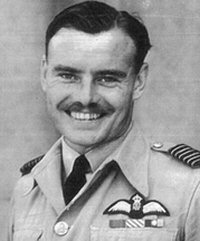 Group Captain George Binmore Johns (deceased) Died : 1991 *Signature Value : £65 Editions signed : Signed Ltd. Ed of 525 prints. | Johns, George (Group Captain George Binmore Johns (deceased)) Volunteered for pilot training in 1939, earning his wings that August before joining the reformed 229 Squadron as a Sergeant Pilot. Flying Hurricanes, he served in France, took part in the Dunkirk evacuation and the Battle of Britain, and was commissioned in 1941. Later that year he deployed to the Middle East, where he achieved several aerial victories before becoming an instructor in Sudan. Awarded the Distinguished Flying Cross (DFC) in 1942, he returned to frontline service in 1943 to command 250 Squadron, later leading 260 Squadron in Italy during the Italian campaign. For his distinguished leadership he received the Distinguished Service Order (DSO) in 1944 before moving to staff appointments. Remaining in the RAF after the war, Johns was awarded the Air Force Cross (AFC) in 1956 and held a variety of senior commands in Britain and overseas, retiring in 1972 as a Group Captain. He subsequently served as RAF Regional Liaison Officer for Scotland until 1977 and died on the 1st of March 1991. |
|
Contact Details |
Sign Up To Our Newsletter!
This website is owned by Cranston Fine Arts. Torwood House, Torwoodhill Road, Rhu, Helensburgh, Scotland, G848LE Contact: Tel: (+44) (0) 1436 820269. Email: cranstonorders -at- outlook.com |