Cranston Military Prints .com Home Page
Customer Helpline (UK) : 01436 820269
Subscribe to our Newsletter!

You currently have no items in your basket

Payment Options Display
Buy with confidence and security!
Publishing historical art since 1985


Navigation Menus
Military
Art Index
Aviation
Art Index
Naval
Art Index
Artists
Index
Product Search         
Aviation
History Archive
Naval
History Archive
HALF PRICE AND FREE PRINT SPECIAL OFFERS
ALWAYS GREAT OFFERS :
20% FURTHER PRICE REDUCTIONS ON HUNDREDS OF LIMITED EDITION ART PRINTS
BUY ONE GET ONE HALF PRICE ON THOUSANDS OF PAINTINGS AND PRINTS
FOR MORE OFFERS SIGN UP TO OUR FREE NEWSLETTER
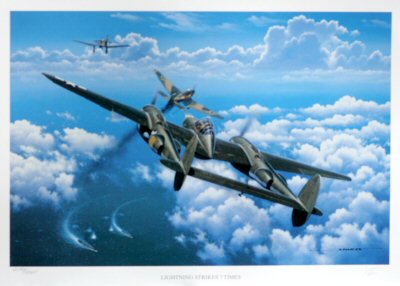
Lightning Strikes 7 Times by Stan Stokes. - Cranston Military Prints

Lightning Strikes 7 Times  by Stan Stokes.


Lightning Strikes 7 Times by Stan Stokes.

The Lockheed P-38 Lightning, called the Fork-Tailed Devil by Luftwaffe pilots in Africa, was one of the largest fighter aircraft to see service during WW II. Flight-testing of the YP-38 prototype was completed in 1941. The first P-38s put into service were dedicated to the defense of the West Coast following the attack on Pearl Harbor. In the spring of 1942 plans were laid to deploy P-38s in Europe. By adding drop tanks the maximum range of the Lightnings were increased to a whopping 2200 miles, making ferry trips to Europe possible. All three P-38-equipped fighter groups in Europe (82nd FG, 1st FG, and 14th FG) were transferred to North Africa in late 1942. These P-38 fighter groups were soon seeing serious combat action in the Mediterranean & North African theaters. The experienced Luftwaffe pilots learned that the P-38s should be attacked at altitudes below 15,000 feet, where they had difficulty maneuvering with the Bf-109s they frequently encountered. Despite these limitations the P-38s had tremendous climbing capabilities and were very effective gun platforms against German and Italian bombers. The Allison engines on the early P-38s were somewhat temperamental and actually caused more difficulties and aircraft losses than enemy action. Most problems related to an inadequate engine cooling system and the lack of cowl flaps. At altitude, gas problems could cause the Allison engines to burn out their valves, backfire through the intercooler ducts, and throw rods. Such problems could often result in the loss of the aircraft. Another problem was compressibility that was encountered during high-speed dives. During this problem the controls might seize up causing the aircraft to go into an uncontrolled dive. As a result P-38 pilots early in the War would often choose not to pursue Axis fighters into a high-speed dive. Both the engine cooler and compressibility problems were eventually solved by the time the P-38J variant was introduced. The large size of the P-38 was both an asset and a liability in combat. The large size made the aircraft easier to spot at distance, but provided a more effective gun platform for downing bombers. Col. William Leverette was a P-38 ace with the 14th FG, attaining 11 confirmed aerial victories. Leverette was born in Florida in 1913, and earned an engineering degree from Clemson University in 1934. He joined the U.S. Army in 1934, and was accepted for aviation cadet training in 1939. Earning his wings in 1940 he was initially based at Selfridge Field in Michigan with the 31st Pursuit Squadron. When War came to America, Leverette was sent to North Africa with the 337th FS of the 14th FG. Flying the P-38, Leverette broke into the scoring column in a most spectacular manner when he managed to splash seven Ju-87s on a single mission on October 9, 1943. Leverettes flight of six aircraft rushed to the defense of a British Cruiser and several destroyers that were under attack by a large group of enemy Ju-87s and Ju-88s. In an exciting 15-minute air battle, the P-38s managed to down sixteen Stukas and one Ju-88. Leverette received credit for seven. Later during his combat tour he would down two Bf-109s and two Me-110s. Leverette remained with the Air Force after the War, rising to the rank of Colonel prior to his retirement to Florida in 1965. Col. Leverette passed away in April 2003 at the age of 89.
Item Code : STK0039GSLightning Strikes 7 Times by Stan Stokes. - Editions AvailableExtra....

A photograph of an edition of the print :

DESCRIPTIONSIZESIGNATURESOFFERSPRICEPURCHASINGPACKS
Signed limited edition of 4750 prints. Print size 16 inches x 11.5 inches (41cm x 30cm) Artist : Stan Stokes£15 Off!
Add any two items on this offer to your basket, and the lower priced item will be half price in the checkout!
Now : £35.00

Quantity:
Limited edition of 100 giclee art prints. Size 21 inches x 14 inches (53cm x 36cm)Artist : Stan Stokes£20 Off!Now : £150.00

Quantity:
Limited edition of 100 giclee canvas prints. Size 27 inches x 18 inches (69cm x 46cm)none£294.00

Quantity:


Some other related items available from this site.

 In 1936 the Lockheed Aircraft Company won a contract to produce a high altitude interceptor for the USAAC. This contract was won despite the fact that the company had been nearly bankrupt in 1932, and had never produced a fighter aircraft. Mr. Kelly Johnson, Lockheeds chief designer on the project, settled on a design incorporating a twin engine scheme utilizing twin booms to house the aircrafts supercharged engines, and a central nacelle which housed the pilot and all the armament. Despite an unfortunate crash of the prototype, the USAAC was impressed with the aircraft, and a production order was placed for the first P-38 Lightnings.  The P-38 was to prove to be one of Americas top fighters of WW II. The Lightning was fast, very heavily armed, had excellent range, and a great rate of climb. The aircraft was capable of flying with only one engine, and this proved advantageous in improving long range reliability. The two most effective models were the J and the L, of which more than 6,000 were produced. One early technical problem with the aircraft was the loss of control during high speed dives when the aircraft obtained speeds approximating 500 MPH. This problem was ultimately solved by the addition of a dive flap beneath the spar to offset a nose down tendency during such dives. Nicknamed the twin tailed devil by the Germans, the P-38 saw a lot of action in the Pacific where its great range was a more important asset. Americas two top aces of the War were P-38 pilots serving with the Fifth Air Force in the Southwest Pacific. Major Richard Bong was a soft spoken Wisconsin native who achieved 40 confirmed victories, but was killed on August 6, 1945 while testing a P-80 jet over Southern California. On July 26, 1943 Bong achieved four victories on a single mission.  Thomas McGuire was born in New Jersey, and enlisted in the Army as an aviation cadet in 1941. Between August 1943 and January 1945 McGuire was credited with 38 victories. McGuire and Bong flew together in combat on many occasions. On December 7, 1944 both Bong and McGuire chalked up two kills during a mission over Ormoc Bay. McGuire was ultimately killed in combat in early 1945 when he stalled his P-38 prior to an engagement with the enemy. Both of these gentlemen received the Congressional Medal of Honor, and both flew aircraft named after women who would become their wives. The print depicts both Bong and McGuire over the Southwest Pacific in 1944. Bongs Marge is in the foreground, with McGuires Pudgy off his wing.

A Pair of Aces by Stan Stokes.
A superb study of the legendary P-38 Lightning, this print commemorates the American Air Forces that operated in the European Theater.

Wide Horizons by Robert Taylor.
 P-38 Lightnings launching a surprise attack on a German freight train as it winds its way through the hills of Northern France towards the battle front, shortly before D-Day, 1944.

Lightning Encounter by Nicolas Trudgian.
 The highest scoring US pilot of the Second World War, Richard Bong, is depicted in his personal P.38J <i>Marge</i>, claiming just one of his 40 confirmed victories. Insisting that he was not the greatest of marksmen, it was Bongs habit to manoeuvre to impossibly close distances before opening fire on his opponents. His eventual total may well have been greater than 40, as a further 8 probables could be attributed to him, together with 7 damaged. He was killed whilst testing a P.80 jet for the USAF in August 1945.

Richard Bong by Ivan Berryman.
Squadrons Related to This Print
337th Fighter Squadron
Aircraft Related to This Print
Lightning (US)

Contact Details
Shipping Info
Terms and Conditions
Cookie Policy
Privacy Policy

Sign Up To Our Newsletter!

Stay up to date with all our latest offers, deals and events as well as new releases and exclusive subscriber content!

This website is owned by Cranston Fine Arts.  Torwood House, Torwoodhill Road, Rhu, Helensburgh, Scotland, G848LE

Contact: Tel: (+44) (0) 1436 820269.  Email: cranstonorders -at- outlook.com

Return to Home Page