Cranston Military Prints .com Home Page
Customer Helpline (UK) : 01436 820269
Subscribe to our Newsletter!

You currently have no items in your basket

Payment Options Display
Buy with confidence and security!
Publishing historical art since 1985


Navigation Menus
Military
Art Index
Aviation
Art Index
Naval
Art Index
Artists
Index
Product Search         
Aviation
History Archive
Naval
History Archive
HALF PRICE AND FREE PRINT SPECIAL OFFERS
ALWAYS GREAT OFFERS :
20% FURTHER PRICE REDUCTIONS ON HUNDREDS OF LIMITED EDITION ART PRINTS
BUY ONE GET ONE HALF PRICE ON THOUSANDS OF PAINTINGS AND PRINTS
FOR MORE OFFERS SIGN UP TO OUR FREE NEWSLETTER
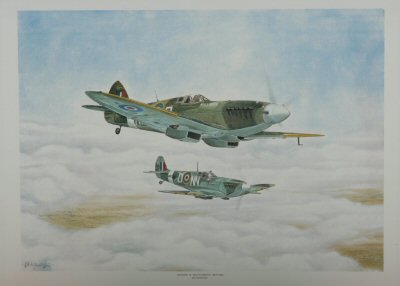
Duxford and Shuttleworth by John Wincentzen. - Cranston Military Prints

Duxford and Shuttleworth by John Wincentzen.


Duxford and Shuttleworth by John Wincentzen.

Item Code : VAR0325Duxford and Shuttleworth by John Wincentzen. - Editions AvailableExtra....


A photograph of the print.

DESCRIPTIONSIZESIGNATURESOFFERSPRICEPURCHASINGPACKS
Open edition print. Image size 22 inches x 16 inches (56cm x 41cm)noneHalf
Price!
Now : £20.00

Quantity:
In 1 Pair
View


Some other related items available from this site.

 Stuart Nigel Rose - A Spitfire pilot with No.602 Sqn throughout the Battle of Britain, he claimed 3 victories.  Later posted to No.54 Sqn and various training units.  He died in 2017.<br><br><i>Clipped together with 3 other signatures : </i><br><br>Mickey Mount - Joined No.602 Sqn flying Spitfires against the Luftwaffe at the height of the Battle of Britain. He served throughout the war, also flying Hurricanes in Malta and Wellingtons in the Middle East. He died in 2002. <br><br>Hugh Niven - Flew Spitfires with No.602 Sqn during the Battle of Britain and was still with the squadron when he was invalided out of the RAF with tuberculosis in 1942.  He died in 2008. <br><br>Hector MacLean - Spitfire pilot with No.602 Sqn during the Battle of Britain, a severe leg injury sustained in combat on 26th August 1940 ended his role as a pilot - he instead became a Fighter Controller on the ground. He died in 2007.

Clipped Signature - Stuart Nigel Rose.
 Royal Air Force and Royal Navy fighter aircrews flew combat throughout the six long years of World War Two. At the outbreak of war in 1939 four RAF Hurricane squadrons and two equipped with Gladiators went immediately to France where in short time New Zealander Cobber Kain became the first Allied Ace of the war. In April 1940 Hurricanes and Gladiators saw in action in Norway, when Rhodesian Caesar Hull of 263 Squadron became the second air Ace. By the fall of France the new Spitfire joined in the great air battles over the Channel as the British Expeditionary Force evacuated Dunkirk. Bob Stanford -Tuck, Douglas Bader, Peter Townsend, Sailor Malan, and many other great Aces gained their first victories, but with German forces massing on the French coast, the invasion of Britain looked imminent. Only RAF Fighter Command stood in Hitlers way. By July, the most famous of all air battles had begun. The next three months, under glorious summer skies, saw the most decisive and continual aerial fighting in history. The British victory in the Battle of Britain was to fundamentally change the course of the war and, ultimately, the course of history. But there were four and a half more years of air battles still to be fought and won -from the English Channel Front to the North African desert, from the Mediterranean to Far East Asia. It fell to Fleet Air Arm pilots to see the last air fighting for British and Commonwealth pilots, by then equipped with Seafires and American Corsairs and Hellcats, as they took part in the final assaults on the Japanese mainland. As the last embers of hostilities faded into history the centuries old doctrine of maritime supremacy had gone. Now the aircraft ruled. In his masterful painting A Time For Heroes Robert Taylor pays tribute to the World War II fighter aircrews of the RAF and Fleet Air Arm. A panoramic scene from the era of the Battle of Britain shows Mk I Spitfires of 234 Squadron, 10 Groups top scoring squadron, returning to St. Eval after intercepting heavy raids on south coast ports during the heaviest fighting, in September 1940. St. Michaels Mount, the castle built on the site of a 14th Century monastery to defend Britains shores from earlier enemies, provides a symbolic backdrop as once again a band of brothers is called upon to defend their Sceptred Isle.  <br><br><i>Sadly, since the passing of Mahinder Pujji in September 2010, all of the great pilots who signed any of the editions of this print have now passed away.</i>

A Time for Heroes by Robert Taylor
 A pair of Spitfire Mk.IXs of 402 Squadron Royal Canadian Air Force, based at Kenley, practise combat manoeuvres in the skies above Kent in May, 1943.

Spitfire Alley by Ivan Berryman.
 Another busy start to the day at Biggin Hill in the summer of 1940. The Battle of Britain is at its height and 92 Squadron Spitfires with Geoffrey Wellum in G for George, depart under early morning sunlight to engage a mass of incoming enemy aircraft over the southeast coast. By the end of 1940 the Squadron was credited with having destroyed 127 German aircraft.

First Light - Battle of Britain, July 1940 by Philip West.
Aircraft Related to This Print
Spitfire

Contact Details
Shipping Info
Terms and Conditions
Cookie Policy
Privacy Policy

Sign Up To Our Newsletter!

Stay up to date with all our latest offers, deals and events as well as new releases and exclusive subscriber content!

This website is owned by Cranston Fine Arts.  Torwood House, Torwoodhill Road, Rhu, Helensburgh, Scotland, G848LE

Contact: Tel: (+44) (0) 1436 820269.  Email: cranstonorders -at- outlook.com

Return to Home Page